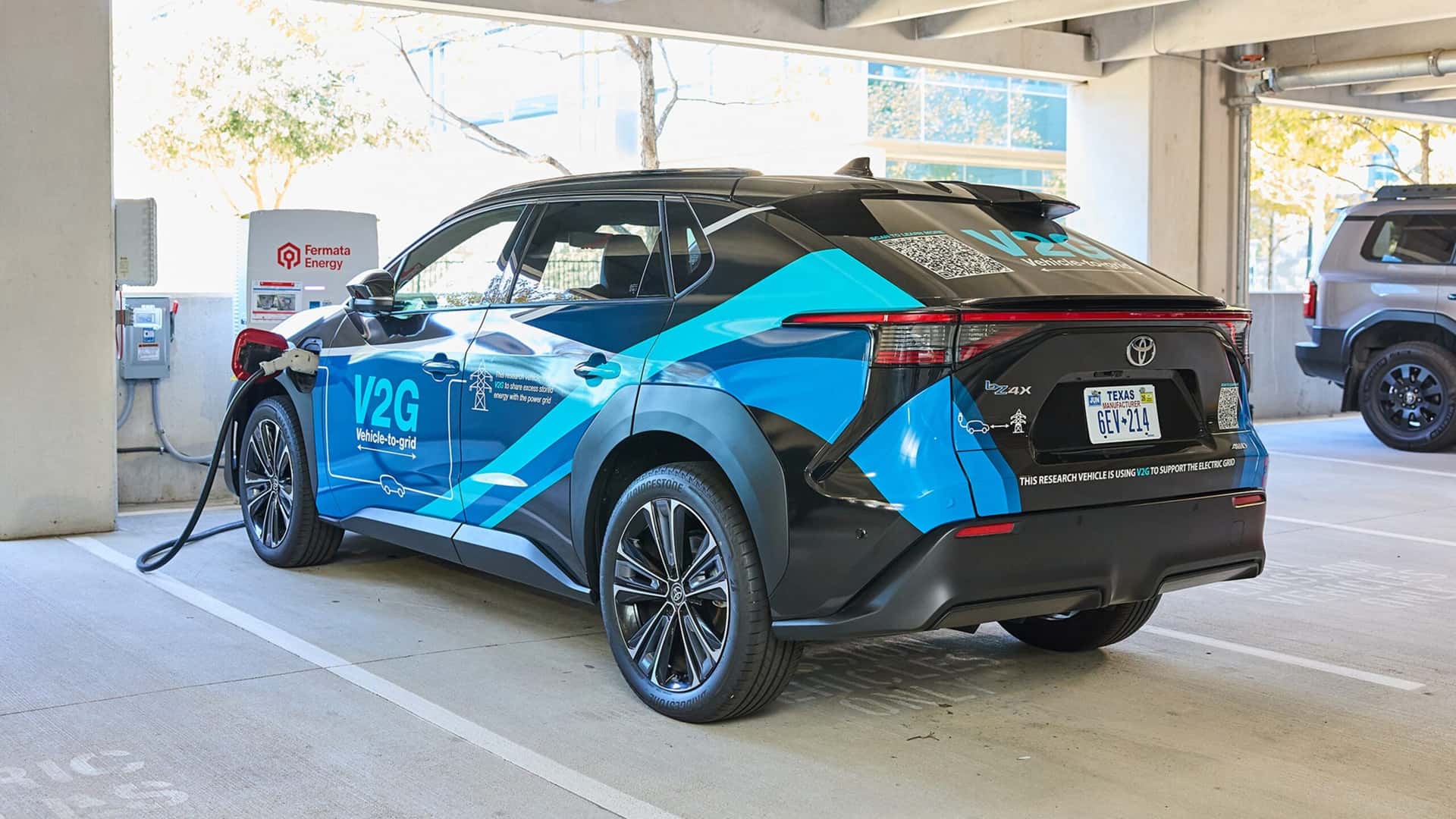
- Toyota is working on the next phase of its vehicle-to-grid (V2G) pilot in Texas.
- The company is studying the ways that its EVs can support the electric grid better, especially during emergencies.
- While Toyota does not yet offer EVs with bidirectional charging, it says the technology has immense potential to "transform the broader energy ecosystem."

Blame AI data centers, or an outdated power grid, or extreme temperatures, or all of the above. However, one thing is clear as we head into 2026: the United States is on track for unprecedented electricity demand.
That might sound like an argument against electric vehicles. After all, why unleash an entire fleet of cars on this country that could further drain our already shaky electric grid? But that's only because most people don't know about bidirectional charging: an EV's ability to charge other devices using its battery, or power entire homes, or even put energy back into the grid.
Several EVs already offer this capability, and it's increasingly becoming a standard feature for these cars. Meanwhile, many automakers are working with electric utilities on vehicle-to-grid (V2G) pilot programs that could more directly support local power networks using energy from EV batteries.
The latest one to step up is Toyota. The automaker recently announced that it's entering a new phase of a longstanding V2G pilot program at its North American headquarters in Plano, Texas. Working with Oncor, a huge energy utility in the Lone Star State, and using Fermata Energy's bidirectional EV charger, a Japanese-spec bZ4X test vehicle is currently putting energy back into the grid. The charger "enables bidirectional energy flow by analyzing price signals and grid conditions to determine the optimal times to charge the vehicle and discharge stored energy back to the grid," the automaker said.
Toyota is also running similar pilot programs with other utilities across the country, including San Diego Gas & Electric and Pepco in Maryland. In doing so, the company is monitoring what those local energy markets' needs actually are, and what customers will need as well.
Generally, with V2G programs, EV drivers hook their cars up to a special charger like this one that is designed to send energy back into the grid. The local electric utility itself must also be set up to do this. When deemed necessary, energy from a car will be transmitted into the grid to support area power, and drivers often get a credit for helping out—and they can opt out or unplug at any time. This is why these are often called "virtual power plants."
It would be a sea change for power in the U.S. if every EV were to be V2G-enabled, and if every electric grid were set up to work with them in this way. But Toyota offered a startling statistic about the potential of this technology: "Currently, more than 4 million battery electric vehicles are on U.S. roads. If all were equipped with bidirectional charging, they could collectively contribute approximately 40,000 megawatts to the grid—a power output similar to that of 40 nuclear power reactors," the automaker said.
While gasoline-powered cars can only send energy in one direction—into the wheels of the car itself—an EV's ability to share power could be a huge boon to the grid as energy demand rises and costs rise along with it. According to the Wall Street Journal, the U.S. Energy Department expects the average residential electricity rate to jump 4% next year, even after a 4.9% increase in 2025.
Clearly, EVs alone can't solve that problem. And Toyota itself does not currently offer any EVs with V2G or V2L capability, unlike Hyundai, Nissan, Ford, General Motors and others. But it seems inevitable that Toyota will jump in eventually.
And as this scales, it could be more beneficial than many people realize. “By enabling bidirectional charging, we’re exploring how we can help customers potentially save money while also reducing carbon emissions from the grid," Christopher Yang, senior vice president of Enterprise Strategy & Solutions at Toyota Motor North America, said in a statement. And that, he said, is "a win-win for drivers and the environment.”
Contact the author: patrick.george@insideevs.com