
Get all your news in one place.
100's of premium titles.
One app.
Start reading
What Hi-Fi?
What Hi-Fi?
Technology
Ketan Bharadia

Topping Audio D900

Topping Audio D900 DAC.

The rise of China’s hi-fi industry has been meteoric over the last decade or so. The likes of WiiM and Eversolo are now firmly part of the hi-fi mainstream thanks to their aggressively priced but technically accomplished products. It wouldn’t be a surprise to find Topping Audio joining them in short order.

Topping Audio is based in Guangzhou and was founded in 2008, so it is hardly a start-up. Take a look at the company’s website, and you will find that it makes a bewildering range of hi-fi electronics. We counted more than 20 models of digital-to-analogue converters alone, alongside an extensive range of amplifiers, be they headphone, integrated, pre or power.

The Topping Audio D900 on test here represents the pinnacle of the brand’s DAC technology. Along with its junior sibling, the D90MKIII, this converter uses a proprietary, discrete 1-bit DAC design called PSRM (Precision Stream Reconstruction Matrix).

This works by converting the original digital audio stream into a sequence of 1-bit pulses. The density of these pulses, whether weighted towards 0 or 1, represents the waveform level. In contrast, other models in the company’s range employ standard off-the-shelf DAC chip solutions, as does much of the competition.

Features

(Image credit: What Hi-Fi?)

The D900’s digital design is fully balanced, with 32 discrete high-speed switching voltage references for each channel. The cheaper D90MKIII makes do with half that amount. In principle, PSRM reminds us of the high-end Ring DAC technology developed by dCS.

Given that this Topping DAC sells for a fraction of the price of one of dCS’s converters, the use of such a design is impressive.

Topping Audio D900 tech specs

(Image credit: Topping)

Inputs Coaxial x 2, optical x 2, USB (Type-B), USB (Type-C), AES/EBU, I2S

Outputs Balanced XLR fixed and variable

Headphone output? No

Bluetooth? Yes

Max file support 32-bit/768kHz PCM, DSD512

Battery-powered? No

Dimensions (hwd) 5.7 x 33 x 21cm

Weight 2.52 kg

Finishes x 1 (silver)

File compatibility is excellent, with the D900 happy to accommodate hi-res PCM datastreams up to 32-bit/768kHz and DSD512. We can’t imagine this DAC falling short of anyone’s requirements, at least not for the foreseeable future.

The D900 is well-equipped. It has a wide range of connectivity, including two coaxial, two optical and USB in both Type B and C varieties. The D900 also has AES/EBU and I2S digital inputs, which may prove useful for some. Bluetooth 5.1 is included and is compatible with high-quality LDAC and aptX HD codecs.

On the output side, Topping has gone all in with balanced XLR connections for both its variable and fixed outputs. Those whose systems lack balanced connectivity will have to use appropriate adaptors. Such adaptors aren’t particularly hard to source, but it is still a shame that Topping didn’t find a way to include a pair of standard RCA connectors on the back panel.

Build

(Image credit: What Hi-Fi?)

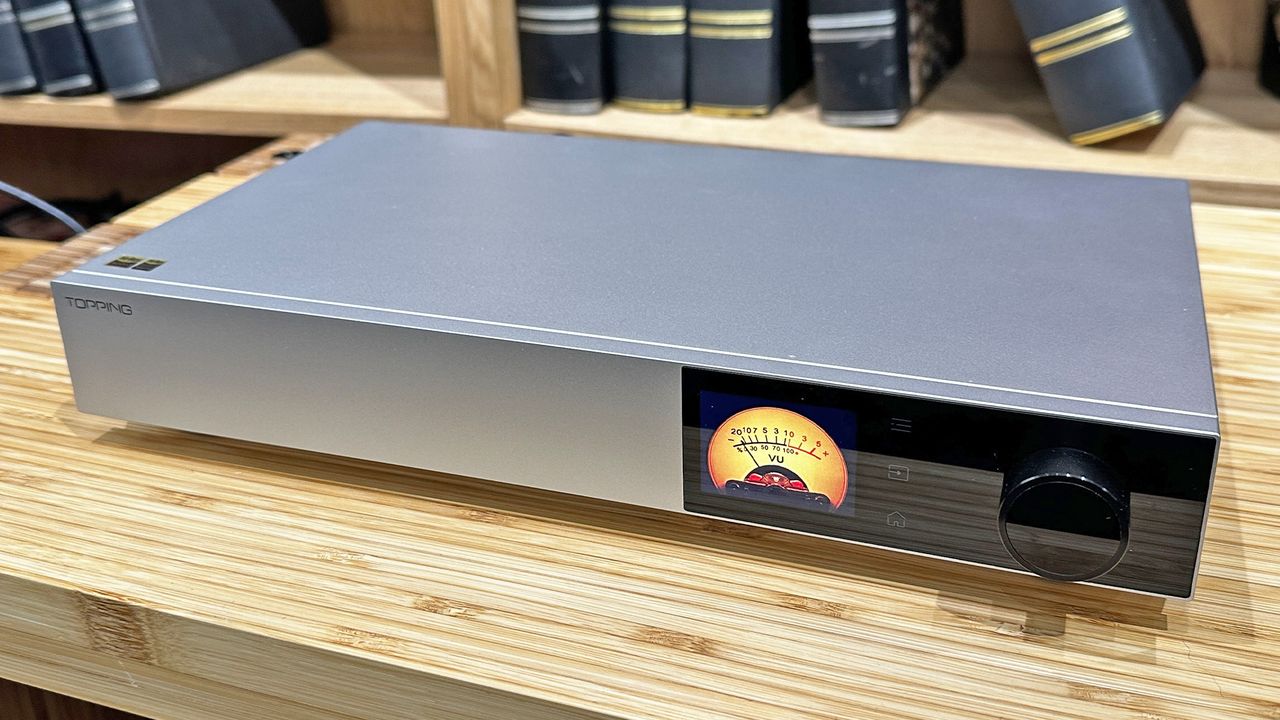
This DAC is nicely made and reassuringly solid. We have no complaints about the fit or finish of the metal casework. The multi-function rotary dial on the front feels positive and precise, while the 2in display is crisp, but on the small side for reading at any significant distance.

It is good for adding visual excitement to the front of the DAC, though, and can be made to show an analogue VU meter or frequency spectrum bar graph. The display also makes it easier to work through the set-up menus and the built-in equaliser function. There are numerous parametric equaliser settings, but in our system at least, none is quite as satisfying as the default neutral option.

Take a look inside the D900, and it’s clear that the engineers have taken a great deal of care with the circuit layout and appearance.

Our digital sources for the Topping are Naim’s ND555/ 555 PS DR music streamer, a Cyrus CDi CD player and a MacBook Pro running Audirvana music-playing software and loaded with plenty of hi-res files.

The rest of our reference system is Burmester’s 088/911 MKIII pre/power driving a pair of ATC SCM50 speakers. We also use a PMC Cor integrated and Epos ES-14N combination to hear how the Topping performs in a more price-appropriate set-up.

Our DAC comparisons are Chord’s Qutest (£1249 / £1795 / $2400) and Hugo 2 (£1795 / $2595 / AU$3800) along with recent experience of the Rotel DX-3 (£1399 /$1699 / AU$2199).

Sound

(Image credit: What Hi-Fi?)

Does the D900’s clever DAC circuitry give it any advantage over those that use more conventional off-the-shelf chip solutions? In truth, we can’t be sure. It is impossible to separate the contribution of the conversion technology from everything else inside. Analogue output stages, power supplies, component quality and signal paths all have a huge impact on the final result.

What we can say is that the D900 sounds unusually talented in some regards.

Regardless of input, with the exception of Bluetooth, of course, the Topping D900 resolves an impressive amount of detail. Give it a complex recording such as Mahler’s 4th Symphony, and it delivers a sound full of texture and subtlety.

We love the sense of space this DAC imparts, even when the music becomes dense, and the delicate way it renders low-level dynamic shifts.

The music comes through with an appealing fluidity that puts us in mind of a good analogue source rather than the usual digital stereotypes. The D900 sounds neutral and unforced; qualities that may not impress on a short demo at a dealer, but we think hold plenty of appeal in the long run.

This Topping DAC is flexible in its approach to music replay. Its insight allows us to dig deep into the fabric of the recordings if we want to; alternatively, we can just sit back and relax, letting the music’s emotional impact wash over us. The D900’s ability to resolve plenty of detail without sounding overly analytical is unusual and welcome.

(Image credit: What Hi-Fi?)

Stereo imaging is expansive and airy, the Topping layering the soundstage convincingly while delivering a fine sense of scale. There is a good degree of stability too, so that the D900’s focus doesn’t waver as the music becomes more demanding.

Tonally, it is as neutral as they come, with no part of the frequency range dominating. Highs are smooth yet don’t lack in bite while the midrange is as clear and articulate as you like. Bass could be better, though. It digs deep but doesn’t have the tautness or muscularity of rivals.

As we try more upbeat music such as Raye’s Click Clack Symphony, Chicago by Michael Jackson and Zion by Soul II Soul, we can’t help but want a bit more energy and drive in the presentation, too.

This Topping sounds restrained and slightly lacking in authority compared to either of the two Chord DACs. We miss their sense of musical cohesion and ability to deliver dynamic contrasts with conviction.

That said, we are still able to enjoy the D900’s clarity and finesse, particularly through the midrange and upwards.

Verdict

(Image credit: What Hi-Fi?)

There is no denying that the Topping D900 is a talented DAC. Its detail resolution and fluid delivery are right up there with the best at the price, as is its file compatibility and build quality.

While we think this Topping falls short of being a complete all-rounder, it remains a viable and appealing alternative to the established benchmarks.

Review published: 14th August 2026

SCORES

  • Sound 4
  • Build 5
  • Features 5

MORE:

Read our review of the Chord Hugo 2

Also consider the Rotel DX-3

Read our Chord Qutest review

Best DACs: USB, desktop and portable digital-to-analogue converters

Quiz! How fast can you solve our turntable challenge? Test your wordsearch skills now

Sign up to read this article
Read news from 100's of titles, curated specifically for you.
Already a member? Sign in here
Related Stories
Top stories on inkl right now
One subscription that gives you access to news from hundreds of sites
Already a member? Sign in here
Our Picks
Fourteen days free
Download the app
One app. One membership.
100+ trusted global sources.