
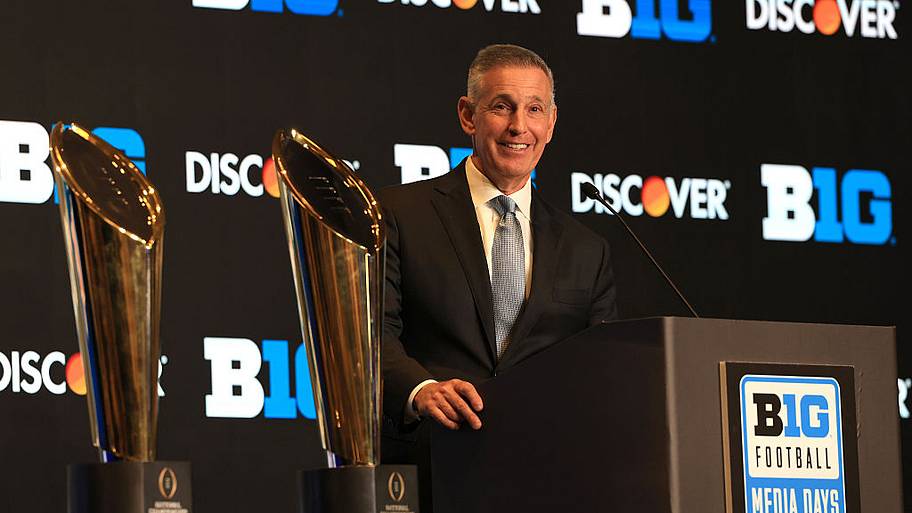
CHICAGO — Tony Petitti was navigating various staircases in the Hilton Chicago to get to the basement for a radio interview Tuesday. At the top of the last one, a security guard stopped him, asking to see his credential. The Big Ten commissioner got ID checked at Big Ten football media days.
The guard was doing her due diligence—and to be fair, Petitti hasn’t been much of a public figure in previous years, despite his high-profile job. It’s hard to be considered one of the faces of a multibillion-dollar industry when people don’t see your face very much.

That’s changed at this event, with Petitti increasing his engagement with the assembled media.
He’s done more sit-down interviews, including one with Sports Illustrated, sitting at a lone table in an otherwise empty room. He worked the media area before delivering the opening remarks Tuesday, shaking hands and saying hello to several reporters. His opening remarks were shorter than last year, leaving more time for questions and answers.
Why not come out of your shell? It’s a great time to be Tony Petitti.
The sea change in college football that has coincided with his tenure is readily apparent here. It’s not just the visual flex of placing the last three College Football Playoff national championship trophies—won by Michigan, Ohio State and Indiana—onstage. It’s also apparent in Petitti’s words.
“I think there's been a lot of movement among coaches and ADs around the country that 24 is the right number,” Petitti said.
Twenty-four is, of course, the number of teams the Big Ten boss would like to see in the College Football Playoff starting in 2027. An idea that had insufficient support a year ago has gained momentum, with the Atlantic Coast Conference and Big 12 climbing onboard, and even some within the rival Southeastern Conference gravitating toward an expansion to that number.
I’m still adamantly opposed to doubling the playoff from its current size. The damage done to the regular season, the dilution of a competitive postseason product, the rewarding of above-average teams, the participation trophy mentality, the scheduling gymnastics that would have to be done to make it work—yuck. Twelve has been a good format in the only two years of its existence.
But I don’t have a vote. None of us does beyond Petitti and SEC commissioner Greg Sankey, although they are open to input from the other FBS commissioners—particularly Jim Phillips of the ACC and Brett Yormark of the Big 12. That’s why their swing in favor of the Petitti Plan is significant.
If Petitti can push his playoff plan across the finish line while his league is simultaneously taking over the sport, it would be a pretty incredible run of success. Likely next steps, according to sources familiar with the process: a presentation of revenue projections that could come from a 24-team model at the CFP management committee meeting in August; then perhaps a vote at the following meeting in September. (The process could also be fast-tracked via virtual meetings or slow-played as late as December, sources caution. Playoff talks have rarely followed a tidy timeline.)
While noting that the Big Ten has withdrawn its push for a set number of automatic playoff bids, Petitti laid out his case again for a 24-team format Tuesday. He argued that it would actually enhance the regular season more than damaging it, with concentric circles of motivation depending where teams stand in the season’s latter stages.
At the outer circle, teams are simply trying to make the field and earn the last bids. In the next circle, more accomplished teams are jockeying for home playoff games. Next: a first-round bye. The innermost circle is competing for top seeding and the most preferential path through the bracket.
“The idea is keeping as many teams in contention for as long as possible. Play as many meaningful games for as long as you can. … The format creates all kinds of incentives. If you think about a 24-team playoff, a bunch of teams are going to be ranked between 16 and 24 that are just trying to make sure they’re in. You're going to have teams playing until the very end to see if they’re in. You’re going to have teams playing to see if they can get a home game. So every game is going to matter because your seeding is always going to be determined by somebody else.
“I think we’ve got a lot of different incentives all across the format that keep you playing hard until the very end. Secondly, I think the idea that we’re playing more competitive games is going to be crucial. … I actually think [the media] will start writing more about how sleeper Minnesota could find a way to the Top 24 if they win this next game. I’m just using them as an example. It could be anybody.”
Another part of Petitti’s pitch for 24 is less supportable: more bids would essentially serve to justify the runaway spending by programs on football. ACC commissioner Jim Phillips and others have made the same argument. It’s a fake reward, an accounting trick. It’s trying to make a 9–3 or 8–4 season seem like a greater accomplishment because it resulted in a playoff bid as opposed to a ReliaQuest Bowl bid.
“We've got institutions making incredible investments in football, and it’s really important to maintain that commitment to invest,” Petitti said. ”You have to have opportunity to play to maintain that investment. While the bowl system has done great things for college football for a really long time, when you get into a playoff world like this … success is defined very specifically about the playoff.”
A willingness to overpay a wide receiver in the portal, to overpay a defensive coordinator, to overpay the department’s 12 assistant athletic directors, should not drive the size of the College Football Playoff. Making the field should be the hardest thing to do in college sports, a just reward for success in the most impactful regular season in college sports.
But the tide has turned Petitti’s way, on the field and in the boardroom. His league is loaded at quarterback, improved in the coaching ranks and making record amounts of money. Times have never been better.
No wonder Tony Petitti is out front more this week than at any other point in his three-year tenure. He’s winning big, and might have more defining victories to come in the near future.
More College Football From Sports Illustrated
Listen to SI’s college sports podcast, Others Receiving Votes, below or on Apple and Spotify. Watch the show on SI’s College YouTube channel.