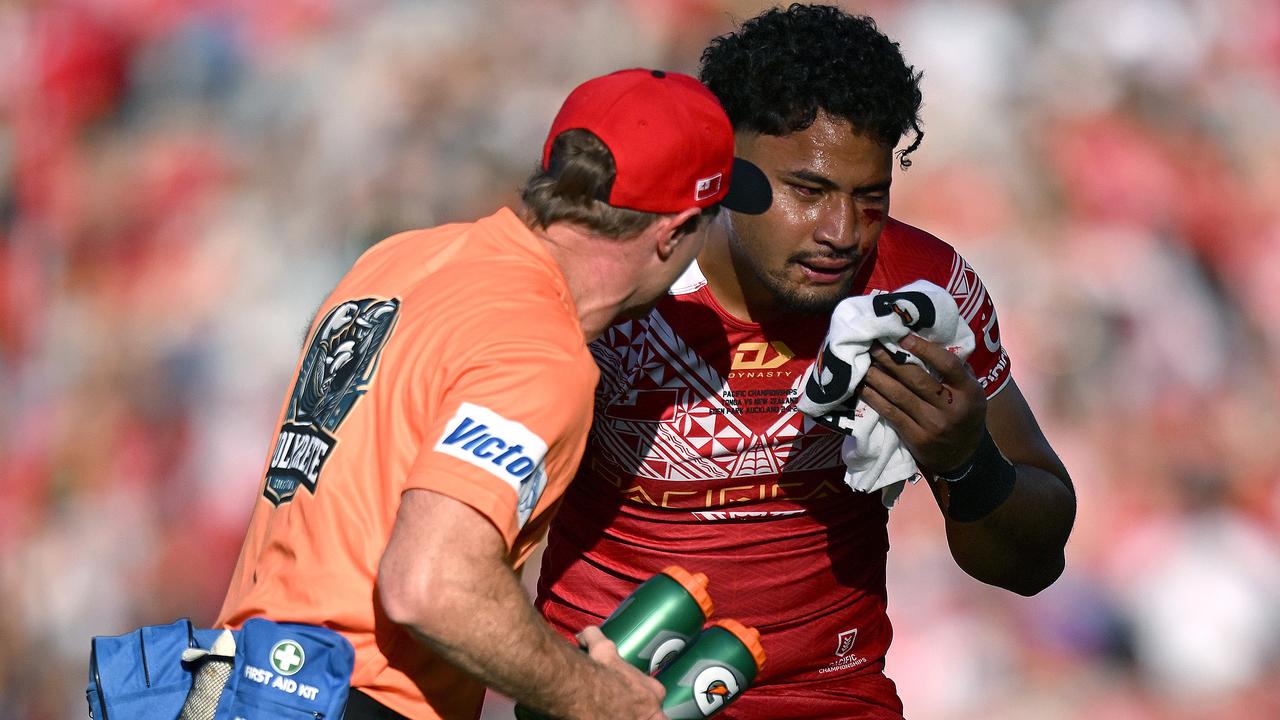
The NRL has proposed two-year bans for three members of Tonga's medical staff, raising alleged concerns over the handling of Eliesa Katoa's multiple head knocks.
More than a month after Katoa required surgery for bleeding on the brain following seizure activity, the NRL handed down preliminary findings into the matter on Monday.
In a statement, NRL bosses said they had "a number of serious concerns" over alleged possible breaches around the way Katoa was treated.
In turn, they have issued breach notices proposing two-year bans for Tonga's head doctor, assistant doctor and head trainer.
In addition, the team's yellow shirt trainer has been handed notice of a formal warning, after he was the man to complete the initial on-field assessment on Katoa in the warm up.
There are no penalties against any members of Tonga's coaching staff, with coach Kristian Woolf, who is also the Dolphins' mentor, cleared of any wrongdoing.

Katoa has already been ruled out of the 2026 NRL season, with no clear timeline on a potential return to the field.
The Melbourne Storm star was first floored when he collided with Lehi Hopoate's shoulder in the warm up for Tonga's Pacific Cup Test against New Zealand on November 2.
Tonga's staff conducted an on-field test and determined Katoa did not require a full HIA, clearing him to start the match.
He then left the field in the first half after a head clash, before returning when he passed that HIA.
A third head knock came in the second half, prompting Katoa to leave the field and he subsequently suffered seizure activity on the sideline.
The 25-year-old was taken to an Auckland hospital where he underwent surgery, before flying home to Melbourne close to a fortnight later.

"The investigation has identified a number of serious concerns regarding possible breaches of the NRL rules and protocols by a number of individuals in the way that Mr Katoa was treated," the NRL said in a statement.
"These concerns relate to a possible breakdown in communication between responsible medical and health professionals in relation to the safety of Mr Katoa, including through a failure to share and disclose information that was vital to the health of the player."
"The NRL rules and protocols exist to protect player safety and wellbeing and must be followed."
Under the terms of the proposed bans, each of the officials would be unable to work with any club, team or player in any competition within the NRL's remit.
The quartet would also be required to undergo training on their responsibilities around head knocks and concussions.
They each have five days to respond to their breach notice.

The NRL has not handed down recommendations around any changes to injury surveillance, with the warm-up period having emerged as a potential black spot in their system.
All mid-week contact training must be filmed to monitor for injuries, with a spotter also handed the duty of watching for head knocks.
The NRL also has an independent doctor in the bunker monitoring for head knocks and concussion symptoms in matches.
However, there is no requirement for warm ups to be filmed, with only broadcast cameras happening to catch the contact between Katoa and Hopoate.
Tonga officials have maintained they did not see a replay of the sickening collision until after the match against the Kiwis.
Following the match, Woolf spoke in support of Tonga's medical staff.
"We've got two very experienced doctors," he was quoted as saying.
"They've done their usual HIA. He's passed all that and passed all that well.
"My job isn't to question doctors. They were both comfortable with him coming back onto the field, so I don't think there's anything there in terms of worrying about the process."