
Get all your news in one place.
100’s of premium titles.
One app.
Start reading
Digital Camera World
Hillary K. Grigonis

Time to watch the skies! The odds for northern lights photography this week just got even better

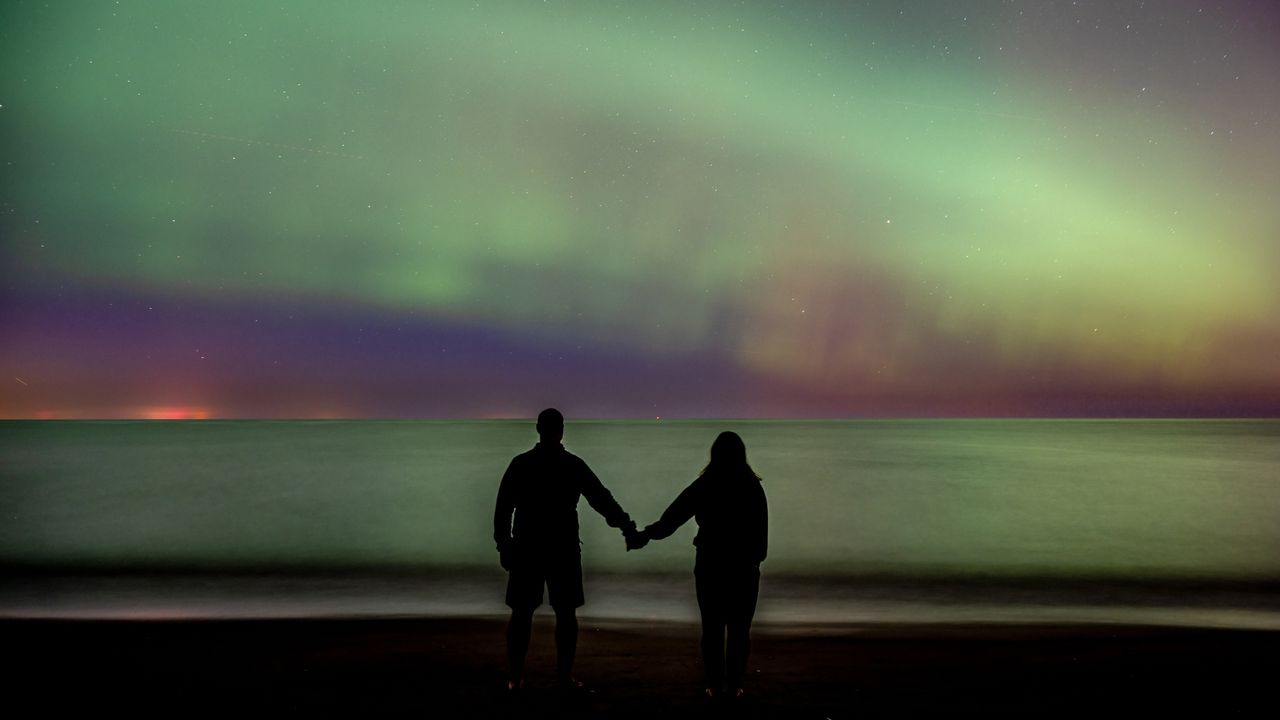
Two people hold hands while watching the northern lights.

Astrophotographers, grab your gear – a strong solar flare has increased the odds for catching the northern lights this week.

The sun let off a flare on Monday that experts expect could bring storms as powerful as a G2. For those in the US, that means potential aurora sightings in more than a dozen states, as far south as Illinois, if current conditions persist.

The UK's MET Office has also now issued a geomagnetic storm watch, with a potential for a visible aurora "as far south as parts of northern England."

While conditions were originally expected to bring a possible solar storm overnight on March 17 and 18, an updated forecast now shows continued odds for March 19 and 20.

The National Oceanic and Atmospheric Administration predicts conditions could peak around a G2, KP6 storm around 8 PM ET on March 19 (which is around 1 AM GMT March 20). Conditions remain at a potential G2 for a few hours before dropping to a potential G1.

Levels could potentially exceed a KP6, G2 storm again on March 20, around 11 PM ET (3 AM GMT on March 21). Conditions are expected to remain favorable through the night.

States above the red line have the highest odds of spotting the aurora (Image credit: NOAA)

Predicting the aurora is never a sure thing – NOAA’s 30-minute forecast tends to be more accurate than the three-day predictions, so photographers may want to check conditions again before heading out.

March tends to be a favorable month for spotting the aurora, as the equinox tends to allow for more interaction between solar wind and Earth's magnetic field.

Along with strong solar activity, photographers will also need clear skies to capture the northern lights. A cloudless sky is best, though skywatchers may be able to find a lucky break with partially cloudy conditions.

Locations away from light pollution also have higher odds. The moon is in the New Moon phase, which should also help conditions, as light from a full moon can make the lights harder to spot.

Photographers have a bit working in their favor, however, as the aurora is often easier for a camera to spot than the human eye. I’ve photographed several minor solar storms that popped up on my camera, but I couldn’t quite make them out with my eyes.

To prep for photographing the aurora, have a tripod ready and the camera batteries fully charged – especially in March, as cold weather can drain batteries faster.

You may also like

Learn how to photograph the northern lights. Browse northern lights photography tips or find inspiration in the best northern lights photos of the year.

Sign up to read this article
Read news from 100’s of titles, curated specifically for you.
Already a member? Sign in here
Related Stories
Top stories on inkl right now
One subscription that gives you access to news from hundreds of sites
Already a member? Sign in here
Our Picks
Fourteen days free
Download the app
One app. One membership.
100+ trusted global sources.







