Good morning. It has rained for 40 days and 40 nights.
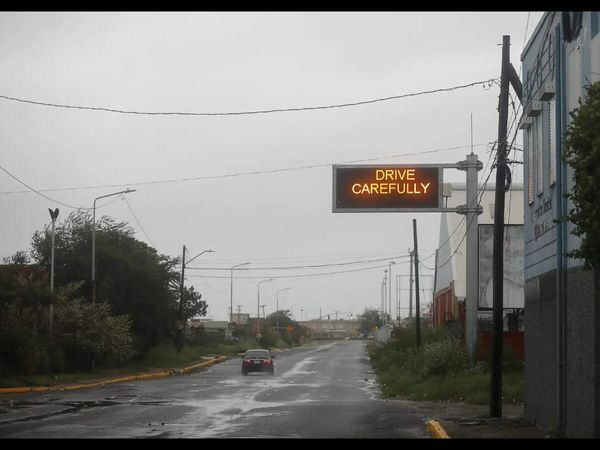
No, I’m not reciting the story of Noah’s Ark, but a tale from the Met Office. In some parts of the UK, the forecaster said it really has rained for 40 days in a row. Devon, Cornwall and Worcestershire have barely had a break.
January 2026 was marked by exceptionally high rainfall, particularly in Northern Ireland, which saw its wettest January in 149 years. Southern England recorded its sixth wettest January since records began in 1836.
The culprit behind Britain’s endless drizzle is no mystery. At current levels of global heating, the Met Office estimates that very wet winters have shifted from once-in-80-year events to once in every 20 years.
And yet, at the very moment the climate crisis feels impossible to ignore, the UK’s sense of urgency on net zero targets and its support for climate policies is falling sharply, according to a major new study.
To understand why, and what it means for climate action in Britain, I spoke to Guardian environment editor Damian Carrington. That’s after the headlines.
Five big stories
Politics | Female Labour MPs have told Keir Starmer to appoint a woman as his de facto deputy to oversee a “complete culture change” in Downing Street after a series of scandals.
Canada | Canadian police have identified the suspect who carried out a school massacre in remote British Columbia as an 18-year-old woman with a history of mental health problems.
UK news | An undercover officer who deceived three women into sexual relationships said his superiors did nothing to prevent him from doing so, the spycops public inquiry has heard.
US news | A Cheshire woman who was shot dead by her “reckless” father while visiting him in the US after a row about Donald Trump was unlawfully killed, a coroner has ruled.
Television | James Van Der Beek, the actor best known for playing the lead in hit 90s teen drama Dawson’s Creek, has died.
With flood warnings flashing across the country and extreme rainfall becoming the new normal, it might seem baffling that public support for tackling the climate crisis is slipping.
But Damian Carrington says the contradiction makes sense when placed within the current economic and political context.
“I saw a good quote from someone who was being asked about this, who said ‘how can you expect me to worry about the end of the world when I’m worried about the end of the week?’” Damian says.
The UK’s cost of living crisis has been compounded by the successive shocks of the Covid-19 pandemic and the Ukraine war, the latter of which has resulted in a sharp rise in energy prices. “People are having a really difficult time in making ends meet so things that seem like they’re potentially in the future, like climate change, tend to fall to the back seat,” he says.
There is historical precedence for this, Damian adds. In 2007, there was a peak in interest in climate change after scientists conclusively blamed humanity for the crisis for the first time. But then the 2008 financial crash came and the salience of climate change in people’s lives dropped off.
***
A growing tide
Before we properly dig into why support for reaching net zero is going down, let’s spell out exactly what the study (pdf) says.
The study found that just 29% of the public now say the UK should reach net zero before the government’s 2050 target. That’s down from 54% in 2021.
At the same time, the proportion who say the UK shouldn’t have a net zero target at all, has jumped from 9% to 26%.
The research was carried out by the Policy Institute at King’s College London, Ipsos, and the Centre for Climate Change and Social Transformations, and is based on a large, nationally representative survey.
Support has also fallen across a range of specific policies. Backing for low-traffic neighbourhoods, taxes on frequent flyers, subsidies for electric vehicles and taxes on environmentally damaging foods have all declined. In several cases, opposition now outweighs support, a sharp reversal from just a few years ago. The drop has been steepest among people aged over 55.
***
A weapon in the culture war
The falling support for net zero targets cannot be separated from a broader political shift taking place in the UK.
“Up until very recently, there was a consensus among the British political parties about the damage the climate crisis is already causing and the urgent need to act,” Damian explains. “But that has been broken in recent years, most notably by Reform in Nigel Farage, but also the Conservative party, which has reversed its position.”
Last October, Kemi Badenoch, the Conservative party leader, vowed to repeal the Climate Change Act if the Conservatives win the next election, dismantling what has been the cornerstone of green and energy policy for successive Conservative governments.
Climate policy has increasingly been pulled into the culture wars. Measures designed to cut emissions, from low-traffic neighbourhoods to heat pumps, have become symbols in wider arguments about the role of the state and personal freedom. Bluntly put, some people don’t like to be told where they can drive in their local neighbourhoods, even if such rules mean the air is clearer for them to breathe.
Misinformation is also a huge issue. “When you look at some of the policies that this polling considers, like low-traffic neighbourhoods or electric cars or heat pumps, there’s a great deal of rubbish published about these things, which is having an effect,” Damian says.
“People are repeatedly told these things are useless, which they are not. It’s not surprising some people come to believe that.”
One of the most powerful and misleading narratives is the idea that the push towards net zero, and especially the development of renewable energy, is to blame for rising energy bills. In reality, the main driver of higher prices has been the soaring cost of gas, following Russia’s invasion of Ukraine.
“It’s a complete red herring,” Damian says. “If we didn’t have the renewable energy that is being increasingly built out, Britain would have spent a lot more.”
There is also a deeper ideological tension at play. Tackling climate change requires collective action, long-term planning and regulation, all of which sit uneasily with parts of the political right. As climate action becomes framed as an attack on individual freedom, support erodes.
***
Fair and green
If public support for climate action is to be rebuilt, fairness has to be at the centre of policy design, Damian says.
“Britain, like many countries around the world, is very unequal. The rich are incredibly rich and the poor are really poor,” he argues. “The problem with climate action sometimes is that it requires upfront investment to save money.”
He points to heat pumps as a good example. While they can be cheaper to run in the long term, the initial cost can be daunting. Air-source heat pumps cost just over £12,500 to buy and install on average, according to a report published last year. This is about four to five times more than a gas boiler. Without proper support, policies that encourage uptake risk feeling as if they are designed for the well-off.
“One of the failings of the last government and the current one is that climate policies have to be affordable and fair for everybody, including people on lower incomes. When that’s not happening, people will react against it,” he says.
And while people are experiencing more extreme weather, “there has always been bad weather,” Damian says. “The climate crisis means it’s getting worse. If you’ve never had floods, and suddenly you get floods that you can pin to the climate crisis, that would be different.”
The other important factor is that the UK, alongside the US and Australia, hosts powerful fossil fuel companies, and has a strong strain of neoliberal economics, as well as a highly influential rightwing press.
Together, those forces make it especially difficult to sustain a broad public consensus on climate action, even as the physical impacts become harder to ignore.
But all is not lost. Despite the falling sense of urgency, the study shows a clear majority of the public (64%) still believe the government’s target for net zero should be at least 2050, if not earlier.
The challenge now is not just holding on to that consent, but building on it.
What else we’ve been reading
Last October, police in Rio carried out a raid against criminal gang, the Red Command, which left 122 people dead. This in-depth investigation brilliantly unpacks the many lingering questions, while Nesrine Malik’s interview with Tiago Rogero for The Long Wave newsletter explores how the event revealed Brazil’s race and class fissures. Lucinda Everett, newsletters team
Simon Hattenstone is a generational talent. His interview with Lisa Nandy has it all: a great news line, funny, and engrossing from start to finish. Aamna
Jonathan Liew is searing and incisive on how Reform’s plan to save the great British pub actually means maintaining “a refuge where old white lads can say whatever they like without ever being challenged”. Lucinda
We are entering a new age of discovery in the field of ancient history, Marcus Haraldsson writes in this fascinating long read on how new technologies are transforming what we know about Maya civilisation. Aamna
“The impossible contradictions around motherhood are a way of making femaleness impossible,” is one of many spot-on insights from Zoe Williams’ interview with Rose Byrne, the star of If I Had Legs I’d Kick You. Lucinda
Sport
Winter Olympics | Lewis Gibson did his best to smile, but the pained pinch on the face of his partner, Lilah Fear, as they twirled around the Milan Ice Skating Arena gave the game away. The Team GB pair had dreamed of becoming the first British Olympic skating medallists since Jayne Torvill and Christopher Dean in 1992. Instead, they endured a nightmare on ice.
Football | Premier League | Manchester City closed the gap on Arsenal to three points with a 3-0 win against Fulham. Liverpool ended Sunderland’s unbeaten home record, while Sean Dyche has been sacked by Nottingham Forest after a draw with rock‑bottom Wolves.
Olympics | Qatar’s bid to host the 2036 Olympic Games has received a boost with the state-owned broadcaster beIN Sports concluding a media rights deal for the 2028 Games in Los Angeles.
The front pages
“Select female deputy to end ‘boys club’ in No 10, PM told,” is the splash on the Guardian on Thursday, while the Mail has “Labour women’s fury over second paedophile crisis,” and the Telegraph: “Labour ‘up for’ closer ties with Europe.”
“PM knew his peerage pick had backed sex offender,” says the Times. “Andrews faces growing police inquiry into Epstein links,” has the i. “Credit cad,” says the Sun.
“UK ‘colonised by migrants’ claims United chief,” is the lead story over at the Express. “Man U Jim ‘racism ‘ storm’”, writes the Star. The Mirror covers the same, running the headline: “Shameful.”
Today in Focus
The untold story of Brazil’s deadliest police raid
Guardian journalists Tom Phillips and Tiago Rogero investigate the bloodiest day in Rio de Janeiro’s modern history, when police last October attempted to capture a drug kingpin in the favelas.
Cartoon of the day | Ben Jennings
The Upside
A bit of good news to remind you that the world’s not all bad
Being plunged suddenly into darkness as streetlights switch off around you may, very reasonably, not sound like good news. However, there is a growing trend in Europe of deliberately darkening our evenings – for the sake of our wildlife.
In this report on one national park in Belgium (curiously, one of the most light-polluted countries on the planet), Phoebe Weston explains how, across the continent “unnecessary lighting is being extinguished, and a key motivation is to protect nature
“Over the past decade an increasing amount of research has shown that illuminating night skies is bad for a wide range of species, including insects, birds and amphibians – disrupting their feeding, reproduction and navigation.”
Sign up here for a weekly roundup of The Upside, sent to you every Sunday
Bored at work?
And finally, the Guardian’s puzzles are here to keep you entertained throughout the day. Until tomorrow.