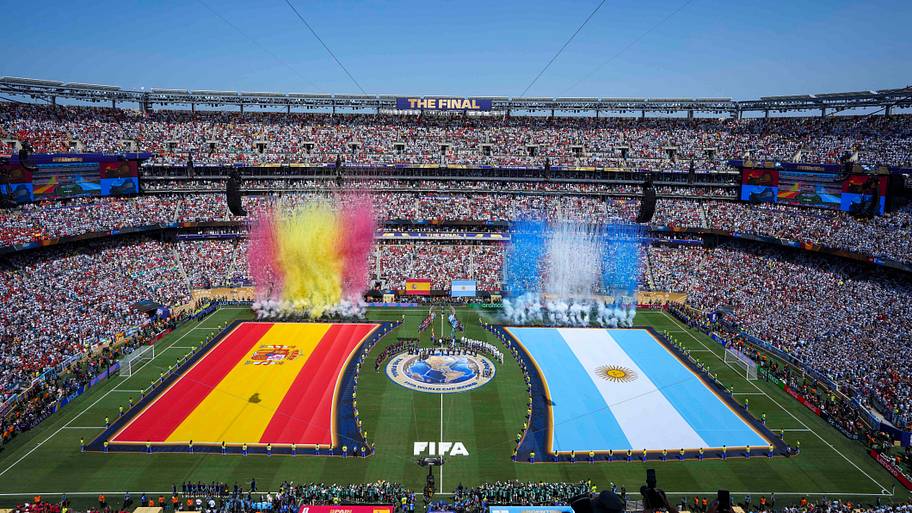
I took my dog for a short walk following Sunday’s FIFA World Cup final. While strolling my neighborhood streets, I couldn’t help but notice a young boy and girl playing (perhaps because my 1-year-old rescue pup pulled me in their direction). Upon further review, the two were not only donning soccer jerseys, but also seemed to be reliving Spain’s 1–0 victory over Argentina that wrapped just moments before.
It put into perspective just how quickly the sport was able to capture North America over the past month-plus.

Throughout the tournament, the United States, Canada and Mexico experienced firsthand the grip soccer has on the rest of the globe. From Scotland’s Tartan Army drinking Boston bars dry to Norwegians packing stadiums and performing their iconic “Viking Row”, fans from all over the world flocked stateside this summer to support their home countries. It made plenty of Americans, too, fall in love with the beautiful game.
Now, however, it’s time for the country’s own favorite sport—American football, of course—to reclaim the spotlight. NFL training camps are set to begin across the country this week, and the start of the 2026 regular season is less than two months away. And while football doesn’t need to become soccer—and shouldn’t—it’s hard not to wonder what the NFL can learn from FIFA after being immersed in the World Cup over the past six weeks.
Here are three lessons the league can take away from the most popular sport on Earth.
Grass fields are the way to go
FIFA has long made player safety a priority, notably requiring its matches to be played on grass fields. The rule became quite the topic of discussion over the course of the World Cup, as seven of the 11 NFL venues swapped their field turf for natural grass in order to meet the body’s requirements—only to already begin reinstalling their old pitches ahead of the 2026 regular season.
MORE: The World Cup Has Exposed the NFL’s Turf Problem. Now It’s Time for Owners to Do Right By Their Players.
The NFLPA surveyed its players prior to the World Cup and found that a whopping 92% would prefer playing on natural grass. Throughout the tournament, meanwhile, several NFL players voiced their disdain regarding the league’s reluctance to make a blanket change to grass surfaces.
That includes George Kittle, who posted the following on Sunday afternoon from MetLife Stadium:
Grass still looks great! Let’s use grass instead of turf @NFL !! Please? Thanks guys! pic.twitter.com/1iS8Jf2zPX
— George Kittle (@gkittle46) July 19, 2026
“Grass still looks great!” the 49ers tight end wrote on X (formerly Twitter). “Let’s use grass instead of turf @NFL !! Please? Thanks guys!”
While NFL injury data from 2012 to ’18 showed that players suffered a 28% higher rate of noncontact lower-extremity injuries when playing on artificial turf versus grass, it’s the financial implications that the owners are seemingly balking at. Natural grass is more expensive to install and maintain—especially when these stadiums also serve as year-round, multi-purpose venues—and turf makes the reconfiguration process more monetarily responsible.
Still, it’s a poor excuse for the world’s most profitable sports league. The NFL should follow FIFA’s lead here.
Continue to go global
Speaking of money, it’s the root of the NFL’s obsession with “more” (which we’ll get to in a minute), and is ultimately why they continue to build out their annual International Series under the guise of growing the game.
Motivations aside, it’s the right move.
In 2026, the NFL will play a record nine-game International Series across eight different countries, and commissioner Roger Goodell has made no secret about his eventual goal of a 16-game international schedule. The downside to this, of course, is the toll the excess travel will take on players. Teams are set to log a staggering 630,824 total air miles over the course of the regular season, with the 49ers leading the charge thanks to trips to both Melbourne and Mexico City.
The upside? Popularizing the sport on a global level. A phenomenon FIFA nailed with the World Cup.
I will admit, this is a bit contradictory to my point above about doing what’s right for the players. That said, there’s a direct correlation between the NFL’s attempt at global expansion and the long-term health of the sport. Unlike the league’s balk at moving towards safer field surfaces—which is purely greed-driven—international popularity brings with it far more benefits than simply keeping the owners’ pockets lined.
More fans mean more investment. More investment means more opportunity, ultimately resulting in a stronger and more accessible game for all.
There’s a balance to be struck, of course. While the NFL should not be sacrificing the well-being of its players—the lifeblood of the league—it should be doing everything in its power to continue introducing the sport to new audiences around the world.
Less is more
You know when a new song starts to become popular, and you then hear it over and over and over again on the radio? That’s what football is starting to feel like.
Not too long ago, the NFL was almost exclusively a Sunday experience. The six-day build-up turned the end of the week into a wire-to-wire football-watching spectacle. The game’s scarcity was part of what made it so popular in the first place.
Today, however, the league has seemingly lost the plot. In addition to its growing slate of international games, the NFL expanded its postseason from 12 teams to 14 in 2020 (in turn adding more playoff games), added a 17th game to its regular season in ’21—a likely precursor to an inevitable 18-game slate—and in ’26 will play games on Wednesdays, Thursdays, Fridays, Saturdays, Sundays and Mondays at various points throughout the campaign.
Compare that to the World Cup, which FIFA holds just once every four years. The lengthy wait between tournaments builds anticipation and buzz that few other sporting events can replicate. It makes every match matter that much more, and turns each into a full-fledged event rather than simply a game.
At this point, the oversaturation of NFL football is impossible to ignore, and could eventually push fans away.
If the past 60 days are any indication, sometimes less is more.