Get all your news in one place.
100's of premium titles.
One app.
Start reading
The Conversation
The Conversation
Science
Joe Moysiuk, PhD Candidate, Ecology & Evolutionary Biology, University of Toronto

Three-eyed Cambrian fossils shed new light on arthropod head evolution

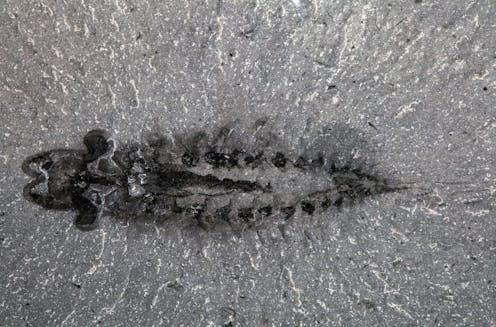
A rare find — a fossil of _Stanleycaris hirpex_ with the nervous system preserved. (Jean Bernard Caron/Royal Ontario Museum), Author provided

The Burgess Shale is located in British Columbia and is a site of marine fossils that are 506 million years old. It is celebrated for its “weird wonders,” containing a treasure trove of astonishingly well-preserved fossils.

These organisms harken back to the Cambrian explosion, a time in Earth’s history when major animal groups were diverging from each other in a burst of evolutionary innovation. In addition to the first representatives of most surviving animal groups, Cambrian deposits preserve a menagerie of sea-dwelling invertebrates unlike anything alive today.

Sign up to read this article
Read news from 100's of titles, curated specifically for you.
Already a member? Sign in here
Related Stories
Top stories on inkl right now
One subscription that gives you access to news from hundreds of sites
Already a member? Sign in here
Our Picks
Fourteen days free
Download the app
One app. One membership.
100+ trusted global sources.