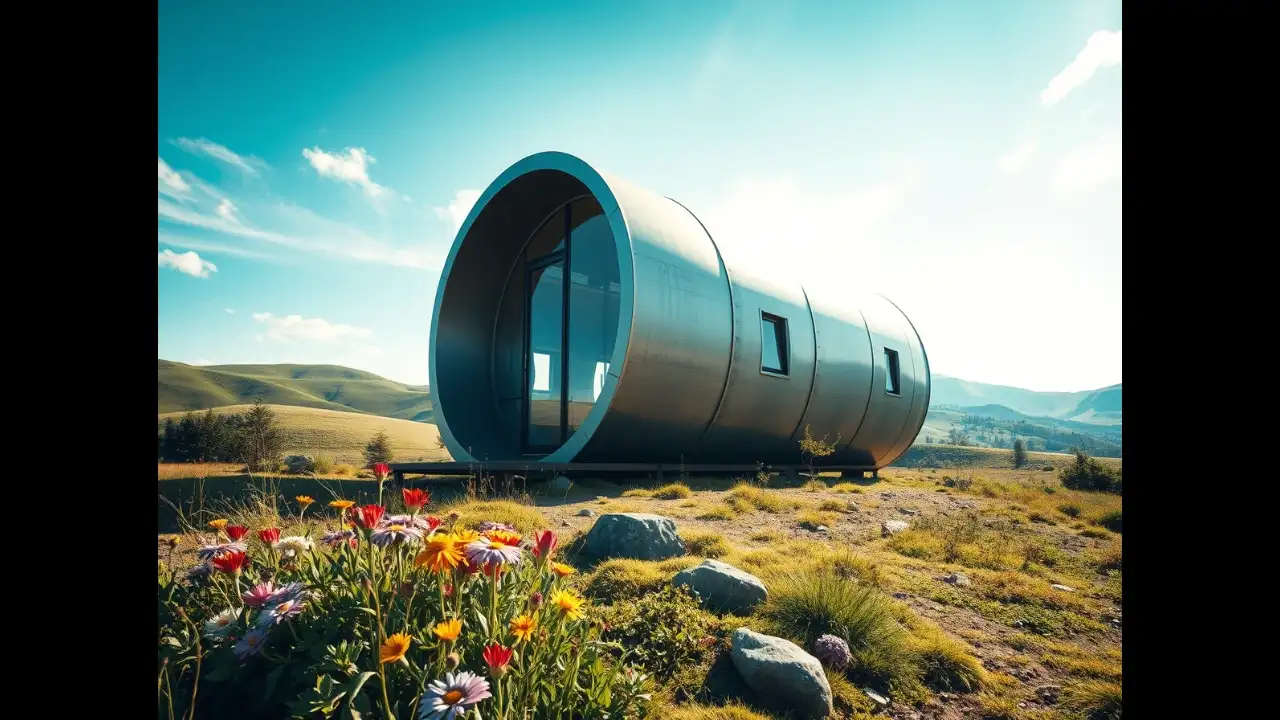
What happens to a wind turbine when its working life finally ends? In the Dutch city of Eindhoven, designers found an extraordinary answer by turning one of the machine's most recognizable components into a place to live. Called Nestle, the project transforms a retired wind-turbine nacelle—the large housing at the top of a turbine—into a compact, building-code-compliant tiny house. Created by Dutch architecture and design studio Superuse in collaboration with energy company Vattenfall and other partners, Nestle demonstrates how components from decommissioned renewable-energy infrastructure can potentially be reused instead of simply being recycled or discarded.
The prototype was completed in 2024 and presented during Dutch Design Week in Eindhoven, where its unusual appearance offered visitors a glimpse of what circular architecture can look like when designers work with an object that was never intended to become a building.
The starting point for Nestle was a Vestas V80 2MW turbine nacelle measuring about 10 metres long. Superuse describes the selected nacelle as approximately 3.5 metres wide and 4 metres high, while other project materials give dimensions of roughly four metres wide and three metres high, reflecting differences in how the curved shell's dimensions are measured. What matters most is that the designers deliberately chose one of the smallest nacelles capable of accommodating a tiny house.
The nacelle originally belonged to a wind turbine at the Gols wind farm in Austria. According to Superuse, the turbine was installed there in 2005 and operated for about 20 years, producing 73 gigawatt-hours of electricity—enough, according to the studio, to supply more than 29,000 households with a year's worth of electricity. After its time high above the ground ended, its nacelle began an entirely different second life.
The idea emerged from a larger challenge facing the wind industry. Thousands of turbines are expected to be dismantled or replaced as the global wind fleet ages, creating an important question about what happens to their components after decades of service. Many turbine parts, including steel structures and certain mechanical components, can be recycled relatively easily. But recycling generally means processing materials so they can become raw inputs again, and that process can require additional energy.
Vattenfall and Superuse instead explored the possibility of preserving a component in something close to its existing form. Vattenfall had invited four design firms to consider second-life uses for retired wind turbines, and Superuse deliberately selected the technically demanding option of transforming a nacelle into a usable building. The project therefore became an experiment in “reuse instead of recycling.”