Get all your news in one place.
100's of premium titles.
One app.
Start reading
The Economic Times
The Economic Times
Muskan Singh

This weird trick helped physicists solve the bird flock mystery that defied Newton for years

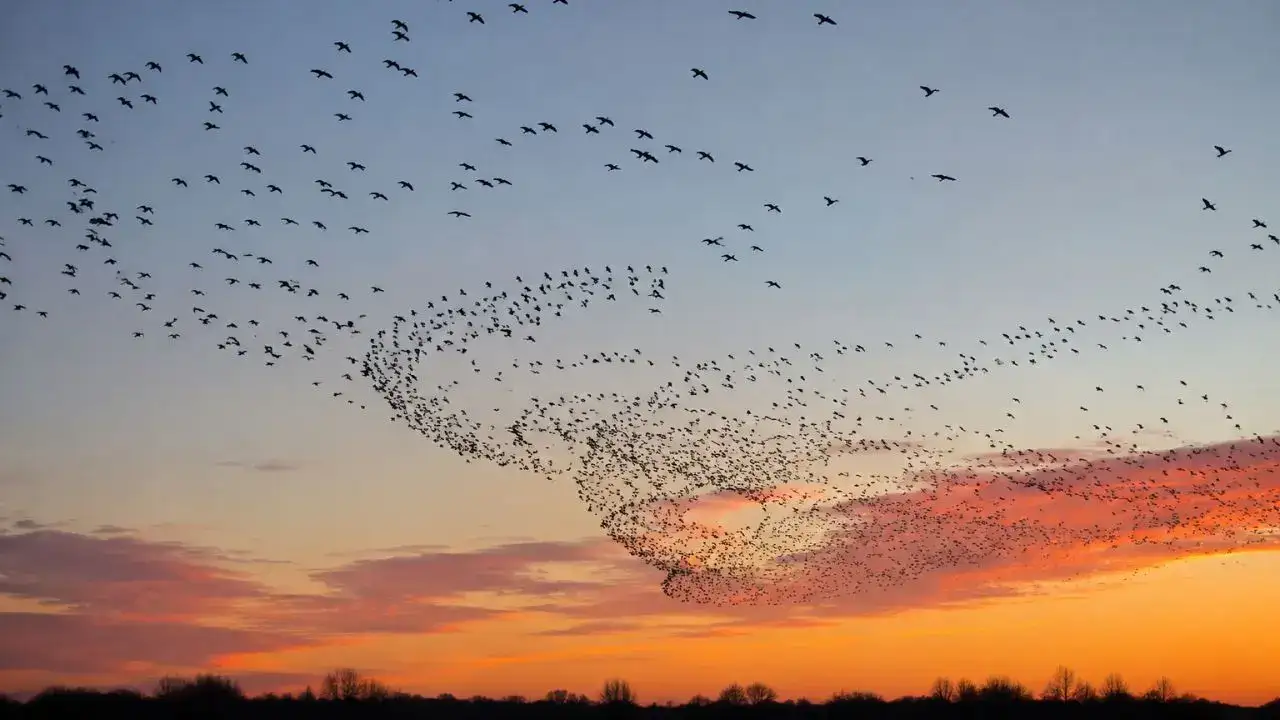
For more than 300 years, Newton’s third law has stood as one of the strongest foundations of classical physics. But the movement of bird flocks, bacterial swarms, and other collective systems has challenged the traditional understanding of action and reaction. Researchers have developed a new theory that explains how these unusual interactions work without abandoning established physics, as per a report by Science Daily.

The discovery could help scientists better understand animal movement, biological systems, and even complex quantum behaviors.
READ ALSO: French Proverb of the Day: 'To love is not to look at each other...'- A thought-provoking lesson about true partnership

For generations, Newton’s third law has helped explain how objects move and interact. The famous principle says that “for every action, there is an equal and opposite reaction.” From walking and driving to rockets and balloons, the rule has been one of the basic ideas behind classical mechanics.

But some systems in nature do not seem to follow this simple pattern. Bird flocks, for example, move together in ways that appear to challenge the action-reaction principle. When birds fly in groups, they observe and adjust to birds beside them or ahead of them. They do not coordinate their movements by responding to birds behind them.

This creates an imbalance where the interaction moves in only one direction.

Researchers have now found a way to explain these unusual behaviors. A team of physicists in Dresden has developed a new framework that allows systems with these one-way interactions to be studied using traditional physics methods.

The work was led by researchers including physicist Roderich Moessner and research group leader Marín Bukov. Their findings offer a new approach for understanding what scientists call non-reciprocal interactions, as per a report by Science Daily.

READ ALSO: Thought of the Day by the father of Political Philosophy Plato: 'Every heart sings a song, incomplete, until...'- Do we all become poets in love? Here's a timeless thought on love, connection, and the poet within us by the ancient Greek philosopher

Why do bird flocks confuse traditional physics?

Newton’s third law works perfectly for systems where actions and reactions balance each other. When a person runs, their feet push against the ground, and the ground pushes back with equal force. The same idea explains movement in cars, boats, and other everyday examples.

“Whatever we normally teach our students in theoretical mechanics, it ultimately rests on the action-reaction principle,” explains Marín Bukov.

However, bird flocks and other living systems operate differently. In these cases, individuals respond only to parts of their surroundings. Similar behavior appears in bacterial swarms, crowds, and groups of cells inside living tissues.

Because these systems do not have equal back-and-forth interactions, scientists have struggled to create accurate models for them.

The researchers’ new theory changes that by extending the traditional framework, as per a report by Science Daily.

READ ALSO: Quote of the Day by Lao Tzu: 'Life is a series of natural and spontaneous changes...' - A timeless lesson about accepting life’s journey

How does the imaginary bird idea work?

The breakthrough came from adding artificial variables that do not exist in the real world but help make the mathematics work.

Physicists usually describe a system using measurable features, such as the speed and position of a bird. But the new approach creates an additional imaginary partner for every part of the system.

“The trick behind the new theory is that it constructs a partner for each component of the system -- a fictitious partner that doesn't exist in nature. The original non-reciprocal interactions are replaced by reciprocal interactions with these auxiliary degrees of freedom,” explains Ricard Alert.

For a flock of birds, scientists can imagine placing a fictional bird in front of each real bird, facing the opposite direction. These imaginary birds are not real animals. Instead, they are mathematical tools that transform one-way interactions into balanced systems that researchers can analyze, as per a report by Science Daily.

READ ALSO: Quote of the Day by one of the world's bestselling living philosophers Ryan Holiday: 'We should not trust the masses who say only the free can be...'- Here's a powerful quote on freedom, wisdom, and the true meaning of education by The Daily Stoic author

This allows scientists to use established methods that were previously limited to systems following Newton’s third law.

What could this discovery change?

The new method could improve simulations of many complex systems, including biological movement, crowds, and animal behavior.

Researchers believe the concept may also open new possibilities in quantum physics. Scientists studying quantum matter are interested in whether exceptions to traditional physical rules could create new collective behaviors.

"In Würzburg and Dresden, we study quantum matter whose particles interact under certain conditions in ways that give rise to new phenomena such as magnetism or lossless current transport. The exciting question now is whether these exceptions to Newton's law lead to entirely new forms of collective quantum behavior. We still know very little about this -- and that is precisely what makes this so fascinating,” says Moessner.

The idea of using additional variables is not completely new in physics, but applying it to non-reciprocal systems represents a major step forward.

The research provides scientists with a new tool to study systems that have always been difficult to explain. Instead of viewing these interactions as failures of existing physics, researchers can now describe them through an expanded framework.

The team’s findings, published in Nature Physics, could influence future studies of everything from animal movements to advanced quantum systems. What once looked like a violation of Newton’s third law may actually be a sign that nature follows a more complex set of rules than scientists previously understood.

FAQs

Why do bird flocks seem to break Newton’s law?

Because birds respond only to nearby birds, not every bird around them.

What did scientists create?

A new model using artificial variables to explain these interactions.

Sign up to read this article
Read news from 100's of titles, curated specifically for you.
Already a member? Sign in here
Related Stories
Top stories on inkl right now
One subscription that gives you access to news from hundreds of sites
Already a member? Sign in here
Our Picks
Fourteen days free
Download the app
One app. One membership.
100+ trusted global sources.