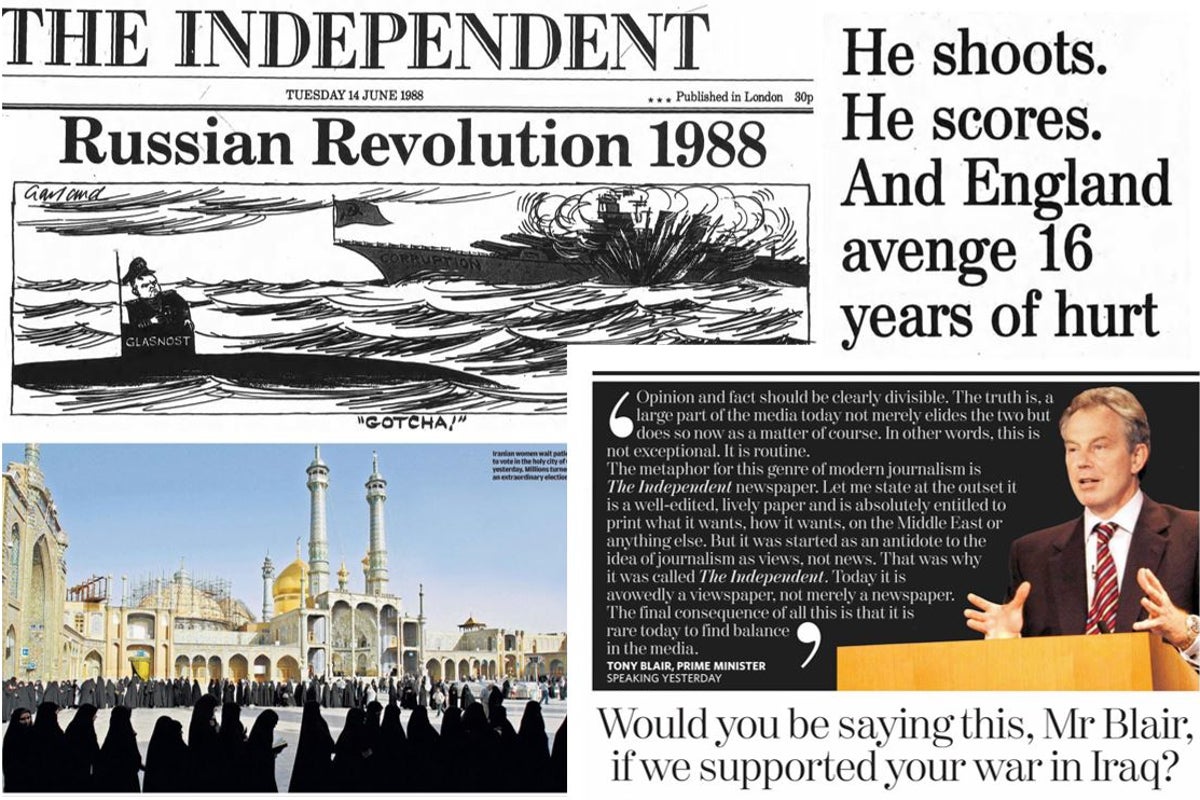
This week’s front pages capture the twilight of the Soviet era, the violent consolidation of hardline power in China, and Nelson Mandela’s defining vision for a unified South Africa. Closer to home, our coverage spotlights Tony Blair’s bruised ego, from a hostile Women’s Institute audience to a remarkable public feud with this very publication. Meanwhile, World Cup drama reaches fever pitch as David Beckham finally finds redemption against Argentina.

8 June 1987 – US threatens Tehran with strikes
Amid the escalating “Tanker War” phase of the Iran-Iraq conflict, the US issues a stark warning to Tehran against deploying Chinese-made Silkworm missiles in the Persian Gulf. Threatening military retaliation to protect vital oil shipping routes, the 1987 standoff foreshadows decades of entrenched US-Iran hostilities and persistent struggles to secure Middle Eastern maritime trade.
14 June 1988 – Moscow admits to years of rigged elections
As Mikhail Gorbachev’s policies of glasnost (openness) accelerate ahead of a crucial Communist Party conference, a senior Soviet official publicly admits that the nation’s elections have been rigged for years. The admission highlights the rapid momentum of political reform sweeping the country as the pivotal June conference approaches.
10 June 1989 – China’s hardliners back in control
Following a three-week absence from public view, Chinese leader Deng Xiaoping appears on television to publicly endorse the military crackdown on the student-led democracy movement in Tiananmen Square. Even as secondary protests continue in cities like Shanghai, the government initiates a severe purge of political dissenters to solidify hardline control.
13 June 1990 – Russia proclaims its sovereignty
The Russian Federation formally proclaims its state sovereignty following an overwhelming vote by deputies. By asserting the exclusive right to control its own territory and national wealth, the largest republic in the Soviet Union deals a major blow to Moscow’s central authority and accelerates the eventual collapse of the Soviet state.
8 June 1994 – Mandela sets out vision for his presidency
Speaking to The Independent in his first newspaper interview since taking office, South African president Nelson Mandela commits to serving a full five-year term. He outlines his central ambition to build a new national identity based on loyalty and unity, acknowledging that true reconciliation means forgiving the many sins of the past.
11 June 1999 – Milosevic’s forces withdraw from Kosovo
As the UN formally endorses a peace agreement to end the Kosovo War, Serbian forces begin a bitter withdrawal from the region. Witnessing the historic pull-out on the ground, correspondent Robert Fisk captures the bizarre reality of the departing troops offering "salutes and smiles", reflecting Slobodan Milosevic’s insistence that his forces were returning “victorious”.
8 June 2000 – Blair ‘handbagged’ by the Women’s Institute
Prime Minister Tony Blair is jeered, heckled, and slow-clapped by the Women’s Institute after attempting to deliver a partisan political speech to an unimpressed audience. Dubbed a "handbagging by Middle England", the spectacular miscalculation becomes one of the most infamous and enduring public missteps of his premiership, exposing the limits of New Labour’s tightly managed image.
8 June 2002 – David Beckham finds World Cup redemption
Captain David Beckham scores a penalty against tournament favourites Argentina in Sapporo, to secure a 1-0 World Cup victory for England in the tournament’s group stages. The goal helps avenge a long history of footballing grievances against the South American side – from Diego Maradona’s controversial 1986 “hand of God” goal to England’s 1998 shootout exit, a match that famously saw Beckham sent off in disgrace.
12 June 2007 – Blair hits out at The Independent
Delivering a highly critical farewell speech on the state of the British media, outgoing prime minister Tony Blair singles out The Independent as the prime example of a press culture that has lost its balance. By accusing the publication of operating as a “viewspaper”, Blair triggers a staunch response from the editorial team, who forcefully defend their journalistic integrity and right to challenge the political establishment.
13 June 2009 – ‘A thunder of free speech’ in Iran
As millions of Iranians brave the sweltering heat to vote in a pivotal presidential election, The Independent’s Robert Fisk reports from Tehran on an unprecedented “outpouring of democratic fervour”. Despite the massive public turnout, Fisk captures the grim reality of the nation’s political system, predicting that the overriding power of the ruling clerical establishment will ultimately stifle the will of the people.