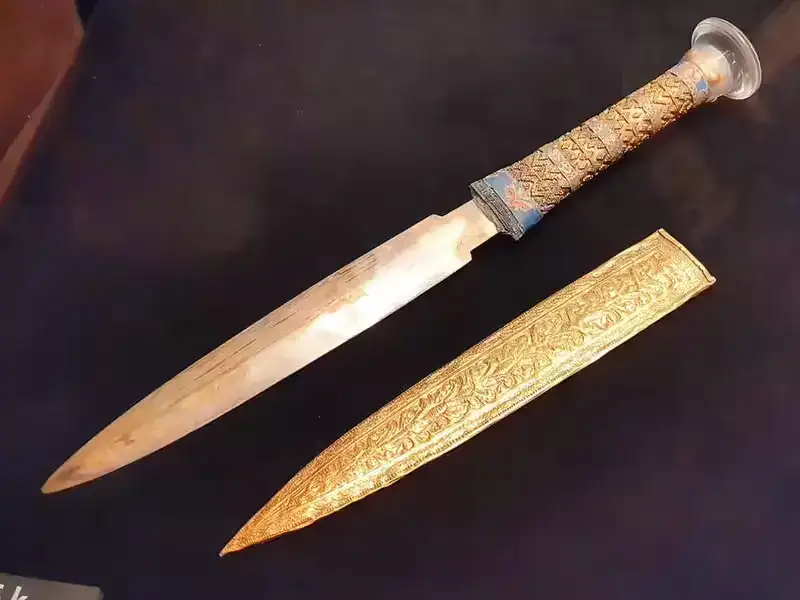
For nearly a century, one object discovered inside King Tutankhamun's tomb puzzled historians and archaeologists alike. Hidden among the treasures wrapped with the young pharaoh's mummy was an iron dagger that seemed centuries ahead of its time, reports Times of India.
Now, scientific analysis has revealed a remarkable answer: the weapon was forged from metal that fell from the sky. More than 3,000 years after it was placed beside a young king, the dagger continues to tell a story of innovation, status, and humanity's earliest encounter with a material that originated beyond our planet.

ALSO READ: Investment banker reveals Rs 1.3 lakh monthly expenses with no vacations, sparks debate on savings
The Ancient Mystery Inside Tutankhamun's Tomb
When archaeologists uncovered the tomb of Tutankhamun in 1922, they found two daggers among the burial objects. One was made of gold, a material commonly associated with royalty in ancient Egypt. The other, however, was far more puzzling.
The second dagger featured an iron blade that showed little sign of rust despite being over 3,000 years old. Its presence raised an important question. During Tutankhamun's reign in the 14th century BCE, Egypt was still in the Bronze Age, and large-scale iron smelting had not yet become established.
So how did an iron weapon end up in the tomb of a young pharaoh?
A Scientific Investigation Solves the Puzzle
The answer emerged in 2016 when researchers published a study in the journal Meteoritics and Planetary Science. An international team of Egyptian and Italian scientists examined the blade using a portable X-ray fluorescence spectrometer at the Egyptian Museum in Cairo. The non-destructive technique allowed researchers to study the metal's composition without damaging the priceless artifact.
Their findings pointed to an extraordinary conclusion: the dagger was made from meteoritic iron.
The Chemical Clue That Changed Everything
The blade's chemical composition provided the breakthrough. Researchers found that the iron contained approximately 11% nickel and 0.6% cobalt. These levels are significantly higher than those typically found in iron extracted from earthly ores.
Instead, the composition closely matched that of iron meteorites that originate in space. The results offered strong evidence that the metal used to craft the dagger had arrived on Earth as a meteorite before being shaped into a royal weapon.
Why 'Sky Iron' Was So Valuable
The discovery sheds light on how ancient Egyptians viewed rare materials. At the time, people could not produce iron on a large scale by smelting ore. As a result, naturally occurring meteoritic iron was extremely rare and highly prized.
Far from being a simple tool, Tutankhamun's dagger was likely considered a luxury object reserved for the highest levels of society.
Its value came not only from its scarcity but also from its celestial origin. To ancient cultures, a metal that literally fell from the heavens may have carried deep symbolic and religious meaning.
Ancient Egyptians Were Using Space Metal Long Before Tutankhamun
The famous dagger was not the first Egyptian object made from meteoritic iron. Archaeologists have discovered even older examples at the prehistoric Gerzeh cemetery in Egypt. These include small tubular beads dating to around 3300 BC.
A 2013 scientific study found that the beads were also crafted from nickel-rich meteoritic iron.
Ancient artisans carefully hammered the rare material into thin sheets before rolling them into tubes and incorporating them into jewellery alongside precious materials such as gold and lapis lazuli.
These finds suggest that Egyptians had recognized and valued meteorite metal for thousands of years before Tutankhamun's reign.
Rethinking the Transition to the Iron Age
The dagger also offers important insights into human technological history. For decades, many viewed the transition from the Bronze Age to the Iron Age as a major technological leap. However, discoveries like Tutankhamun's dagger suggest the process was far more gradual.
Before people learned how to extract iron from ore efficiently, small amounts of meteoritic iron were already being collected and worked into prestigious objects.
This means some of humanity's earliest interactions with iron did not come from mining the Earth but from materials that arrived from outer space.
A Weapon That Connects Earth and the Cosmos
Tutankhamun's dagger stands as one of the most fascinating artifacts from the ancient world. Rather than proving that Egypt had mastered iron smelting centuries ahead of its time, the blade reveals something arguably more extraordinary: skilled craftsmen were shaping metal from meteorites long before iron production became widespread.
(With TOI inputs)