Designer and quilter Kate Owen has a talent for breathing new life into old things. Just as she patiently stitches together treasured fabric remnants, she and her husband, Luke, have lovingly pieced back the history of a Victorian London terrace, creating a cosy home in the city.
‘Bit by bit we transformed it from a white box into a house with colour and character, adding features, such as panelling and plasterwork, and plenty of pattern,’ says Kate.

Brimming with nostalgic charm reminiscent of a prairie farmhouse, it’s surprising to learn that the home is within five miles of central London.
Home for Christmas

Decorating the tree is a Christmas highlight for Kate; she always goes for the largest possible, and there is plenty of space for it here in the playroom.
Ribbons, handmade decorations and ornaments that she has collected over the years create a magical scene, along with paper chains and star garlands, for a vintage, homespun feel.

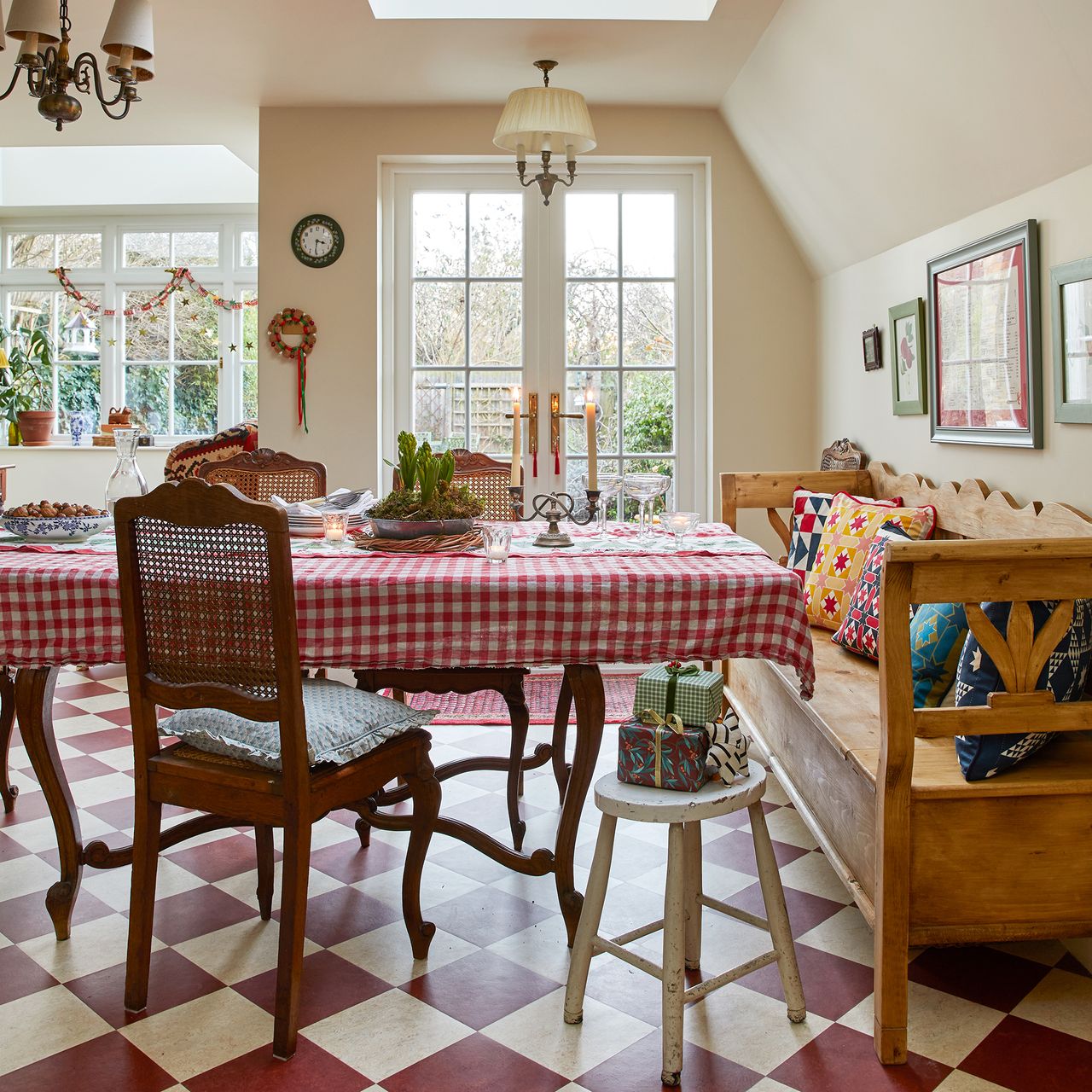
In the dining area, the table is laid with a gingham tablecloth, topped with a 1950s runner for a touch of Christmas kitsch.
Most furnishings are second-hand, and Kate has a penchant for handcrafted wooden pieces.
Kitchen extension

When Kate and Luke first viewed this house, located on a quiet street, it was far from the character property they dreamed of, as most Victorian features had been removed.
‘All that remained were two fireplaces and the old wooden shutters,’ remembers Kate.
‘The house had been done up to sell to a developer. Everything was grey, and even the doorknobs felt like something from an office block.’
Despite this, the property had a good-sized garden and potential to extend, so they made an offer.
With the help of an architect, Kate and Luke submitted plans for a bright open-plan kitchen extension, accommodating the kitchen, with a dining area and snug.
The design was completed with roof lanterns and traditional French doors onto the garden.
‘The back of the house is north-facing, so we needed to maximise the light,’ says Kate.
The house is not listed, but is in a conservation area, which impacted on the final plans. ‘It pretty much designed itself; we knew what we wanted and the heights and boundaries we had to work with.'

Kate had always wanted a chequerboard floor and chose eco-friendly Marmoleum floor tiles.
Luke named the snug area in the extension ‘The Nana Nook’ in homage to Kate’s grandma. ‘It’s a lovely space for wine, old movies, reading, chatting and doing crosswords, or some hand sewing,’ says Kate.

They chose simple wooden kitchen cabinets with plenty of storage and open shelves to enhance the country aesthetic. The kitchen was created using handmade modular pine cabinets, which Kate painted in Farrow & Ball’s Old White, a soft grey-green.
The units were configured according to Kate and Luke’s design and fitted by a local builder. The result is a vintage country kitchen look.
Essential repairs

Surveys revealed that the property needed some essential repairs, but luckily Kate and Luke were able to have the work done before moving in.
‘It needed a new roof, damp-proofing work and repointing on the back wall,’ she says.
Inside, there were also problems with the downstairs floor. ‘It had a big dip due to lack of support, so we had all the joists replaced and had reclaimed pine floorboards laid.’
Reinstating decorative plasterwork

When they finally moved in, the couple set about reinstating period features, starting with skirting boards and decorative ceiling plasterwork in the ground-floor rooms.
‘The plasterwork was one of the best things we did; it’s definitely worth the money. Each room has a different design,’ says Kate.
‘The elaborate cornicing and the ceiling rose in the living room look like they’ve always been there.’
Wall panelling

Tongue-and-groove wall panelling was fitted to dado height throughout the hallway, landing and main bedroom to bring more texture and character to the space.
‘I just love panelling and the period effect it gives,’ says Kate. ‘It also allowed me to paint the hallway a rich red without it feeling too dark.’
Layers of pattern

Perhaps the most striking aspect of the interiors is the layers of colour and pattern. Kate has had a love for textiles since childhood and learnt to quilt at the age of four.
After a career as a fabric buyer, she now runs a runs a business specialising in patchwork homewares and kits.

Her creations adorn every room and look perfectly at home alongside William Morris prints, chintzy florals and vintage kilims.
In the main bedroom, Kate made the bed canopy using an old patchwork quilt, which had been handmade by Luke’s grandmother, and she made the bedspread using a mix of new fabrics and remnants of treasured old clothes.
‘I like a traditional, cosy look which is full, colourful and textured,’ says Kate. She describes it as ‘almost prairie farmhouse with a bit of Shaker style’, which is a nod to her American upbringing.
As a maker, the run-up to Christmas is the busiest time of year for Kate.
Once posting dates have passed, though, she looks forward to hosting festivities but still likes to find time for peaceful stitching in the warm glow of Christmas lights.
This feature first appeared in Period Living Magazine. Click here to subscribe.