Get all your news in one place.
100's of premium titles.
One app.
Start reading
MusicRadar
MusicRadar
Entertainment
Chris Bird

“This track is very much John Deacon world. I don’t think I was on it at all to start off with! He was much more into funk than we were. So it’s his rhythm guitar playing – not mine”: Brian May on the No 1 hit that made Queen the biggest band in the world

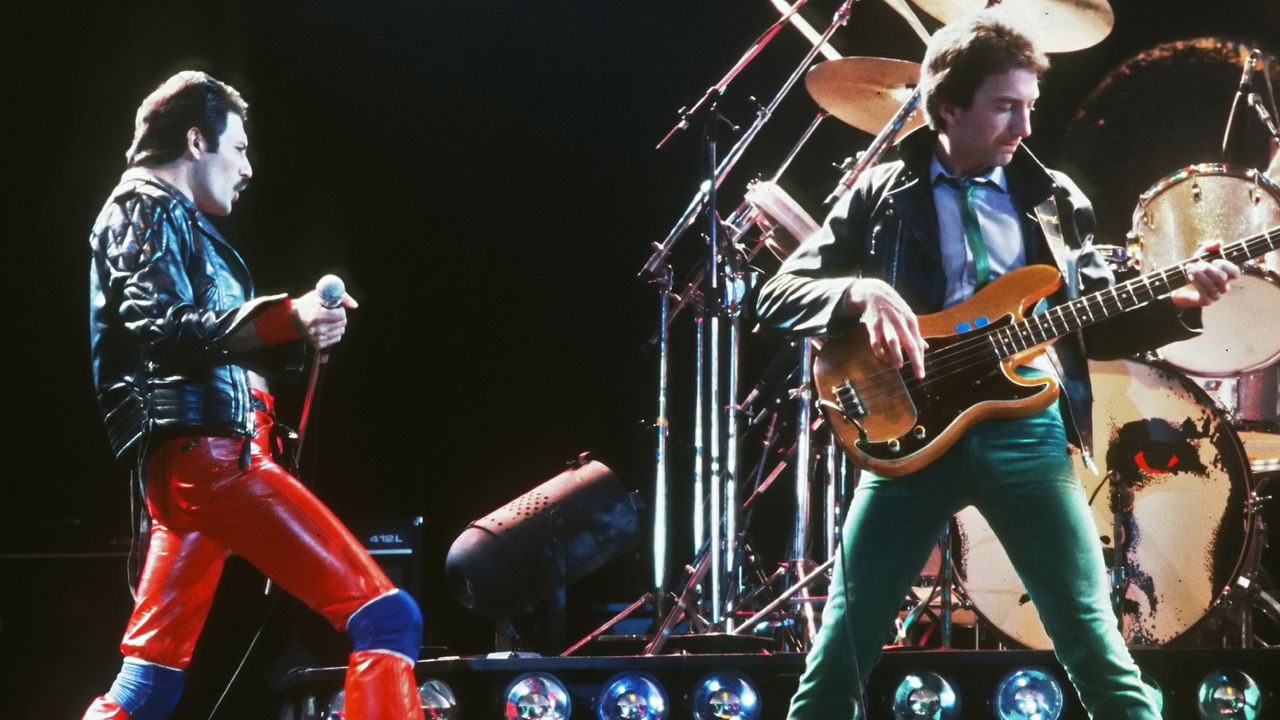
Queen in 1980.

“That song is a very important part of the Queen canon,” Brian May said. “It’s perhaps our biggest song ever in terms of sales.”

The legendary guitarist was talking about Another One Bites The Dust, the disco-influenced track from 1980 that hit the top 10 in the UK and all over the world and became the band’s second US No 1.

It was also Queen’s first No 1 to be written by someone other than Freddie Mercury. The singer’s magnum opus Bohemian Rhapsody was the band’s first No 1 in 1975 – in the UK and across Europe. And his rock ’n’ roll throwback Crazy Little Thing Called Love was their first US No 1 in 1979.

But it was bassist John Deacon who composed funk-powered Another One Bites The Dust – a song influenced by Chic and loved by Michael Jackson.

Deacon had been at New York’s Power Station Studios when Chic were recording their 1979 album Risqué, which featured the classic Good Times, itself a US No 1 smash.

Inspired by that song and especially the contribution of bassist Bernard Edwards, Deacon began playing around with the simple bass riff that became the backbone of Another One Bites The Dust.

In an interview with Bassist & Bass Techniques, Deacon recalled: “I listened to a lot of soul music when I was in school and I've always been interested in that sort of music. I’d been wanting to do a track like Another One Bites The Dust for a while, but originally all I had was the line and the bass riff. I could hear it as a song for dancing but had no idea it would become as big as it did.”

By 1979, Deacon had already proved himself as a songwriter with the singles You’re My Best Friend and Spread Your Wings.

However, when sessions for Queen’s eighth album, The Game, began at Musicland studios in Munich, there was resistance to Deacon’s new song – mainly from drummer Roger Taylor.

As Brian May recalled in a 2024 interview with Total Guitar: “Roger actually didn’t want to have it on the album. Didn’t like it. It was much too funky and not enough rock for him.

“I was a bit on the fence. I kind of enjoyed it. But it obviously wasn’t the rock that I would have been creating.”

He also confirmed that Deacon – whom he affectionately referred to as Deacy – played the funk rhythm guitar on the track, while May provided the rock licks.

“I don’t think I was on it at all to start off with!” May said. “Because he [Deacon] was hell bent on getting what he wants. So it’s his rhythm guitar playing – it’s not mine. That very funky style, that’s John.

“And he wanted Roger to have a sort of disco-type sound. And it’s all done on a loop, so Roger reluctantly put loads of tape on his drums and played very stiff, and Deacy made a loop out of it. So it starts to be unnatural at that point. It’s a damn good loop, though, and it’s beautiful. And Deacy did the bass, Deacy did the rhythm.”

For the rhythm guitar parts, Deacon played an E minor chord rooted on the seventh fret of the fifth string, an A minor rooted on the seventh fret of the fourth string and another variant of same the chord in fifth position, sliding up from a fret down at the end of the phrase.

“This track is very much John Deacon world,” May said. “That’s what he was into. He was much more into funk than we were, and he brought that into our workings. It’s very Deacy and it’s very much influenced by Nile Rodgers.”

May revealed that Mercury was Deacon’s chief ally and cheerleader in the creation of this song.

“Deacy didn’t sing, so he would tell Freddie what the words were, and play the tune on the guitar,” May said. “You can imagine it was quite a strange process. Freddie absolutely adored it. He just stepped into it with a vengeance. And he sang it until he bled! He was forcing himself to get those high notes and he loved it. Freddie really was such a driving force.”

May said of his own contribution to the song: “I remember saying, ‘Look, it needs a little bit of something a bit more dirty on it.’ So I started playing these little bits of the more grungy guitar.

“I don’t think the word ‘grungy’ existed in those days. But the distorted guitar is obviously me, and that punctuates it and gives it another dimension, takes it to a slightly more rocky place.”

May, of course, played these parts on his Red Special. And Deacon’s choice of guitar?

“It was a Strat I think,” May said. “I’m pretty sure of that. My memory is telling me it was a brand new Strat. At least that’s the way I remember it. I think I can remember him playing it.”

Another One Bites The Dust was released as a single on 16 August 1980.

In an interview on Absolute Radio in 2011, Roger Taylor admitted: “I didn't think that would ever be a single. We were playing in the Forum in Los Angeles, and Michael Jackson used to come and sit in the corner and watch. And he said, ‘You guys have got to release this.’ I said, ‘No, you're mad, that won't be a hit.’

“And then it was actually taken up by the black radio stations in New York and Detroit, and they were playing the hell out of it. And the next thing I knew that they put it out, and... I think it’s the biggest ever record on Elektra/Asylum, it sold four million copies in America. Great, we’ll take it!”

May told Total Guitar: “I remember Michael Jackson hearing it and saying, ‘That’s where I want to be. That’s what I want to do.’ And I think his whole album which followed [Thriller] was deeply influenced by Another One Bites The Dust and the fact that it straddled funk and rock. Michael came to the same place from a different direction. Very interesting!”

May went on to describe how this song presents unique challenges when performed in concert.

“When we do it live, that’s one of the more difficult things I have to do,” he confessed. “I have to not try too hard, because it has to roll off the wrist in a very natural way. And you have to get the sound exactly right.

“It can’t be too burned out or it doesn’t work. It can’t be too turned down or that doesn’t work either. It’s tricky to get that sort of real clean funky sound. It comes and goes with me. Sometimes I just do it my way. And ometimes I veer back more to the way of John’s playing.

“I always think about John when I’m playing it – always. I can’t be John, you know, nobody can be someone else. So I do it my way.

“And the song, it’s actually still evolving, which is quite something after all these years. So every time we do it, it gets a little bit of a different drift. And I enjoy it a lot more these days.”

Looking back to those heady days of 1980, May recalled the huge impact of John Deacon’s classic song on Queen’s career:

“I think it’s still the biggest record we have ever had,” he said. “We kind of became the biggest band in the world at that moment.

“It’s a fleeting moment, cause someone else will come in and take over. But for that moment, we kind of owned the world.”

Sign up to read this article
Read news from 100's of titles, curated specifically for you.
Already a member? Sign in here
Related Stories
Top stories on inkl right now
One subscription that gives you access to news from hundreds of sites
Already a member? Sign in here
Our Picks
Fourteen days free
Download the app
One app. One membership.
100+ trusted global sources.