
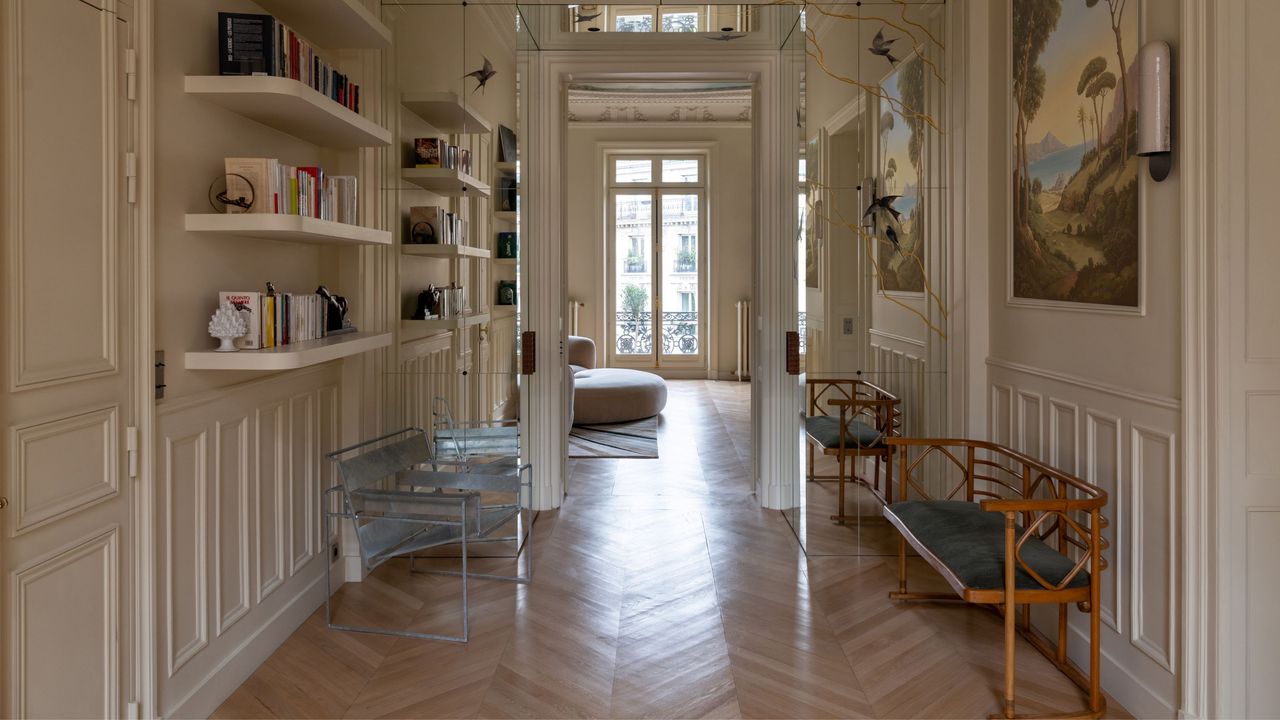
When Giulia Felicani, the Italian-born co-founder of communications agency Com & Stories, relocated from London to Paris with her French partner Hughes, she envisioned settling in a quintessential Parisian modern home. "For me, Haussmann architecture is Paris in a nutshell," she explains. "So when I imagined living here, I pictured beautiful moldings, generous proportions, high ceilings, and a sense of timeless elegance."
If there's one neighborhood that embodies all of this, capturing the essence of Paris-style decor, it's the 8th arrondissement — an area long associated with the city's bourgeois heritage and landmarks such as La Madeleine and the Opéra Garnier.
"We loved that Belle Époque spirit, but honestly, the choice for this location was driven by more personal reasons," Felicani explains. For starters, the proximity to Parc Monceau and its beautiful gardens, and a desire to remain within walking distance of the city center without being immersed in the intensity of central Paris.

London, though, didn't leave Felicani quite so easily. Instead, it seeped into many stylistic decisions she took alongside Charlotte Petit, founder of ARGIA Architecture, known for her sensory and curatorial approach to spaces.
"Living in London taught me to embrace color, personality, and bold design choices," says Felicani. "London interiors are often less constrained by convention and more willing to take risks."
Those risks are visible throughout the home; in the lacquered and mirrored surfaces that double as architectural tools, extending perspectives and multiplying light, in the unexpected material combinations, in the shapes that surprise.
But first, Petit took a close look at the apartment's flow. "Previous interventions had fragmented some of the spaces and diminished the clarity of the original layout. Here, I paid particular attention to the quality of the light, the circulation between rooms, and the visual connections throughout the apartment."
At the beginning, she was joined by interior architect Marie-Sophie Roussel, whose contribution to the spatial reorganization was, as Felicani puts it, invaluable. "What was so rewarding was the constant exchange between all parties involved. It truly felt like a collaborative creative process."
Together, they reimagined the whole home as a sequence of visual experiences, an approach shaped in part by Petit's time at the Musée d'Orsay. "After training at the Ateliers Saint-Luc in Brussels, that period at the museum taught me to approach interiors almost as a form of scenography," shares the designer.
The entrance acts as a prologue: a mirrored archway that immediately extends the perspectives and creates an unexpected sense of depth.
Later, Felicani commissioned an artist to paint birds onto the mirrors, creating the illusion that they float through the reflections. Petit also introduced a figurative painting by Roman artist Luca Morelli into the entrance. "I love it when art is not simply added to an interior but becomes an integral part of its architecture and identity," she says.
What follows is an intimate reception room, and then, at the heart of the home, a deep green lacquered kitchen with a large pendant floating above: a dramatic reveal at the end of the entrance axis. Many people who walk in, Felicani attests, pause for a moment and gasp.
The living room offers a softer counterpoint: curved lines, a calmer palette, and an art collection that gets to breathe. The dining room shifts the mood again: richer materials, a sculptural marble table, both elegant and bold.
As you move into the private spaces, everything softens. Until the bathroom, where a theatrical spirit re-emerges: a bathtub inside an almost cinematic colored capsule, and a marble washbasin carved in the shape of a shell.
"Why should a bathroom not be a bit theatrical instead of purely functional?" Felicani asks. "Growing up in Rome, I learned that a home should be joyful and expressive. Spaces should not always behave exactly as expected."
Yet for all the rich detail, Petit is clear that decoration was never the point. "It's part of a broader architectural composition; all these gestures make sense within the space and the history of the space." Heritage was a key component, or better yet, such was the dialogue between history and the future.
"We should always remember where we come from while remaining open to new ideas. Ultimately, a home should tell a story about the people who live there. It should reflect their identity and their memories," the designer explains. In this case, it leaves margin for quirky anecdotes, too, as the apartment previously belonged to the Montgolfier family, the inventors of the hot air balloon.
One original architectural element they were adamant to preserve was the frescoes in the primary bedroom. Partially concealed over time, restoring them became one of the defining gestures of the project.
"We reorganized the entire space around the ceiling rather than treating it as a decorative element," Felicani explains. Even the custom wardrobes were designed to remain open at the top so that the fresco could be appreciated in its entirety.
"What I find so beautiful about these historical details is that they carry memory," she says. "They connect us to the people who lived here before and remind us that architecture is always part of a larger legacy."


For more inspiring home tours and design ideas, subscribe to the Livingetc newsletter, and all the latest will be delivered directly to your inbox.