
Get all your news in one place.
100's of premium titles.
One app.
Start reading
Woman & Home
Woman & Home
Lifestyle
Grace Walsh

This simple exercise targets more muscles than planks and lunges, and it's great for core strength - here's how to do it

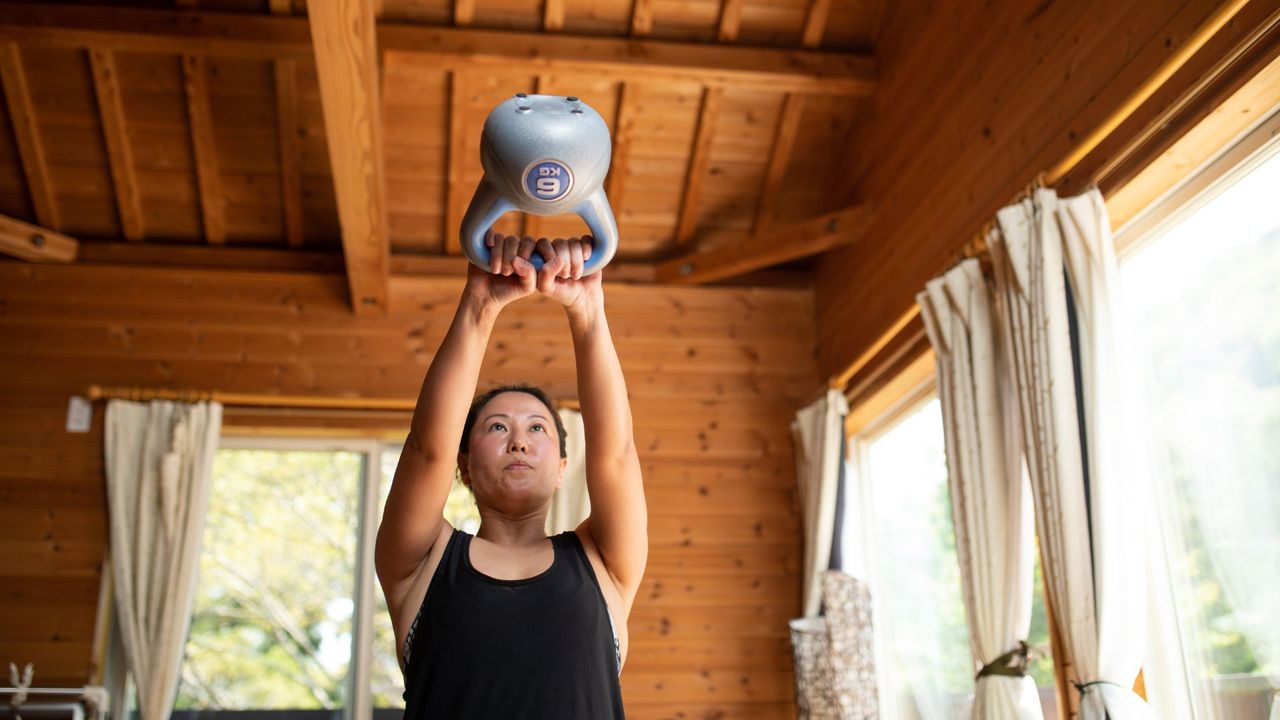
Woman doing kettlebell swing at home.

If you're short on time or motivation, you'll want movements like the kettlebell swing in your strength training routine that use multiple muscles at the same time. All you need is a kettlebell and some space to do it.

I counted up the muscles used in this exercise myself with a pen and paper. A modest estimation would suggest that this one exercise uses 15 of them, if not more, from the core to the shoulders to the glutes, and even the calves.

That means that you can get more for your time and effort with this exercise than you might with others. While the lunge is a great quadriceps or glute exercise and the plank is a go-to for building core strength, the kettlebell swing also uses these muscles - and many more.

What is the kettlebell swing?

The kettlebell swing is one of the most effective exercises for strengthening the hamstrings, glutes, lower back, and core, says Marcus Prestegård, a certified strength and conditioning coach at Dabbs Fitness.

It involves holding a kettlebell and swinging it up using your glutes and hips to launch it, rather than your arms. But, as your arms, shoulders, and back all need to be prepared for the load, it's considered one of the best full-body movements.

"The kettlebell swing also teaches the hip hinge pattern, one of the most fundamental movement patterns in training," he says. "Get that pattern ingrained and everything else improves around it."

How to do the kettlebell swing correctly

  • Stand with your feet shoulder-width apart with your kettlebell an arms' length in front of you.
  • Keep your spine neutral, pull your shoulder blades back and down, and sit back (as if you're doing a squat) to grab the kettlebell handle.
  • Pull the weight between your legs, closer to your hips than your knees.
  • Drive your hips forward, let the kettlebell swing forward to about chest level. You should now be standing up straight with the weight.
  • Keep your arms relaxed but straight, squeeze your glutes and lock out your knees.
  • Allow the kettlebell to fall back down between your legs on its own, hinging at your hips when it reaches in line with your thighs.
  • Repeat the movement.

How heavy should the kettlebell be?

Start with a weight that's about 30% of your body weight. It should feel like a challenge in your kettlebell workout, but you need to be able to keep the proper form.

The key to a good kettlebell swing is also using a weight that's heavy enough. Most people go too light, fearful that they'll injure themselves. However, if you go too light, you won't get the benefits.

What are the benefits of kettlebell swings?

  • Improves power: Power in the body, improved with explosive movements like the kettlebell swing, is essential for healthy ageing. It allows us to move quickly in everyday settings, like getting up from a chair, climbing stairs, and recovering quickly from tripping, so it doesn't turn into a fall.
  • Strengthens muscle and bone: With every swing, you put your bones through a force that triggers the body to create more cells, increasing bone density. The same goes for the strain, growth and repair needed to build muscle.
  • Raises the heart rate: Not keen on a walking workout today? Try kettlebell swings. "It's also a high-output, full-body movement that spikes the heart rate," explains Marcus. "I recommend shorter, sharper bursts so technique remains good."
  • Improves grip strength: Recent research published in Frontiers in Medicine has shown that grip strength is a key marker of healthy ageing. The stronger your grip, the longer you're likely to live. It's also a good idea to improve it for daily tasks like carrying shopping.
  • Also useful as a warm-up exercise: "It quickly switches on the nervous system and fires up the posterior chain, priming the body in a way other movements don't," says the personal trainer.

What is a common mistake people make with kettlebell swings?

People often accidentally squat the kettlebell during the swing, says Marcus. "The hips drop, the chest comes up, and the movement falls apart. The swing is a hinge, so the hips drive back, hamstrings load, and the bell moves forward from the hip drive. Not from the arms, not from the back," he warns.

To avoid this common mistake, "relax the shoulders and let the power come from the hips", he says.

"It looks simple. That's the trap. The mechanics are specific enough that most people need coaching to get it right. A few good cues early on make a significant difference to both the safety and the effectiveness of the movement."

Sign up to read this article
Read news from 100's of titles, curated specifically for you.
Already a member? Sign in here
Related Stories
Top stories on inkl right now
One subscription that gives you access to news from hundreds of sites
Already a member? Sign in here
Our Picks
Fourteen days free
Download the app
One app. One membership.
100+ trusted global sources.







