Whitby Abbey was once one of England’s most important Christian sites, so I was surprised to see a few witches and a man wearing demon’s horns exploring the ruins alongside me.
But then again, Whitby takes its darker side seriously. One poster I saw in the back of a pub claimed the town as “Satan’s mini-break”.

That spookiness clearly played on Bram Stoker’s mind when he came here on holiday in 1890.
“Right over the town is the ruin of Whitby Abbey, which was sacked by the Danes,” Mina Harker, one of the main characters in Dracula, writes in her diary. “It is a most noble ruin, of immense size, and full of beautiful and romantic bits; there is a legend that a white lady is seen in one of the windows…”

The atmospheric ruins still brood over the town, and if it hadn’t been for all the real-life supernatural beings on the site, my mind would have created some.
But the abbey isn’t the only part of Whitby to feature in Stoker’s classic novel. He supposedly found the name “Dracula” in the town’s library, and heard talk of a Russian ship which had been wrecked in its harbour a few years earlier.
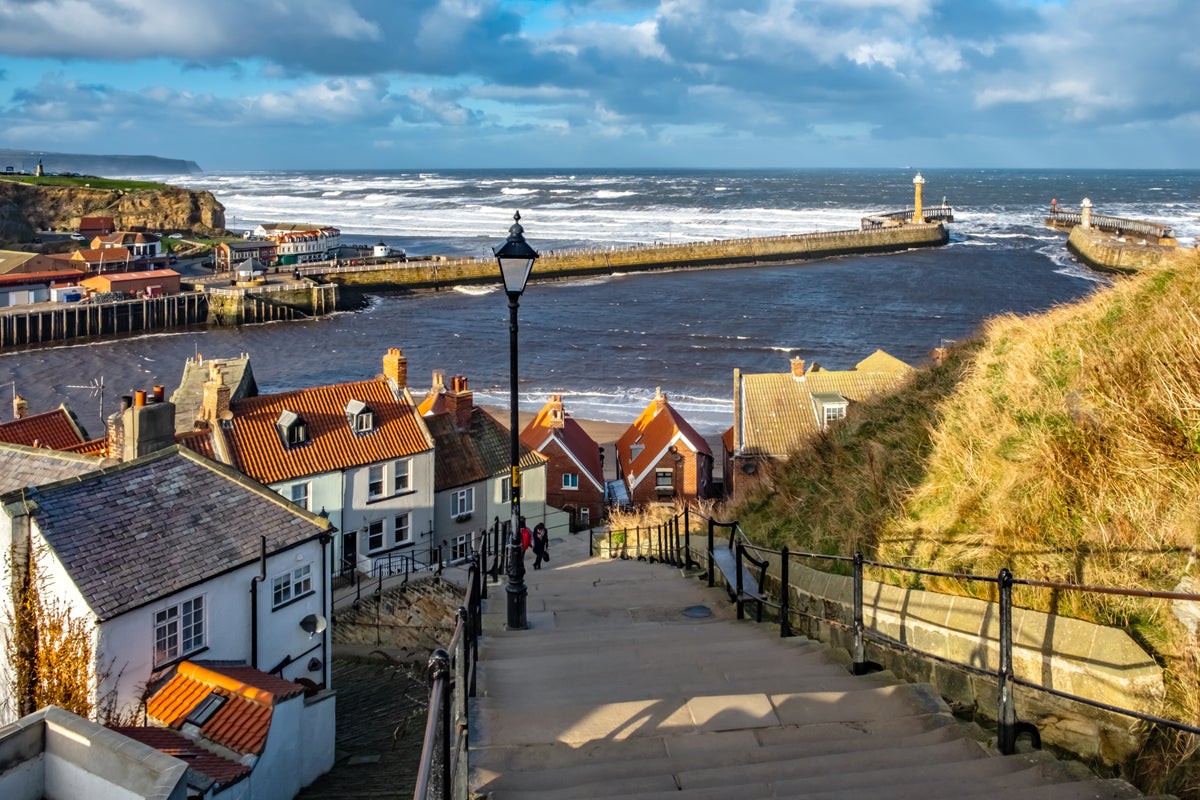
This ship provided the inspiration for the Demeter, on which Dracula arrives in England in the form of a black dog, which leaps onshore and runs up the 199 steps to linger in St Mary’s Churchyard. It is there he claims his first victim on English soil.
Thanks to its association with Dracula, Whitby has been cemented as the premier gothic site in Britain, almost becoming a place of pilgrimage. Since 1995, it has hosted the biannual Whitby Goth Weekend, which has grown to become one of the largest gatherings of the goths in the world. A few thousand people gather during the festival to listen to music or mooch through its stalls.
One young goth, with a magnificent homemade mushroom-shaped hat, told me that it was all about “yearning and mourning”.
“Mary Shelley kept the calcified heart of her husband with her for 30 years after he died. That is goth.”
Walking the streets, you’ll come across a lot of witches, pirates, demons and other strange characters. There’s also a very strong showing from the steampunk scene, a retro-futurist aesthetic with heavy boots, finely decorated coats and big goggles.
The festival also attracts a bunch of “goth spotters” who just come to look at the amazing outfits. Some of the costumes are beautiful, others genuinely freaky. I saw one man with such a realistic zombie mask that the oozing wounds on his face almost invited you to check that they weren’t real. Almost.

Read more: This much-maligned city is secretly the most cultural spot in the UK
The steps which lead up to the abbey become a kind of giant vertical catwalk during the weekend. Looking across from the other side of the valley, it looks like one big great black line snaking up the side of the cliff.
“I just like the individuality of it all,” one repeat visitor told us. “People can come here and be themselves.”
Visitors don’t need to come during the festival to experience the town’s unusual side, though. In the Whitby Museum is the “hand of glory”, an apparently mummified hand of a hanged man, discovered in 1922. The local wisdom is that the appendage could be used to put victims of robbery into a trance. That might not be true, but its grey, shrivelled form is something to behold.
If it’s the paranormal you’re after, Red Hat Ghost Walks run year-round, wheelchair-accessible tours of the town. A must-see spot is the “screaming tunnel” – an alleyway in which people report seeing dark, shadowy figures and hearing otherworldly shrieks. It offers, incidentally, unrivalled views of the abbey.
Despite the strangeness, Whitby has an undeniably lively atmosphere. I’ve never faced a longer queue for a beer than at Whitby Brewery, an excellent spot just over the road from the abbey. There’s the White Horse and Griffin, too, a traditional pub and hotel, which is – you guessed it – also rumoured to be haunted. Even the Tripadvisor reviews feature tales of spooky encounters.

For something more worldly, wander past the red-roofed Fortune’s Smokehouse – the last remaining smokehouse in the harbour. Five generations of herring fishermen have worked out of the space and their cured kippers make for a suitably eccentric souvenir. And as this is a seaside town, you could do worse than to tuck into the fish and chips (try the award-winning Mister Chips by the beach.)
For something even more apt, visit one of the charmingly idiosyncratic independent shops – Pandemonium is a prime example – which sell gothic accessories and costumes. Or visit one of the many jewellers, who craft rings and necklaces out of Whitby jet: a black “gemstone” made of fossilised driftwood. Ebor Jetworks comes highly recommended.
It is not just in the town itself where the boundaries between the human and the strange seem a little blurred. On Saturday morning I walked up the coast to Sandsend and then inland to the ruins of Mulgrave Castle.

Read more: The most beautiful places in London you have to visit
The remains date to the 13th century, but local legends suggest that the existing castle stands on the site of an earlier structure built by a giant named Wade, who is connected to a number of different sites across this part of Yorkshire. Elsewhere in the forest, a fairy named Jeannie is supposed to live in a cave, casting curses on passing men who disturb her.
I didn’t find Jeannie, nor did I see any signs of Wade. Perhaps they’d both gone into Whitby for the weekend. And that was the beauty of it. So often, the strongest feelings of enchantment come from stepping away from a busy settlement. But at Whitby, the supernatural was thrust into the heart of the town. It had become human.
How to do it
Whitby can be a challenging place to get to by public transport. Northern Rail runs a service from Middlesbrough multiple times a day on weekdays but less regularly on weekends. From London, I recommend taking a train to York and then a bus over the North York Moors, which is a great way to ease into the atmosphere of the area. And at £3 for a two-hour journey, its also fantastic value.
Where to stay
I stayed at Union Place, a beautiful Georgian townhouse a few minutes walk from the centre of Whitby. Richard, the owner, is an artist. If you’re lucky, he might show you his studio. There’s also two dogs in the property, which (for me) made the whole experience doubly homely.
Union Place has rooms for two from £90 per night on a B&B basis.
Culture, music and Mersey views – how to discover Liverpool’s accessible side
Why the Caledonian Sleeper train is Britain’s contender for world’s greatest rail journey
Seven castles in the UK for a Traitors-style getaway
Independent Travel’s Go-To Guide for 2026