
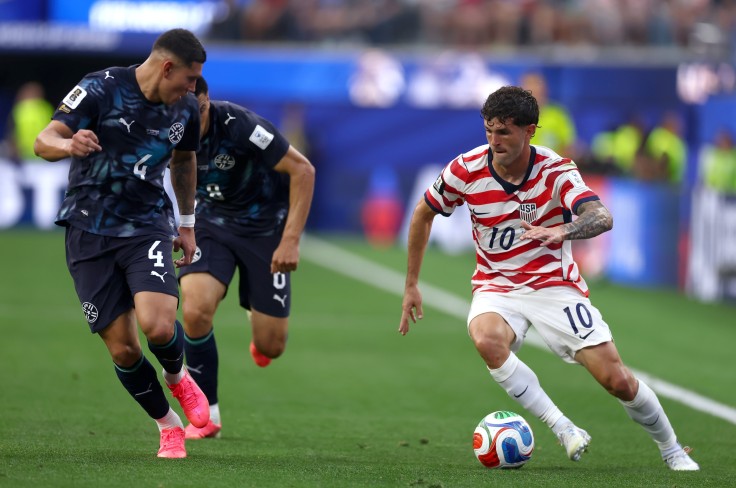
Two weeks ago, we named 10 dark-horse nations capable of crashing the party at the 2026 World Cup. The group stage has now returned its verdict, and it wasn't kind to everyone on that list. Uruguay are out, beaten 1-0 by Spain in their final group game and unable to climb out of the third-place reckoning. Türkiye are out too, sunk by defeats to Australia and Paraguay before a meaningless 3-2 win over an already-qualified USMNT. Croatia survived, but barely, and now meet Portugal in a Round of 32 tie few expect them to win.
The other seven dark horses are alive. One of them, in particular, looks less like a surprise package now and more like a genuine threat to win the whole thing.

The dark horse with the best shot: Morocco
Of the seven survivors, Morocco have the cleanest path and the most complete profile. They finished second in Group C without losing — their only dropped points coming in a 1-1 draw with Brazil — though a 4-2 final-day win over Haiti, in which they twice fell behind, showed the back line can still be rattled. Their reward is a Round of 32 date with the Netherlands: tough on paper, but Morocco have already shown at this tournament and the last that they don't fear favorites. The spine built around Yassine Bounou and Achraf Hakimi remains the foundation, and the arrival of Brahim Díaz has handed Mohamed Ouahbi's side a final-third gear the 2022 vintage lacked.
What separates Morocco from the rest of this list isn't only talent, it's resilience. Norway can detonate any match through Erling Haaland, but they're still a young side learning what knockout soccer feels like. Japan have the system to trouble anyone but lost their most creative attacker to injury. Ecuador's defense is elite, yet a team that scored sparingly in qualifying will eventually need goals against an opponent that won't sit deep. Morocco pair real fight with enough attacking quality now to punish teams. If one dark horse reaches the semifinals, the smart money says it's them.
Where the rest of the group stands
Norway topped expectations in pure spectacle — Haaland racked up four goals across their first two games before sitting out a heavily rotated finale — and now face Ivory Coast, a side with more talent than its ranking suggests, in the Round of 32. Japan finished second in Group F and drew Brazil, the toughest possible assignment for a team still adjusting to life without Kaoru Mitoma. Switzerland topped Group B and were handed Algeria, a winnable tie, with the Colombia–Ghana winner waiting in the Round of 16 if they advance. Ecuador snuck through as a third-place qualifier and now meet co-host Mexico in Mexico City, arguably the single hardest draw on the entire bracket. Colombia topped Group K and will fancy their chances against Ghana. Croatia advanced as Group L runners-up but drew Portugal, a side buoyed by Cristiano Ronaldo rediscovering his scoring touch. The USMNT topped Group D and face Bosnia and Herzegovina as heavy favorites — a winnable tie that sets up a likely Round of 16 meeting with the winner of Belgium and Senegal.
Round of 32 predictions: all 16 matches
| Match | Pick to advance |
|---|---|
| South Africa vs. Canada | Canada |
| Brazil vs. Japan | Brazil |
| Germany vs. Paraguay | Germany |
| Netherlands vs. Morocco | Morocco |
| Ivory Coast vs. Norway | Norway |
| France vs. Sweden | France |
| Mexico vs. Ecuador | Mexico |
| England vs. Congo DR | England |
| Belgium vs. Senegal | Belgium |
| USA vs. Bosnia and Herzegovina | USA |
| Spain vs. Austria | Spain |
| Portugal vs. Croatia | Portugal |
| Switzerland vs. Algeria | Switzerland |
| Australia vs. Egypt | Egypt |
| Argentina vs. Cape Verde | Argentina |
| Colombia vs. Ghana | Colombia |
A few of these are near coin flips. Norway–Ivory Coast and Colombia–Ghana both pit a gifted underdog against a side that should be favored on paper but hasn't proven it under pressure. The USMNT–Bosnia tie looks the most lopsided of the round, given the hosts' home-soil edge and Bosnia's slim goal difference. Mexico–Ecuador might be the best fixture of the lot: a red-hot co-host against the tournament's stingiest defense.
The star turn nobody saw coming
While Messi, Mbappé and Haaland have dominated the Golden Boot chatter, the quietest standout of the group stage belongs to Folarin Balogun. The USMNT striker scored twice in his side's tournament-opening win and became the first American to record a multi-goal game at a World Cup since 1930, then backed it up with another influential shift against Australia. He isn't the most decorated name on the American roster, but he's been the most productive.
Right alongside him is Deniz Undav, the 29-year-old Stuttgart forward who arrived as an afterthought behind Germany's bigger names and has instead become one of the side's most dangerous attackers, with goal involvements in each of his first two appearances. And in Japan's camp, Ayase Ueda became the first Japanese player to score twice in a single World Cup match, filling the void left by Mitoma's injury more capably than anyone expected.
The stars living up to the hype — and the ones still searching
There's no other way to put it: Lionel Messi has been the story of the tournament. He turned 39 during the group stage and still became the all-time leading men's scorer in World Cup history, posting a hat trick against Algeria and a brace against Austria to reach 18, looking like the best player at the event he's graced for two decades. Kylian Mbappé has kept pace, breaking France's all-time World Cup scoring record and reinforcing his standing as the Golden Boot heir apparent. Erling Haaland has been exactly as advertised, scoring in both of his first two World Cup appearances and looking like the most physically dominant forward in the field, even with Norway resting him late in group play.
Not everyone has matched the moment. Harry Kane has goals on the board — and became England's all-time World Cup top scorer — but the Three Lions have looked toothless in stretches, including a scoreless draw with Ghana that exposed real concerns heading into the knockouts. Mohamed Salah has a goal to his name but hasn't found his rhythm, Egypt's attack has been inconsistent, and Salah now carries a hamstring knock from the Iran finale. The bigger worry, though, is Brazil: Vinícius Júnior conjured a stunning equalizer against Morocco but has long been more decisive for his club than his country, and with Neymar managing his fitness, the pressure on Brazil's attack to deliver in the knockouts is enormous. Cristiano Ronaldo started slowly before finally finding the net — twice — against Uzbekistan, but at 41, in what is almost certainly his final World Cup, questions linger about how much he has left for a deep run.
The group stage handed us chaos, records and a few genuine surprises. The knockout rounds, starting now, are where dark horses either become legends or go home telling their grandkids about it.
s been the story of the tournament. He turned 39 during the group stage and still became the all-time leading men's scorer in World Cup history, posting a hat trick against Algeria and a brace against Austria to reach 18, looking like the best player at the event he's graced for two decades. Kylian Mbappé has kept pace, breaking France's all-time World Cup scoring record and reinforcing his standing as the Golden Boot heir apparent. Erling Haaland has been exactly as advertised, scoring in both of his first two World Cup appearances and looking like the most physically dominant forward in the field, even with Norway resting him late in group play.
Not everyone has matched the moment. Harry Kane has goals on the board — and became England's all-time World Cup top scorer — but the Three Lions have looked toothless in stretches, including a scoreless draw with Ghana that exposed real concerns heading into the knockouts. Mohamed Salah has a goal to his name but hasn't found his rhythm, Egypt's attack has been inconsistent, and Salah now carries a hamstring knock from the Iran finale. The bigger worry, though, is Brazil: Vinícius Júnior conjured a stunning equalizer against Morocco but has long been more decisive for his club than his country, and with Neymar managing his fitness, the pressure on Brazil's attack to deliver in the knockouts is enormous. Cristiano Ronaldo started slowly before finally finding the net — twice — against Uzbekistan, but at 41, in what is almost certainly his final World Cup, questions linger about how much he has left for a deep run.
The group stage handed us chaos, records and a few genuine surprises. The knockout rounds, starting now, are where dark horses either become legends or go home telling their grandkids about it.







