
Get all your news in one place.
100’s of premium titles.
One app.
Start reading
GamesRadar
GamesRadar
Technology
Christian Hoffer

This Lord of the Rings card game is a puzzle-solving masterclass

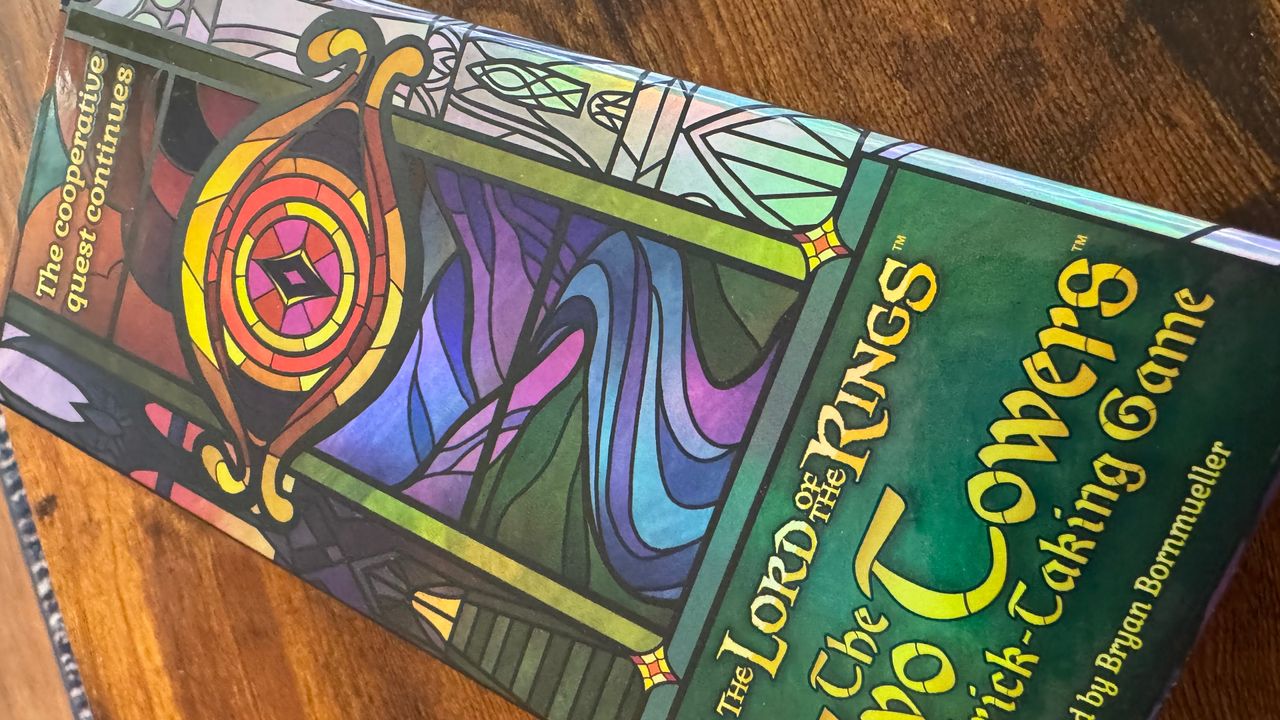
The Two Towers Trick-Taking Game box lying on a wooden surface.

One of the hottest tabletop games of 2025 was the Fellowship of the Ring Trick-Taking Game, a cooperative campaign-style project by Bryan Bornmueller and Office Dog. Given that the game only covered a third of the expansive Lord of the Rings novels, it was inevitable that a sequel game would be published, especially since the first was so popular. Due out in early 2026, The Two Towers Trick-Taking Game introduces several new wrinkles to a familiar gameplay cycle, with enough variance that each round feels fresh and exciting. Every new addition added to various chapters feels like a natural progression of gameplay, with even subtle changes layering more strategy to each round.

While it'll be a better experience all-round if you've played the first one, The Two Towers Trick-Taking Game is still an adventure worth going on if you're a fan of the best board games.

The Two Towers Trick-Taking Game features & design

Price

$27.99/£24.99

Ages

10+

Game type

Cooperative/trick-taking

Players

1-4

Lasts

30mins

Complexity

Low

Designers

Bryan Bornmueller

Publisher

Office Dog

Play if you enjoy

Fellowship of the Ring Trick-Taking Game, Fox in the Forest

  • A trick-taking game, e.g. submit the highest-value card to win a round
  • Part two of a series, but can be played standalone
  • Revisits the same unique stained-glass aesthetic

The Two Towers Trick-Taking Game is divided into chapters. The narrow box for the game is split into three sections, with players adding new cards (typically character cards and descriptive chapter cards) as they prepare for the next round of play. There are a handful of tokens that eventually get added as well, primarily serving as visual cues to represent who has what critical card or whether or not a certain suit can be used in play yet. Each component is made of plastic, which means they’re sturdy and won’t degrade from constant use.

The cards themselves utilize a stained-glass aesthetic with unique designs for the various Lord of the Rings characters. These designs aren’t based on the Peter Jackson movies, but rather are uniquely designed based on their descriptions from the books. Some characters are instantly recognizable, but fans might be distressed to see a clean-shaven Aragorn as opposed to Viggo Mortensen’s decidedly scruffier visage. Personally, I like that the game keeps to the original books, as it allows for a deeper breadth of characters than what the movies would have allowed for.

(Image credit: Future/Christian Hoffer)

The card quality is standard for an Asmodee game. While the cards themselves are generally sturdy enough to survive frequent shuffling, it’s a wise move to at least sleeve the cards in the deck, as they’ll be used a minimum of eighteen times, not including long chapters where multiple rounds are required or chapters in which players fail and will need to try again. The box also doesn’t have any room for dividers, so players will need to keep the cards organized in between play sessions, especially if they want to eventually re-use the game by playing through it a second time.

Gameplay

(Image credit: Future/Christian Hoffer)
  • A pure cooperative experience (players will need to work together to take tricks)
  • Can be played with 1-4 players, but ideal size is 3-4 players
  • Each character has unique win conditions, with some required to complete each chapter

Every round of the Two Towers Trick-Taking Game begins with players being dealt cards from a deck containing 5 suits (Hills, Mountains, Shadow, Forest, and Orcs) and two special cards – the White Tower and the Black Tower. After the cards are dealt, players choose which character they’ll play as, with each chapter requiring certain characters for completion. Typically, the player holding the White Tower card (and in later chapters, the One Ring card) will be required to play as a certain character. After characters are selected, players can trade cards with restrictions as to whom they can trade with listed on the character card. Once trades are completed, players can proceed into the actual gameplay of the round. Outside of trading and the White Tower card, players aren’t supposed to know what cards the other players have, so limited table talk is recommended.

The gameplay itself is almost identical to the Fellowship of the Ring Trick-Taking Game. The first card played in a trick is the chosen suit and players win a trick by playing the highest numbered card from a suit. While the Fellowship of the Ring Trick-Taking Game (usually) had a single trump card in the form of the One Ring, Two Towers features two trump cards – the White Tower and the Black Tower. While players always know who has the White Tower, the Black Tower’s holder remains hidden until it’s played. This is important as some characters require the holder of the White Tower and the Black Tower to complete certain tasks, so it may be advantageous to use the Black Tower early to get the information out for players as soon as possible.

The road goes ever on
(Image credit: Future/Matt Thrower)

Lord of the Rings fans have been eating well over the past year or so; alongside the Fellowship Trick-Taking Game, The Hobbit: There and Back Again really won us over in 2025. Meanwhile, Fate of the Fellowship caused such a buzz in the community that it was near-impossible to find in stores.

The White Tower and the Black Tower cards are by their nature more powerful than the One Ring card that dominated the Fellowship of the Ring Trick-Taking Game. Neither card is limited by a suit restriction, so they can be played at any time during a round. There are some wrinkles to what happens if a Tower card is played first or what happens if both cards are played at the same time, but those rules are pretty easy to remember and rarely happen during gameplay.

The other new wrinkle in the game are Orc cards, which are dead cards that can’t be led with at any time. Orc cards follow the other rules of the game. Since they’re always off-suit, they can only be played when a player has no cards of the lead suit in their hand. This means that Orcs typically are held in the hand until late into a round, when options become more and more limited. If a player has to lead with an Orc at any time, the players automatically lose the round, which becomes especially tricky if a player has multiple orcs in their hand late in the game. The presence of Orcs adds an auto-lose condition to every round, adding an additional subtle layer of strategy. Of course, some characters also require players to take tricks containing a certain amount of orcs, so players will occasionally need to save orcs for the right point in time.

While characters are the most frequent way that chapters feel different from one another, there are other wrinkles that the game adds during set-ups. Some chapters add new cards to the deck, while others feature “long” chapters that require multiple successful rounds to complete. Eventually, other cards such as the One Ring card from the Fellowship of the Rings Trick-Taking Game also come into play, as well as new burden tokens that replace the Threat cards from the previous game. All of these wrinkles are properly laid out in the chapter cards, with some further elaboration provided in an instruction booklet that contains a chapter-by-chapter FAQ that covers just about any question you might have.

(Image credit: Future/Christian Hoffer)

The key to the Two Towers Trick-Taking Game is being able to hand over “control” to other players. The lead player has a built-in advantage of dictating which suit to lead with, so a good strategy is to complete your character’s objective and then pass off control to another player by playing a weak lead card. The biggest frustration in the game is when, especially in later chapters, a round is ruined when one player has a less than ideal hand and a character with a difficult victory completion. Because of the limitations on trades, there are few ways to mitigate a bad hand of cards, which can result in multiple replays through a round.

The good news is that rounds of the game move fast, so players shouldn’t be too frustrated if they’re dealt a poor hand. Most short chapters take about fifteen minutes or less to complete and there’s almost no setup time, since the game consists of a deck of cards and a few tokens. The ease of setup comes into handy in later chapters, as you will eventually need to replay rounds as the win conditions become harder and harder to complete.

While the game supports 1-4 players, it’s recommended you play the game with at least three players. A two-person game involves the use of a card pyramid that’s laid out on the table and is controlled by the first player to choose a character. Players still have to complete the card pyramid’s victory condition, but they are limited to what cards they can play based on what cards are uncovered on the pyramid. This mode is fine, but it’s far inferior to having three or four players trying to get in sync and conquer a round together. In other words, this is not one of the best 2-player board games.

Should you buy The Two Towers Trick-Taking Game?

(Image credit: Future/Christian Hoffer)

The Fellowship Trick-Taking Game was one of my favorites of 2025, and The Two Towers Trick-Taking Game effortlessly builds on that foundation and finds new ways to surprise and challenge players. The only reason I can’t call the Two Towers a unique experience is because it feels so similar to its predecessor. That’s not necessarily a bad thing – I think the cooperative trick-taking format lends itself to a lot of variability and wrinkles, and these games make sure that every last nook and cranny is explored in detail. However, I do think that players should start with Fellowship of the Ring Trick-Taking Game first and then move on to the Two Towers after completing those challenges.

Ratings

Criteria

Notes

Score

Game mechanics

Simple to play through, the game offers a barrage of variables that keeps rounds challenging without significantly veering from a familiar norm.

5/5

Accessibility

Anyone who’s ever played a trick-taking game can pick this game up, regardless of their LotR fandom.

5/5

Replayability

The campaign mode is the true star here, with 19 chapters to progress through. There’s an infinite play mode for after the campaign, although you may be spent after playing through the story.

4/5

Setup and pack-down

The game takes almost no time to setup, but players will need to come up with their own organization scheme due to a small box.

4/5

Component quality

The cards are sturdy and the plastic tokens are unlikely to wear throughout the campaign.

5/5

Buy it if...

Don't buy it if...

How we tested The Two Towers Trick-Taking Game

(Image credit: Future/Christian Hoffer)

This review was conducted using a copy provided by the publisher.

As with all of our tabletop reviews, the reviewer made sure to familiarize themselves with the rules before beginning testing (a process made easier by them having tested this game's predecessor beforehand). They then played multiple test-matches with a variety of player counts, all to help them judge the game's longevity and to see how the experience differed with a variety of people.

For a more in-depth look our process, see how we test board games or the full GamesRadar+ reviews policy.


Looking for other recommendations? Don't miss the best adult board games or the best card games.

Sign up to read this article
Read news from 100’s of titles, curated specifically for you.
Already a member? Sign in here
Related Stories
Top stories on inkl right now
One subscription that gives you access to news from hundreds of sites
Already a member? Sign in here
Our Picks
Fourteen days free
Download the app
One app. One membership.
100+ trusted global sources.