
Get all your news in one place.
100's of premium titles.
One app.
Start reading
Space
Space
Science
Robert Lea

This is the largest and most detailed image of our Milky Way — with over 60 million stars and 50 exoplanet systems

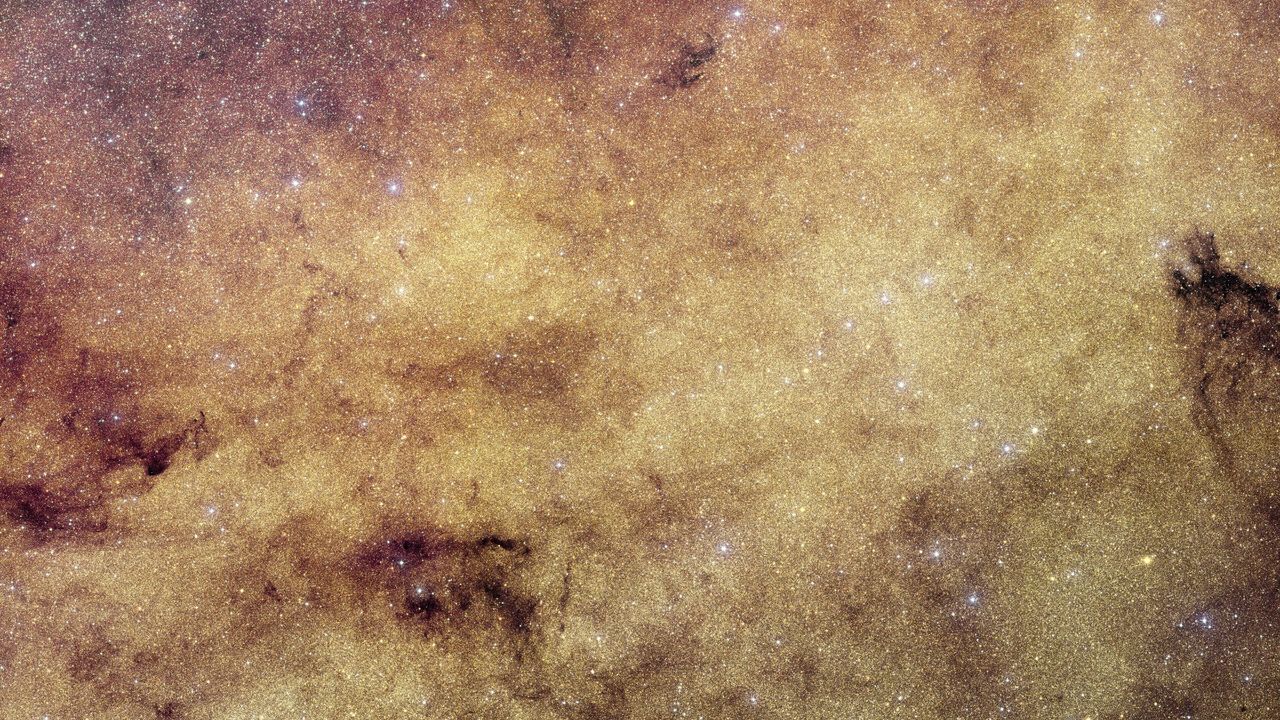
A dense field of glowing stars with cloudy wisps of gas scattered throughout.

In 2025, the European Space Agency dark universe detective spacecraft Euclid turned its attention to the heart of the Milky Way for just 26 hours. In just over one day, Euclid was able to create the largest and most detailed photo of this region of our galaxy ever made.

The image, packed with 60 million stars, could help scientists hunt for extrasolar planets, exoplanets, in this region known as the galactic bulge.

Euclid is designed to study dark energy, the mysterious force that drives the accelerating expansion of the universe, by studying distant galaxies. That means the space telescope is powerful enough to distinguish individual stars in the central bulge of the Milky Way. Other telescopes fail to do this because they are too blinded by the densely packed stars in this region.

The largest high-resolution photo ever made of our Milky Way galaxy's center in visible light. It was taken on March 23, 2025 by the European Space Agency's Euclid space telescope. (Image credit: ESA/Euclid/Euclid Consortium/NASA, CFHT, image processing by J.-C. Cuillandre and E. Bertin (CEA Paris-Saclay))

Euclid was requested to monitor the central bulge of the Milky Way to assist astronomers in the hunt for exoplanets because this is the perfect region for so-called "microlensing" events to occur.

"To catch microlensing, you need to observe parts of the sky that are crowded with stars, such as close to the center of our galaxy," team leader Jean-Philippe Beaulieu of the Institut d'Astrophysique de Paris in France said in a statement.

Microlensing is a weak form of gravitational lensing that occurs when objects with mass cause the very fabric of space to warp. When light from a background source passes through this warping of space, its path is curved. This can be used to study the background source; for example, scientists have used it to great effect with the James Webb Space Telescope (JWST) to study some of the most distant and early galaxies. However, the curvature of light from background sources can also be used to detect faint objects like planets.

The location of Euclid’s new image of the galactic bulge is visible on Gaia’s map of the entire sky. (Image credit: ESA/Euclid/Euclid Consortium/NASA, CFHT, ESA/Gaia/DPAC,image processing by J.-C. Cuillandre and E. Bertin (CEA Paris-Saclay))

Spotting planets using microlensing requires one star to pass in front of another and act as a gravitational lens. The presence of a planet causes a tiny perturbation in the lensing of light from the background star. It's a small effect, but one that has been used very effectively in the detection of exoplanets.

"During the last twenty years, almost 300 exoplanets have been discovered using this technique, all with ground-based telescopes and all towards the center of our galaxy," Beaulieu said. "This image from Euclid includes 51 known planetary systems – and it will assist in studying many more that will be found."

This infographic places Euclid’s galactic bulge survey in the broader context of the Milky Way’s structure, using data from ESA’s Gaia mission. (Image credit: Euclid images: ESA/Euclid/Euclid Consortium/NASA, CFHT, image processing by J.-C. Cuillandre and E. Bertin (CEA Paris-Saclay); Milky Way artist impressions: ESA/Gaia/DPAC, Stefan Payne-Wardenaar))

Despite Euclid's study of the central bulge pointing the way forward in observing new microlensing events, there are no such events in the data from the ESA spacecraft. That is because detecting such events takes around 20 days.

Instead, it will be up to telescopes like the forthcoming Nancy Grace Roman Space Telescope to observe this region for longer periods and compare with this day's worth of Euclid data to find microlensing events.

"In 24 hours, Euclid has already captured the stars involved in all the future microlensing events that the Roman space telescope will detect, but before the stars and planets involved have aligned," team member Natalia Rektsini of the Institut d'Astrophysique de Paris said.

"This means that anyone who detects a microlensing event in the same region, for example, with Roman, will be able from now on to use Euclid data as a time reference in the past and see how the stars looked before they overlapped. Since Euclid can clearly separate individual stars, one can then measure how fast they move over time and use that information to confirm the existence of a planet and determine its mass. This would not be possible with data from one point in time."

A diagram shows how microlensing can be used to detect planets (Image credit: ESA)

One reason this is so exciting to exoplanet hunters is that other techniques used to spot these distant worlds tend to excel at detecting hot and massive planets close to their host stars.

Microlensing, however, can be used to detect more diminutive planets much farther from their host stars and with chillier temperatures. That means it could be used to detect ice giants like Uranus and Neptune in wide orbits around central bulge stars.

"This result shows what a relatively small, dedicated team can achieve within a large international mission," says Valeria Pettorino, Euclid Project Scientist at ESA.

"That's why this Euclid data will be a time reference for past and future missions and enable studies of exoplanets and their masses. This data can also be used for other scientific applications, from brown dwarfs and binary stars to stellar motions and dust across our galaxy."

Sign up to read this article
Read news from 100's of titles, curated specifically for you.
Already a member? Sign in here
Related Stories
Top stories on inkl right now
One subscription that gives you access to news from hundreds of sites
Already a member? Sign in here
Our Picks
Fourteen days free
Download the app
One app. One membership.
100+ trusted global sources.