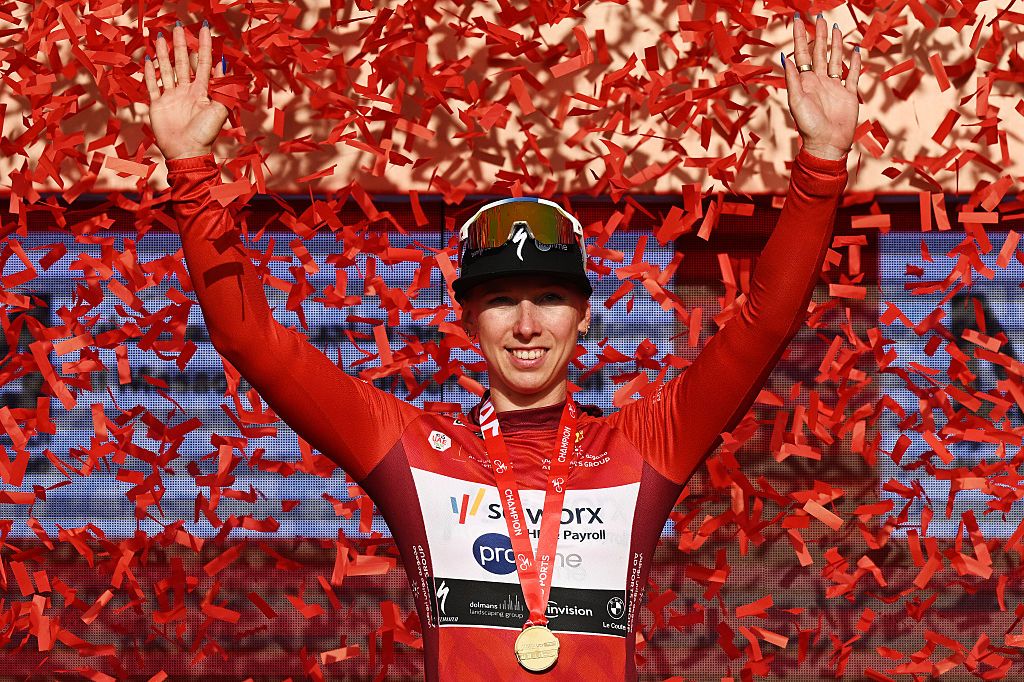
Lorena Wiebes (SD Worx-Protime) continued her string of sprint victories on stage 1 of the UAE Tour Women, emerging on the final 100 metres to win the opening stage for the third time in a row.
Wiebes is now unbeaten in a sprint since July 2024, but a new season always starts with a clean slate, and winning her first race gives the 26-year-old confidence for the challenges to come in 2026.

"As a sprinter in general, you need to have a bit of confidence. Of course, it helps when you have good numbers in training with sprints. But then you still don't know what the others in the peloton are doing. That's why it's also important to start the first sprint of the season in a good way, it gives you more confidence for the upcoming races," Wiebes told Cyclingnews at the press conference after the stage.
In the final, the SD Worx-Protime team had chosen to use its strength to keep Wiebes and Barbara Guarischi at the front going into the final kilometres and let the two riders make their decisions from there instead of trying to go head-to-head with the other lead-out trains.
"It was pretty hectic, but that's always the case with the first sprinting stage. When UAE and the other teams passed on the right side, the chaos began a bit, but I still followed Barbara. She started her sprint early, but I could be in the wheel of Gillespie, and luckily I still had some space on the left side. First, I thought I'd go right, and that didn't work out, so I went back to the left and then I had space to go, that was the most important," Wiebes explained the final kilometre.
The importance of trust and communication between a sprinter and her lead-out rider is hard to overstate. Usually, Wiebes is happy to follow Guarischi's moves, but in Madinat Zayed, she decided to sit back when the Italian opened up.
"I was like, 'I think it's a bit too early', because it was more than 500 meters to go, so I kind of let her go. But I know that she's doing the right things. That's the trust I have in her. And at the end, I can also find my own way if they put me in the right spot," said Wiebes.
These decisions must be made in split seconds and at high speed, making bunch sprints a mental challenge almost as much as a physical one.
"You try to focus on a couple of things. With this sprint, I also needed to focus on how many metres it was to the finish. I almost wanted to start my sprint, and I was like, 'It's still 250 [metres] to go' in a headwind sprint. You need to focus on quite a lot of things, and it's going quite fast at the end," the Dutchwoman said.
Before she could ready herself for the sprint, Wiebes had to get through a stage through the windswept desert where she had to be prepared for echelon action.
"You keep an eye on the points where there can be crosswinds. I saw that there was a chance of crosswinds after 30 kilometres, but it didn't really work out. But directly from kilometres zero, there was a lot of nervousness in the peloton. That's always a bit harder, there's a higher chance of crashes, it's just a lot of chaos, and that's why you need to stay a bit more sharp to keep the focus. It's really hard to plan also with the sprint finish 10 kilometres straight. This is one of the harder sprint stages to do," she finished.