Get all your news in one place.
100’s of premium titles.
One app.
Start reading
Digital Camera World
Peter Travers

This is how I photograph gritty portraits like an award-winning TV crime show using filters & flash!

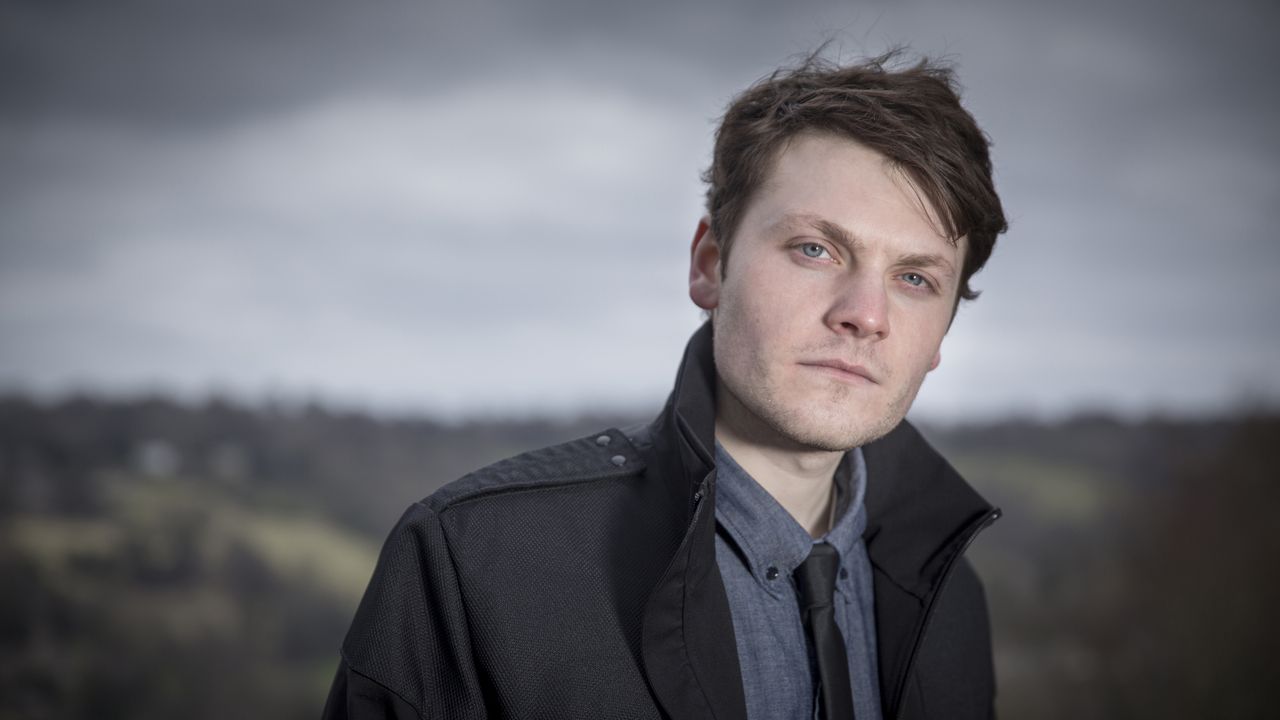
White man with dark hair, shirt and tie and black jacket, posing against a backdrop of a hillside and sky.

Have you ever wondered how streamers like Netflix and Amazon create those dramatic portraits of the stars in their thrillers? You know, the ones of the grizzled detective in a moody scene, where the actor is well lit, but the background is somehow both dark and blurry?

Well, you don't need a visual artist or illustrator – or any AI! – just the right camera techniques, and the right lens, a flashgun, and ND (Neutral Density) filter...

Portrait shot with an EF 24-70mm f/2.8L II USM at 70mm: at f/2.8 with no flash and no ND filter  (Image credit: Peter Travers)

So, what’s the best way to shoot portraits in daylight? Use a long focal length and wide aperture to blur the backgrounds so the subject stands out? Or what about if you want to use some fill flash and underexpose the background for extra contrast and drama?

If you use a wide aperture for a shallow depth of field to blur the background behind your subject in even lighting, you may have to accept annoying shadows on their faces, and the backdrop will be much the same brightness as your subject as well. As our example above illustrates.

Portrait shot with an EF 24-70mm f/2.8L II USM at 70mm: at f/9 with flash but no ND filter. The face is a bit brighter, but at f/9 the background isn't as blurry so more distracting.  (Image credit: Peter Travers)

If you use flash you can fill in shadows on faces. But with your camera’s maximum flash sync speed of around 1/200 sec, you’ll need to shoot at an aperture of around f/9 or more if you want to underexpose and darken the background in broad daylight – and at that aperture the depth of field increases and this means the background isn’t that blurred, and so your subject doesn’t stand out as well (see above example shot).

But what if we could combine a wide aperture and flash to capture both a dark and blurred background? Well, by using an ND filter on our lens, we can!

We have a winner! Portrait shot with an EF 24-70mm f/2.8L II USM at 70mm: at f/2.8 with flash and an ND filter! The face is well lit, and now the background is both dark and blurry. (Image credit: Peter Travers)

By adding an ND filter to your lens, it reduces the amount of light reaching the sensor, which means we can use a wide aperture but still keep the background dark.

With an ND filter attached to our fast Canon EF 24-70mm f/2.8L USM lens, on our overcast day we could we can shoot at f/2.8 and 1/160 sec to blur the background and, crucially, to darken it too.

Plus by using a flashgun to brighten up our subject, it will separate him or her from the background, creating a really dramatic and dark portrait – a look that’s popular with gritty TV shows and films on Netflix, Amazon, HBO, Apple TV, Sky, ITV, and the BBC.

I used a Manfrotto 3-stop ND filter. Choose the correct filter size for your lens: for our EF 24-70mm f/2.8 lens we needed one with an an 82mm filter thread (Image credit: Peter Travers)

With an ND filter on your lens, for a dramatic portrait we need to set an exposure so the background is dark and contrasts with our subject. We were shooting on
an overcast day so our exposure was f/2.8 and 1/100 sec, with the ISO set to 320 to ensure the flash was bright enough on our subject.

We added a softbox diffuser for softer light. To create moody side-light rather than boring straight-on flash, we’ve used triggers and flash on a stand to one side of our subject. As the ND filter cuts the light reaching the sensor, we need to set out flashguns to full power to light our subject’s face effectively.

Older DSLRs may struggle to focus when using an ND filter, whereas newer mirrorless shouldn't have the same problem (Image credit: Peter Travers)

With our lights and exposure set up perfectly, now it’s just a case of focusing accurately, working on our composition and getting our subject to pose for a great shot. We encouraged our subject to have a moody expression, and found shooting against the under-exposed sky worked well together.

Choose a subject who is good at looking moody - such as people from your local drama club or acting class (Image credit: Peter Travers)
Sign up to read this article
Read news from 100’s of titles, curated specifically for you.
Already a member? Sign in here
Related Stories
Top stories on inkl right now
One subscription that gives you access to news from hundreds of sites
Already a member? Sign in here
Our Picks
Fourteen days free
Download the app
One app. One membership.
100+ trusted global sources.