Get all your news in one place.
100's of premium titles.
One app.
Start reading
The Times of India
The Times of India
World

This experiment is reviving a 10,000-year-old Ice Age ecosystem to save the Arctic

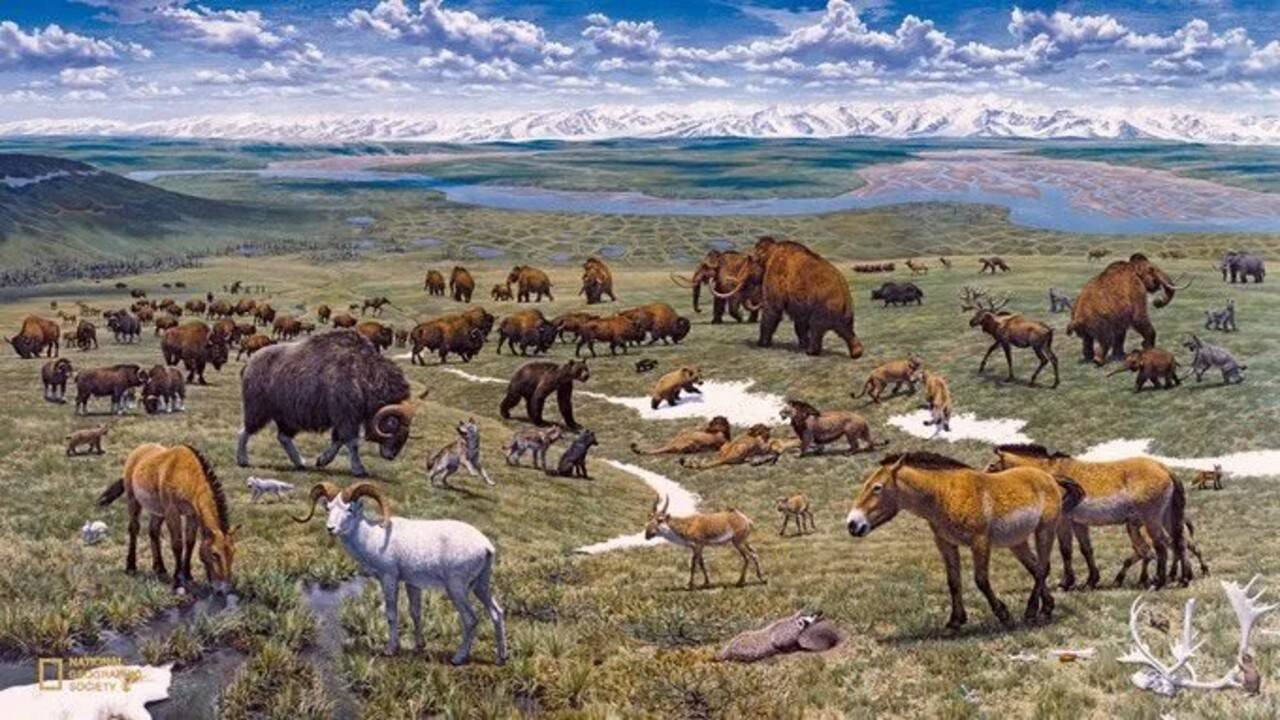
Imagine waking up in a world 10,000 years ago. Towering grasslands stretch as far as the eye can see, woolly mammoths roam alongside bison and wild horses, and the Arctic is alive with some of the largest herds the planet has ever seen. It may sound like the setting of a prehistoric documentary, but scientists believe this ancient ecosystem could hold clues to tackling one of the biggest climate challenges of the 21st century.

Get breaking news anytime, anywhere. Download the TOI app now!

Deep in northeastern Siberia, researchers are reintroducing large grazing animals into a remote reserve called Pleistocene Park. Their goal is to test an unusual idea: that restoring an ancient grassland ecosystem could help keep the Arctic's permanently frozen ground, known as permafrost, from thawing. If successful, it could slow the release of billions of tonnes of greenhouse gases locked beneath the frozen soil. The project has sparked global curiosity and scientific debate, raising a simple but profound question: can lessons from Earth's distant past help shape its climate future?

“We created Pleistocene Park to observe how quickly animals could transform the moss tundra into productive grassland,” Russian geophysicist Sergey Zimov said in a 2022 interview with UNESCO Courier. His original aim, he explained, was to solve a scientific mystery: why the Arctic, once home to vast grasslands and enormous herds of grazing animals, had become dominated by moss, shrubs and sparse forests.

A landscape transformed by the loss of giants

During the last Ice Age, much of northern Eurasia was covered by what scientists call the mammoth steppe: an immense grassland stretching from western Europe to Alaska. Woolly mammoths, bison, horses, musk oxen, woolly rhinoceroses and other large herbivores grazed these plains, trampling snow, fertilising the soil and preventing shrubs from taking over.

Around 10,000 to 12,000 years ago, many of those animals disappeared as the climate warmed and human populations expanded. According to Zimov, the disappearance of these large grazers fundamentally altered the Arctic ecosystem. Mosses and shrubs gradually replaced productive grasslands, changing how the land stored heat, water and carbon.

Pleistocene Park, founded by Zimov in 1996, is designed to test whether some of those ecological processes can be restored using living species rather than extinct ones. Today, the reserve is home to Yakutian horses, European bison, musk oxen, reindeer, yaks, moose and Kalmykian cattle. Despite frequent references to mammoths in popular culture, there are none at the park.

“We are not trying exactly to reconstruct the mammoth steppe ecosystem, because we don't have the mammoth,” Zimov told The New Yorker. “But we are trying to reconstruct the highly productive steppe ecosystem.”

Can animals help keep the Arctic frozen?

The science behind the project centres on permafrost – ground that has remained frozen for at least two consecutive years. Across the Arctic, permafrost stores enormous quantities of organic carbon accumulated over thousands of years. As global temperatures rise, thawing ground allows microbes to decompose this material, releasing carbon dioxide and methane into the atmosphere and creating a feedback loop that accelerates climate change. NASA, the National Snow and Ice Data Center (NSIDC) and the Intergovernmental Panel on Climate Change have identified permafrost thaw as one of the major long-term climate risks.

Zimov's hypothesis is simple, first outlined in a 2005 Science paper. During winter, grazing animals trample thick snow, making it denser and less insulating. That allows the intense Arctic cold to penetrate deeper into the ground, helping keep permafrost frozen. During summer, grazing suppresses shrubs and encourages grasses, which reflect more sunlight than darker vegetation and create a different soil environment.

“I created Pleistocene Park to observe how quickly animals could transform the moss tundra into productive grassland” Zimov told UNESCO, adding that after two decades, “the peat bogs have been trampled, the shrubs broken, and the amount of grass... has increased significantly.”

What the evidence says

The project has produced promising results. Field experiments published in 2020 by researchers working at Pleistocene Park found that areas with higher densities of grazing animals accumulated less insulating snow during winter, helping lower permafrost temperatures locally by nearly 2°C. The findings offered early evidence that large herbivores can influence Arctic ground conditions, although researchers stressed that the results were limited to the experimental site. Even so, many scientists caution against viewing the park as a proven climate solution.

“The kind of animal density you'd need... greatly exceeds anything that could be maintained naturally,” Duane Froese, a geologist at the University of Alberta, told The New Yorker in 2022, referring to the enormous numbers of herbivores that would be required across the Arctic for the idea to have a significant global impact.

Researchers also point out that climate change is driven primarily by greenhouse gas emissions. While ecological restoration could become one useful tool, it cannot replace the need to reduce fossil fuel use. The park should therefore be viewed as an ongoing scientific experiment rather than a ready-made climate solution.

Where the experiment stands today

Nearly three decades after it was established, Pleistocene Park remains a working research site rather than a completed conservation project. New animals continue to be introduced where feasible, while researchers monitor vegetation, snow cover, soil temperatures and permafrost to understand how grazing reshapes the Arctic landscape.

For Sergey Zimov, however, the project has always been about more than restoring wildlife. “Thawing permafrost is a direct threat to the climate,” he told UNESCO Courier, arguing that the Arctic's frozen soils have long been overlooked in discussions about global warming.

The experiment has gained wider attention as concern over Arctic warming has grown. A 2022 study published in Communications Earth & Environment found that the Arctic has been warming nearly four times faster than the global average since 1979. NASA and the National Snow and Ice Data Center (NSIDC) say the rapid warming is accelerating permafrost thaw, making the region an increasingly important focus of climate research.

While scientists broadly agree that large herbivores can alter vegetation and snow conditions at local scales, they continue to debate whether the approach could make a meaningful difference across the vast Arctic landscape. Whether Pleistocene Park ultimately proves capable of slowing permafrost thaw on a larger scale remains an open scientific question. For now, it stands as one of the world's most closely watched ecological experiments to test whether lessons from an ecosystem that disappeared around 10,000 years ago can help address one of today's biggest environmental challenges.

Sign up to read this article
Read news from 100's of titles, curated specifically for you.
Already a member? Sign in here
Related Stories
Top stories on inkl right now
One subscription that gives you access to news from hundreds of sites
Already a member? Sign in here
Our Picks
Fourteen days free
Download the app
One app. One membership.
100+ trusted global sources.