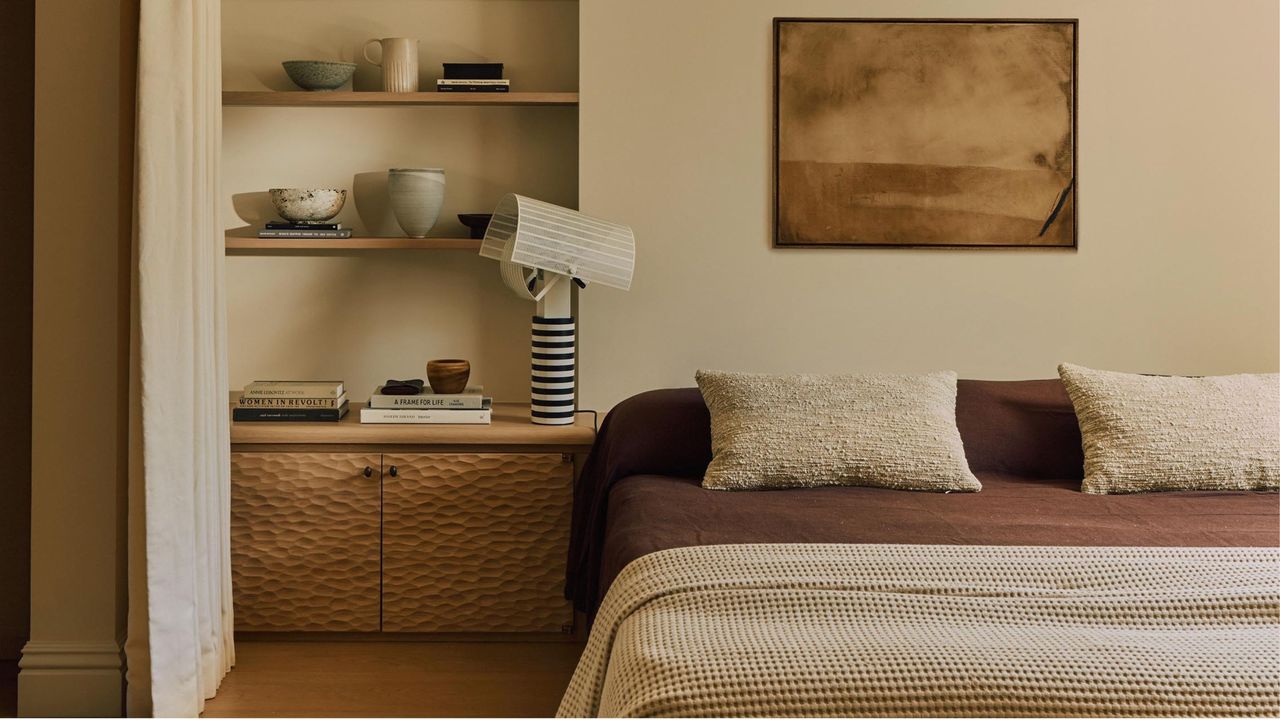
I once told my partner that "texture is a color," and even though he rolled his eyes wildly at me, I stood by it and still do. Now, let me clarify: it's not that I think you'll find 'texture' on the color wheel or in the ROYGBIV rainbow; it's that I think it can often achieve the same job as color can in an interior. Choose one interesting enough — like this 'dimpled' timber I've been seeing everywhere lately — and you'll add just as much visual character without having to commit to a bold color.
But don't just take it from me. Interior designer Andrew Griffiths agrees, adding that for the bedroom above, the texture of the hand-chisselled timber side table replaced the need for color in the space. "The carving creates its own depth through shadow and light, so the room can stay tonal and restrained and still feel rich rather than flat," he explains.

I'm noticing this faceted, 'dimpled' timber surface in interiors a lot lately. It goes by many names — hand-gouged timber, hand-chisselled timber, hand-carved sculptural relief — with the key being the handcrafted element. "As our lives become increasingly digital, handcrafted surfaces offer something technology can't replicate. They hold imperfections, labour and personality," interior designer Ruby Shields of Studio Shields tells me. So, here's what to know about the textured design trend, and how to bring it into your own space.
Why Is 'Dimpled' Timber Trending?
"People are craving evidence of the hand again — surfaces that show process, imperfection, time," explains A New Day's Andrew Griffiths. "This texture does that instantly; you can't fake it with a machine and get the same soul."
It also speaks to the current trend for vintage and antiques — the new (or old, I guess) shorthand for adding character and story to a space. Rather than looking to more modern, minimalist movements, people are looking back, digging through the archives to discover the opulence of design styles like Art Deco and the detail of the Arts & Crafts movement.
"[The growing popularity of 'dimpled' timber] certainly draws from the Arts & Crafts movement, with its belief in honest materials, craftsmanship, and creating objects with longevity rather than disposability," shares Ruby Shields. "There's also an influence from Art Nouveau in the flowing, organic carving."
"I think both movements feel increasingly relevant because they prioritize story over perfection," Ruby adds. "As technology continues to accelerate, handcrafted design becomes even more valuable. People are looking for homes with authorship, places that couldn't exist anywhere else because they're shaped by real people, their hands and their histories."
Andrew says it's hard to pinpoint a specific design movement that 'dimpled' timber speaks to, but echoes that it's the focus on craft and the handmade that runs through many of them.
"It's a shared instinct across periods: the hand should be visible in the object," he explains. "That instinct keeps resurfacing as a counterweight to mass production, and it feels especially pointed now, when so much of what we come into contact with is templated or AI-generated."
How to Style 'Dimpled' Timber in Your Home
The short answer is sparingly. "The strength of a carved surface comes from allowing it to become the focal point," says Ruby. "Texture works best when every element isn't trying to compete but complement. If you give one handcrafted piece room to breathe, it creates a moment that people remember."
Andrew agrees. "Let everything around it stay smooth and quiet," he adds. "It should read as a singular textural moment, not a motif repeated across the room. The restraint is what makes it feel considered rather than decorative."
And while it can replace the need for color, the 'dimpled' texture can also be a wonderful complement. "Natural timber has an incredible ability to sit alongside color because it carries so much variation within itself," shares Ruby. "I’ve seen people staining it with vibrant hues and painting it. We’ve also been experimenting with charring this carving technique, which creates an entirely different mood — much darker and almost mysterious."
Interior designer Rebecca Jansma says she's been working with the surface for years. "We think of it as a custom timber finish of the highest order — every time we incorporate this finish, the shape, scale and style of the carving is different," she shares. When it comes to styling, it's important to "match the materials in the space with scale and balance; color and tone," she adds. "It's tricky, but when it all comes together it’s timeless and very special."
And then there's the way it interacts with light. Interior designer Tali Roth chose a dimpled timber surface for this living room, and finished it in a dramatic green high-gloss paint.
"The carved surface has an almost reptilian quality, reminiscent of crocodile or snakeskin, creating an incredibly tactile finish that brings another layer of life to the space," she shares. "The high-gloss lacquer catches and reflects natural light differently throughout the day, constantly shifting in appearance and adding movement and depth."
Ruby adds that lighting is what makes dimpled timber really come alive. "Because the relief is irregular, it responds differently as the sun moves," she says. But avoid flat frontal lighting, she adds. "Grazing light [lighting placed very close and at a slight angle], whether natural or artificial, is what reveals the depth and creates shadow. That's when the carving becomes sculptural."
"Through the day the shadows shift with the sun; by lamplight in the evening the dimples deepen, and the whole surface feels almost geological," adds Andrew.
Shop the 'Dimpled' Timber Trend


Ultimately, "Whether it's carved timber, handmade tiles or woven textiles, these materials ask you to slow down and experience them rather than simply look at them. That creates a far more emotional connection to a space," says Ruby.
But if a dimpled timber feels too rugged for you and your space, why not go in the complete opposite direction and try glossy lacquered walls or furniture; the impact is just as evocative.
To stay up to date on the latest trends and design ideas, subscribe to Livingetc's newsletter.