
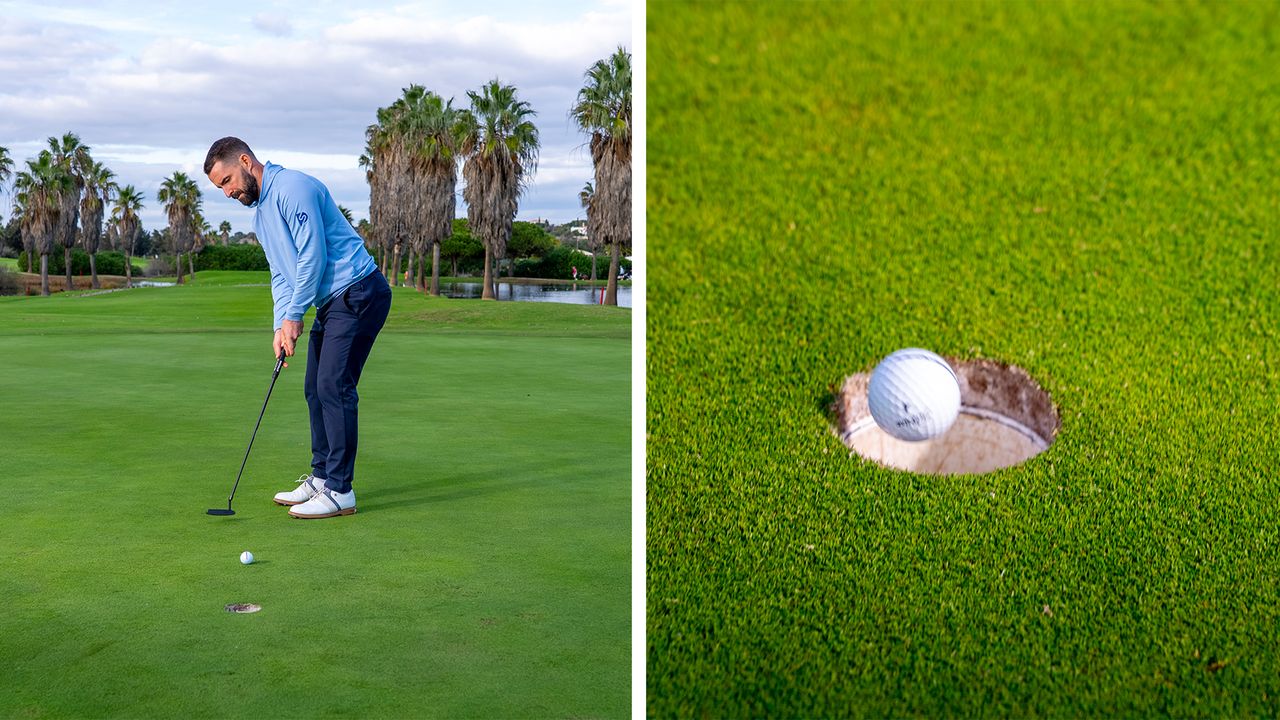
Missing a short putt on the golf course is one of the most infuriating experiences for any player - regardless of ability or experience within the game.
There are plenty of great tips and drills on how to hole out more often from short range in our ultimate putting improvement guide, or our tailored high-handicapper's putting manual, but many amateurs don't realise they are stifling their potential due to a common misconception.

According to putting expert James Jankowksi, who has helped more than 3000 golfers to improve on the greens, the idea that you should never aim outside the hole for a short putt is misleading.
Below, James explains why and shares his top tips to help you hole more short putts on the course...
This Common Short Putting Misconception Is Holding You Back
Before we start, let's look at the latest Shot Scope data to see what sort of success rate you should be looking for from 0-3ft.
Benchmarking yourself against the average amateur in your handicap index bracket is a great exercise to help you understand your starting point, which you can then build on with James' expert tips below.
Short Putt Success Rate (0-3ft)
Percentage of putts holed from 0-3ft by amateur golfers in different handicap index brackets
% Putts Made (0-3ft)
0-handicap985-handicap9610-handicap9615-handicap9320-handicap9025-handicap880255075100
| Product | Value |
|---|---|
| 0-handicap | 98 |
| 5-handicap | 96 |
| 10-handicap | 96 |
| 15-handicap | 93 |
| 20-handicap | 90 |
| 25-handicap | 88 |
Common Misconception (Short Putts)
Many amateurs try to take the break out of short putts. Sometimes this can be effective but it often leads to under-reading and lip-outs.
There's a common idea that you should never aim outside the hole on short putts. That's misleading as short putts still break.
This also introduces the idea of an effective centre or entry point. For example, on a left-to-right putt as here, the effective centre of the cup shifts slightly to the left of the physical centre.
Visualising where the ball is most likely to enter helps clarify the intended start line and improves spatial awareness relative to that entry point. Start picturing and feeling that entry point.
The Role Of The Hands
Short putts are a different motor task to longer putts. A 3-footer is not a scaled-down 40-footer – it is a fine motor movement.
Longer putts rely on a larger, more rhythmic motion from the shoulders and torso to generate energy, but intricate movements are typically felt through the hands, even though the stroke is coordinated through the whole body.
On short putts, the hands provide the sensory ‘read' for the movement, helping to organise timing and face control without excessive motion. Feel the smooth motion in the hands and putter, and the rest will often follow.
Entry Speed
Even on short putts, entry speed matters. The ball needs enough momentum to hold a true roll but not so much that the hole effectively shrinks.
‘Capture size' is the effective opening of the hole at different speeds.
The more speed, the smaller the hole effectively becomes and the less ability to drop the ball has. But at around 0.95mph or below, the ball's roll loses stability, with more chance of it wobbling or drifting offline late on.
Aim for it to enter the hole with some momentum, not dribbling in the front or ramming into the back.