
Get all your news in one place.
100's of premium titles.
One app.
Start reading
Digital Camera World
Hillary K. Grigonis

The world's largest cyanotype is so big, it took more than 100 people to create – but the hardest part is still ahead

A behind-the-scenes photo from creating what could be the world's largest cyanotype in Grand Rapids, Michigan.

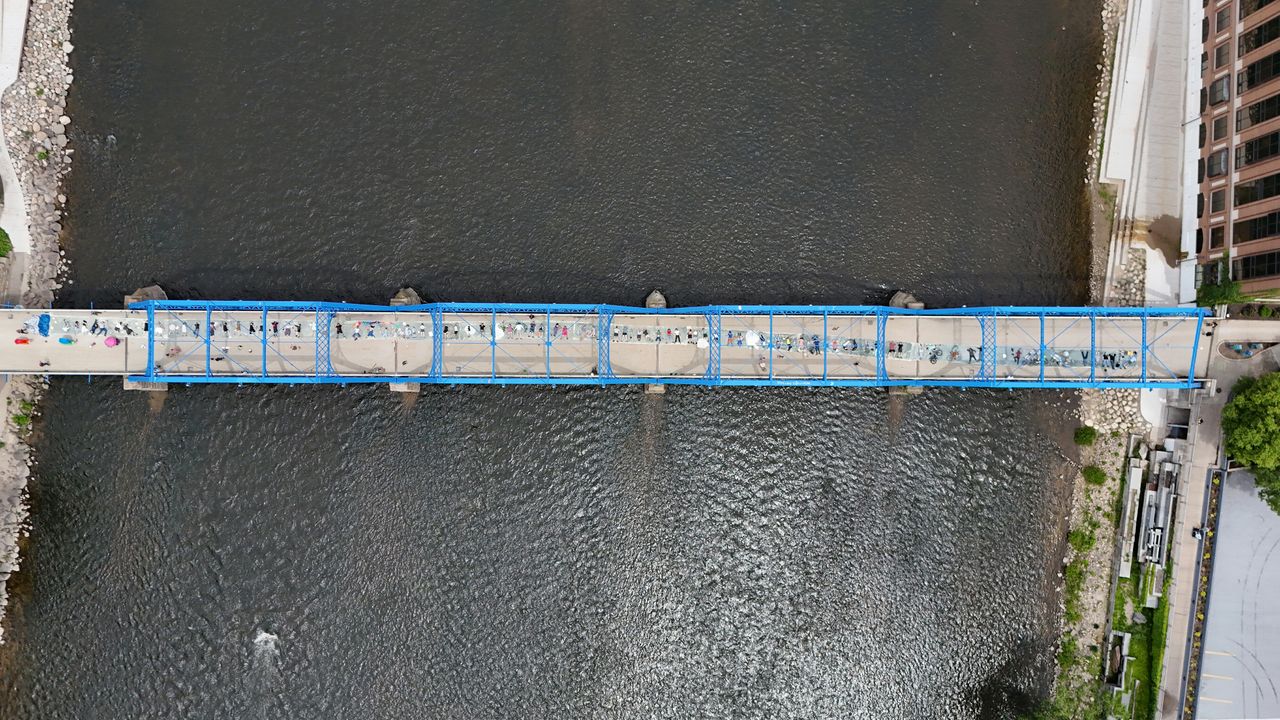
A photograph so large it took up most of an entire bridge could break a world record for the world’s largest cyanotype. Created by a group of artists and nearly 100 volunteers in Grand Rapids, Michigan, the cyanotype stretches more than 430 feet long.

Bobby Philips (@improvgnosis), filmmaker and director of Yeah Media, and Meg Roach (@adventuretextiles), cyanotype and fabric artist and Owner of Adventure Textiles, together with nearly 100 community volunteers, took over the Blue Bridge, a pedestrian bridge in Grand Rapids, Michigan, on the summer solstice and set out around 430 feet of pre-treated, light-sensitive fabric.

Gathering an arrangement of objects from their childhood, more than 80 people then laid down on the fabric, holding still for about 10 minutes, to expose the cyanotype. The sun then worked its magic, creating a cyanotype silhouette of everything on the fabric. The image measures roughly 430 feet long by 7.5 feet tall – or about 3,200 square feet.

(Image credit: Bobby Phillips / Meg Roach)

To prevent the beginning of the roll of fabric from being brighter than the end, the team timed the roll out in sections, then timed the roll up so that each section was only exposed to the sun for about 10 minutes.

The current Guinness Book of World Records holder for the largest cyanotype is 276.64 m² (2977.72 ft²), created by Stefanos Tsakiris of Greece in 2017. While the organizers were unable to raise the $20K estimated to get the record verified by the Guinness Book of World Records, the artists said that even Tsakiris reached out to congratulate them on the project.

A cyanotype is a type of photography that doesn’t require a camera – instead, a mixture of chemicals (Potassium Ferricyanide and Ferric Ammonium Citrate) creates a light-sensitive surface. Objects – and in the case of the largest cyanotypes, humans – are placed over the fabric in the sun. The final result is a deep blue with a white silhouette where any objects are laid on the surface.

(Image credit: Bobby Phillips / Meg Roach)

The next part of the process for Phillips and Roach, however, could be the most challenging – the next step is to rinse all 430 feet of fabric in a hydrogen peroxide solution, the final step that brings out the deep blue cyanotypes are known for. The team expects to begin the rinsing project in the next few days.

The rinse is similar to the most challenging part of the project so far: treating the fabric itself during the initial phase of the project. Hanging the fabric from the ceiling, the group worked in 45-foot sections to spray the fabric with the light-sensitive chemicals using a paint sprayer. The fabric was then stitched together and rolled up in preparation for exposure. That process took two days of working until 2 AM.

(Image credit: Bobby Phillips / Meg Roach)

Phillips says he expects the rinsing process to be just as intense, as the team will need to regularly fill and drain large tubs with the hydrogen peroxide solution. The duo expects to have well over 100 hours into the project by the time the process is complete.

Another key challenge: How does one display a work of art that’s 430 feet long? The duo is exploring a few different options, including creating a spiral of fabric to walk through or suspending it from a ceiling in waterfall-like fashion. The group hopes to be able to find a venue large enough to display the work for ArtPrize 2027, an international art competition and festival so large that it covers 4.5 square miles of Grand Rapids, Michigan every fall.

Bobby Phillips and Meg Roach (Image credit: Bobby Phillips / Meg Roach)

“The philosophy of [the project] was based around just wanting to create that true community experience for the people who were there, whether they knew anything about cyanotype or not,” Phillips said. “It was truly a joy to watch everyone be in a spirit of camaraderie. Everyone was so excited to be a part of this, and they all did a great job, and that means it’s a success as far as I’m concerned.”

The process so far has included around 100 volunteers, along with drone photographer Dan Terpstra (@originart). The project was made possible through a Downtown Grand Rapids Inc. Activate Grant, a program supporting public art installations and community events.

A post shared by YEAH MEDIA (@improvgnosis)

A photo posted by on

The cyanotype, much like analog photography and retro digicams, has seen a resurgence in art trends in recent years. “Cyanotypes are really accessible,” Phillips said. “The chemicals are not all that expensive, and it is pretty self-explanatory, learning how to use them and mix your own chemicals. It’s definitely an accessible alternative to photography.”

You may also like

For more analog photography inspiration, browse the best film cameras. Or, read more about how to make cyanotypes.

Sign up to read this article
Read news from 100's of titles, curated specifically for you.
Already a member? Sign in here
Related Stories
Top stories on inkl right now
One subscription that gives you access to news from hundreds of sites
Already a member? Sign in here
Our Picks
Fourteen days free
Download the app
One app. One membership.
100+ trusted global sources.


