
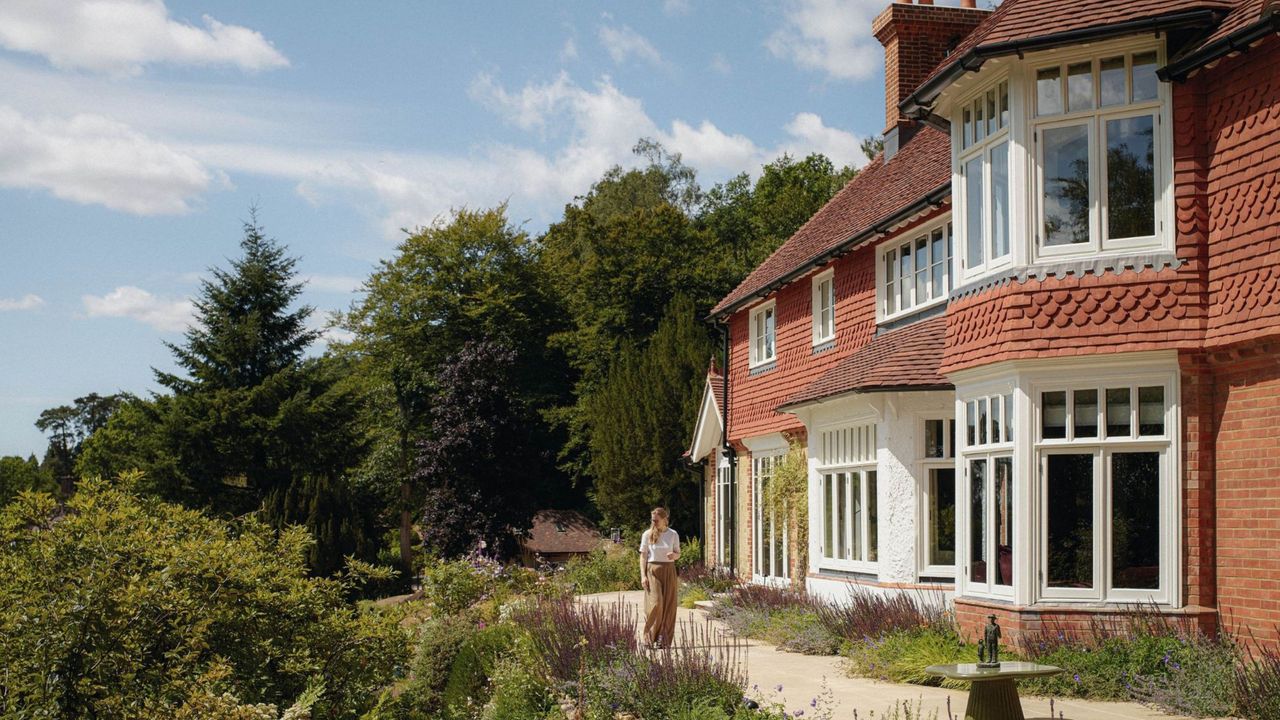
On a clear day, the view from this house, high in the English Surrey Hills, stretches across the South Downs to a sliver of sea glinting more than 30 miles away. That breathtaking horizon was what first captured the imagination of its new owners, an Anglo-Australian family returning to the area.
But the setting was only part of this house design story: the home itself carried a rich creative history, shaped by artists, astronomers, and musicians.

Designer Irene Gunter of Gunter & Co remembered the house well. She had visited when an artist was in residence and had never forgotten the view, the arts and crafts detailing, or, unusually, the two observatories – one octagonal and originally capable of rotating, the other an underground chamber carved into the hillside for solar observations.
‘It had always stayed with me,’ she says. ‘So when the new owners contacted us, it felt like a chance to help write the next chapter of a special house.’

The family needed the building to work for modern life while honoring its history, and the brief began with solving the muddled circulation at its center.
Working with architects Mitchell Evans and building firm Compass Construction, Gunter & Co. reimagined the plan from the inside out, stripping it back to the studs and creating a new oval entryway with a sweeping staircase and curved walls.

‘It was like unlocking a puzzle,’ says Sasha Purcell, the lead designer. ‘Once we repositioned the staircase and aligned the axes, you could see straight from the front door to the kitchen window and the view beyond. It transformed everything.’

Curves became the thread that tied the new layout together: arched doorways, softened corners, and a rhythm of repeated shapes that guide movement through the house.
The kitchen – a favorite of the Australian wife – features a domed, black-framed conservatory which encloses a vast banquette, seating guests within the woodland panorama. ‘The clients are passionate about nature and wanted to feel connected to the landscape from every room,’ explains Sasha.

That affinity shaped the color palette of the whole house. Greens, rusts, and sky blues wash through the interior in tones chosen to feel mellow and lived-in.
Botanical motifs in fabrics and wallpapers echo the surrounding flora, while in the sunroom, a hand-painted mural depicts plants meaningful to the family as well as a butterfly discovered by and named after a previous occupant.
Natural timbers further the connection, adding texture and gently rooting the spaces within their setting.

The clients’ art collection was central to the design, with many rooms informed by pieces they owned.
In the dining room, the focal point is a lenticular light box portrait of Grace Jones by Chris Levine. Its deep reds and teals set the room’s moody, glamorous tone, echoed in the Rosso Levanto marble fireplace and ceramics.
For the living room, the owners acquired work by Leonard Campbell Taylor and Frank Craig, who had both lived in the house in the early 1900s.

The main bathroom became the project’s most technically ambitious element. Formerly a dressing room, it was extended into a serene, spa-like space with a skylight and tadelakt plaster finish that bathes the room in soft light.
‘It looked wonderful on paper,’ says Sasha, ‘but getting it built was a labor of love.’

Elsewhere, the designers embraced the house’s quirks. The original 17-meter-deep well remains in the snug; the former pantry sink still serves in the utility; and the vintage bell-pull system has been restored and now summons the children for supper.
Throughout, the aim was a mix of personality, practicality, and playfulness – a home that feels joyful yet deeply usable. ‘We didn’t want a museum,’ says the owner. ‘It had to be somewhere we could live without feeling intimidated.’

Perhaps the project’s greatest success is how the reimagined interior now stands up to the landscape outside.
From the driveway, the extension sits so comfortably that the house appears unchanged. But open the front door, and the shift is immediate: light pours through the circular skylight, the long sight line draws you through the curved hallway, and the house – in all its layered color, arts and craft unfurls toward the trees and the distant sea.
‘The only downside,’ say the owners, ‘is that it makes it difficult to go away.’