
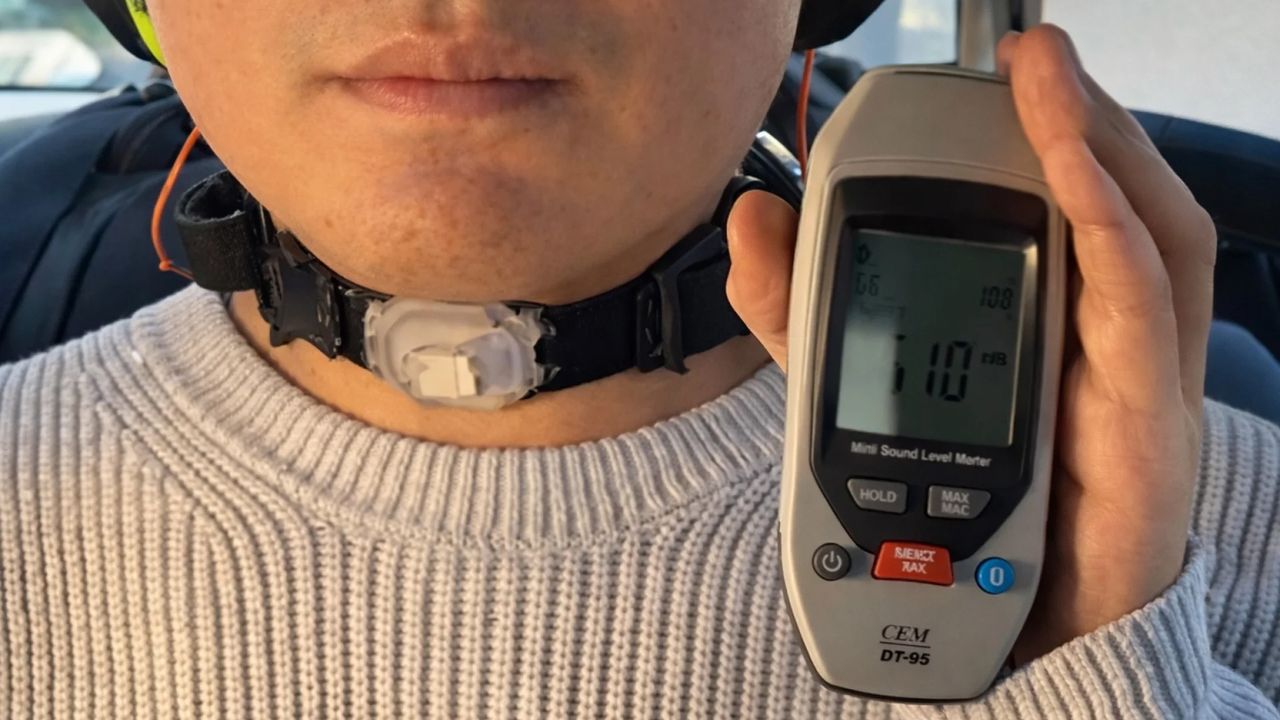
- AI is being used to turn neck movements into words
- It's the work of researchers from South Korea
- The system could eventually be used for 'silent conversations'
One of the many talents offered by AI systems is advanced pattern recognition, and researchers from the Pohang University of Science and Technology (POSTECH) in South Korea have put this to good use by developing a wearable neck band that translates muscle and skin movements into speech.

As outlined by the researchers (via New Atlas), the device is intended to restore "lost voices" — to give the power of speech back to those who are unable to talk normally. A small camera is used to track a "movement map" on the neck when the wearer intends to say something, with no vocalizations required.
The algorithm-based estimation of what a person is trying to say is then combined with speech synthesis technology to verbalize the words. This speech synthesis system can even be trained on the wearer of the AI neckband (an example of deepfake technology actually being used for something worthwhile).
"It is a noteworthy technology because it has a wide range of potential applications, including assisting laryngectomized patients, communicating in noisy industrial environments, and even supporting silent conversations," says Professor Sung-Min Park, who led the study at POSTECH).
85.8% recognition accuracy

Those "silent conversations" could be in libraries or conference rooms, for example, when people aren't able to talk audibly for whatever reason. It could even be used as an alternative to radios or text messaging for staff working in an area where it's impractical to be holding face-to-face conversations.
There's quite a long way to go before this is ready for anyone to use, however. While the band can achieve 85.8% recognition accuracy, this is only across 26 predefined words — the NATO phonetic alphabet ("Alpha", "Bravo", and so on). When the subject is moving, meanwhile, the accuracy rate currently drops to 39.72%.
That rate should improve as the system is trained further. Encouragingly, the neckband performed well when it came to cutting out background noise, and words could be recognized with white noise levels of 90 decibels in the background (that's about the equivalent of a busy construction site).
Another benefit of the AI wearable system is that it's much simpler and less bulky than other thought-to-speech systems currently in development, including technology based on electroencephalography (EEG) brain wave readings. It's a significant step up in terms of portability and accessibility.