
Get all your news in one place.
100’s of premium titles.
One app.
Start reading
The Times of India
The Times of India
World
TOI World Desk

This 3,000-year-old treasure in Spain was made with iron that fell from the sky

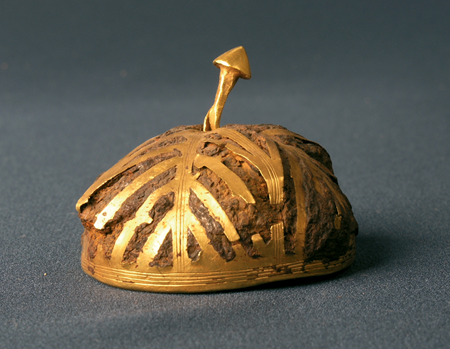
For decades, the Villena Treasure has been examined and valued, most notably its gold. The trove, discovered in Alicante in 1963, contains dozens of well crafted items that are consistent with researchers' expectations for the Late Bronze Age. However, two little pieces never quite fit. They were dull, rusted, and constructed of iron in an era when iron was not supposed to exist in Iberia. For years, they were regarded as curiosities or potential incursions from a later time. New scientific examination has definitely placed them in the Bronze Age and suggested that their metal did not come from the Earth at all. Instead, it seems to have fallen from the sky.

Researchers identify meteoritic iron in a 3,000-year-old Iberian treasure

Among the gold bowls, bracelets and vessels were a plain open bracelet and a small hollow hemisphere covered with pierced gold sheet. Both looked out of place from the start. Their dark surface and heavy corrosion stood in sharp contrast to the surrounding goldwork. Early descriptions noted their iron-like appearance but stopped short of firm identification. Because large-scale iron production in Iberia began much later, these pieces caused discomfort. Some scholars suggested they must belong to a later phase, despite being found within a closed Bronze Age deposit.

Meteoritic iron before iron smelting

Before humans learnt how to smelt iron from ores, the only workable iron available was meteoritic. Iron meteorites are rich in nickel and cobalt, elements that are usually absent or present only in trace amounts in early terrestrial iron. Across the ancient world, a small number of prestige objects made from meteoritic iron are known, including beads from Egypt and the famous dagger from Tutankhamun’s tomb. These objects were rare, difficult to work with, and often symbolically charged.

Why corrosion complicates identification

Identifying meteoritic iron is not straightforward, especially in objects that have been buried for thousands of years. Iron corrodes readily, and over long periods the corrosion process can strip away nickel and other elements that would normally signal an extraterrestrial origin. In extreme cases, little or no metal survives beneath the rust. This makes traditional metallographic analysis risky or impossible, particularly for museum objects that cannot be cut or transported easily.

Careful sampling from valuable artefacts

In 2007, researchers were granted permission to take tiny samples from the corroded surfaces of the Villena objects. The amounts removed were minute, taken from areas already damaged by oxidation. Later, a second slightly deeper sample was taken from the bracelet to improve confidence in the results. These samples consisted entirely of corrosion products rather than fresh metal, reflecting the fragile state of the objects.

Chemical signatures point to a cosmic source

Despite these limitations, chemical analysis revealed patterns consistent with meteoritic iron. The ratios of nickel to iron and nickel to cobalt aligned closely with values seen in heavily weathered meteorites rather than terrestrial iron. While absolute nickel levels were low, this was expected given the age and degree of corrosion. When compared against published datasets, the Villena samples fell within the range associated with altered meteoritic material.

Implications for Iberian Bronze Age chronology

If the Villena iron pieces are meteoritic, their presence no longer forces a later date for the treasure. Instead, they support a Late Bronze Age chronology before widespread iron production began in the region. This fits well with other evidence linking the Villena hoard to nearby sites such as Cabezo Redondo, which was abandoned before 1200 BC. The objects may have been valued not for practical use but for their rarity and origin.

A rare confirmation for the Iberian Peninsula

These findings make the Villena objects the first confirmed meteoritic iron artefacts from the Iberian Peninsula. While similar items are known elsewhere in Europe, they are uncommon and often slightly later in date. Further non-invasive testing could strengthen the case, but even now, the evidence suggests that Bronze Age communities in Iberia had access to and recognised the value of iron from space. The two modest objects, once overlooked, now sit quietly at the centre of a much larger story.

Sign up to read this article
Read news from 100’s of titles, curated specifically for you.
Already a member? Sign in here
Related Stories
Top stories on inkl right now
One subscription that gives you access to news from hundreds of sites
Already a member? Sign in here
Our Picks
Fourteen days free
Download the app
One app. One membership.
100+ trusted global sources.


