- Electric car conversions usually go for tens or hundreds of thousands of dollars.
- That’s because most conversion specialists focus on the luxury market.
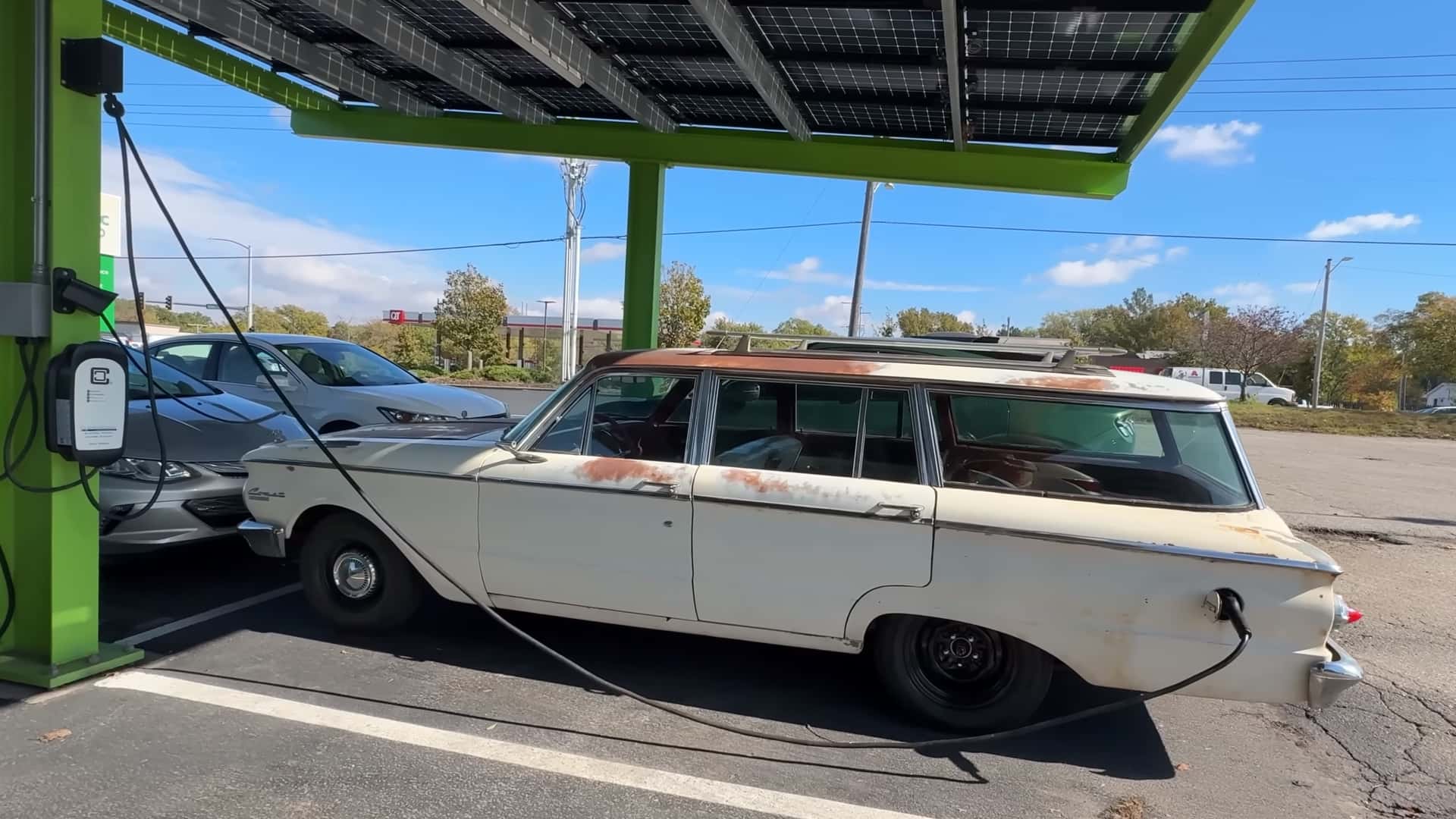
- But it doesn’t need to be this way, and this Mercury Comet DIY EV conversion proves it.
Converting an old car into an EV has a lot of benefits. After it’s all said and done, you get to enjoy the same thrills of a classic car but without the toxic fumes, oil leaks and iffy reliability. (It might not be for everyone, though, as the gas engine is the car’s heart, and a lot of people love that.)
The problem with an EV conversion, however, is that it’s usually very expensive. Most conversion specialists out there focus on cars that are already very expensive, and after they work their magic, the final bill can sometimes be in the hundreds of thousands of dollars.
But it doesn’t have to be like this. We’re now at a point in time where there are plenty of used but solid EVs out there that can provide all the necessary parts for a proper EV conversion. And that’s exactly what This Old Jalopy did. Best of all: it’s all documented on his YouTube channel.
The story starts with a dead 1962 Mercury Comet station wagon that was sitting and collecting dust. The perfect candidate for an EV conversion. And then came a wrecked 2014 Nissan Leaf that still had a functioning high-voltage system, including the battery pack, inverter and electric motor.
When the project started, the goal was simple: do the conversion for less than $6,000, excluding the car itself. And I’m happy to report that the goal has been achieved, albeit with a lot of elbow grease that was free.
The donor EV cost $3,000, and the Resolve EV controller, which enables communication with the original Nissan high-voltage parts, including the battery management system (BMS), cost another $900. Various other parts, like metal tubing, leaf springs and other bits and bobs, brought the final tally closer to $6,000.
The Leaf’s electric motor, which originally powered the front wheels, was mounted on the rear axle of the Comet. A fair bit of fabrication work was needed to make a De Dion axle that works with a set of upgraded leaf springs, and the original CV shafts had to be shortened to fit in the old station wagon. But it works and it looks stock.
The original 48-module, 24-kilowatt-hour battery was disassembled and the modules were fitted into a new cradle that sits under the hood, where the original gas engine used to live. That said, some modules had to be replaced because they were damaged during disassembly.
A fair bit of troubleshooting also had to be done, as the wheels would not turn when everything was connected the first time. The high-voltage cables’ terminals were inverted at one point, which likely led to the on-board charger failing. A new (used) charger was installed, but that still didn’t do it. So a new pre-charge resistor was fitted, and that fixed the issue–but the wheels turned in the wrong direction. It turned out that the owner had installed some high-voltage wires incorrectly, and after that was corrected, it finally worked.
The J1772 AC charging port was placed where the fuel filler used to live, making for a sweet throwback to when the Mercury station wagon was sipping dinosaur juice. The custom controller was fitted in the glovebox, and it all looks very clean.
As for the usable driving range, the owner estimated that he could squeeze up to 78 miles on a full charge, presuming the data read by the custom controller is accurate. That’s just six miles shy of what the original 2014 Nissan Leaf was rated for, and I’d call that a win.