Get all your news in one place.
100's of premium titles.
One app.
Start reading
The Economic Times
The Economic Times

This 16-year-old Canadian student built an autonomous AI-powered robot turtle that can detect tiny microplastics in water

A 16-year-old Canadian student has turned inspiration from a turtle into an unusual piece of environmental technology that could help scientists detect one of the world's most persistent pollutants.

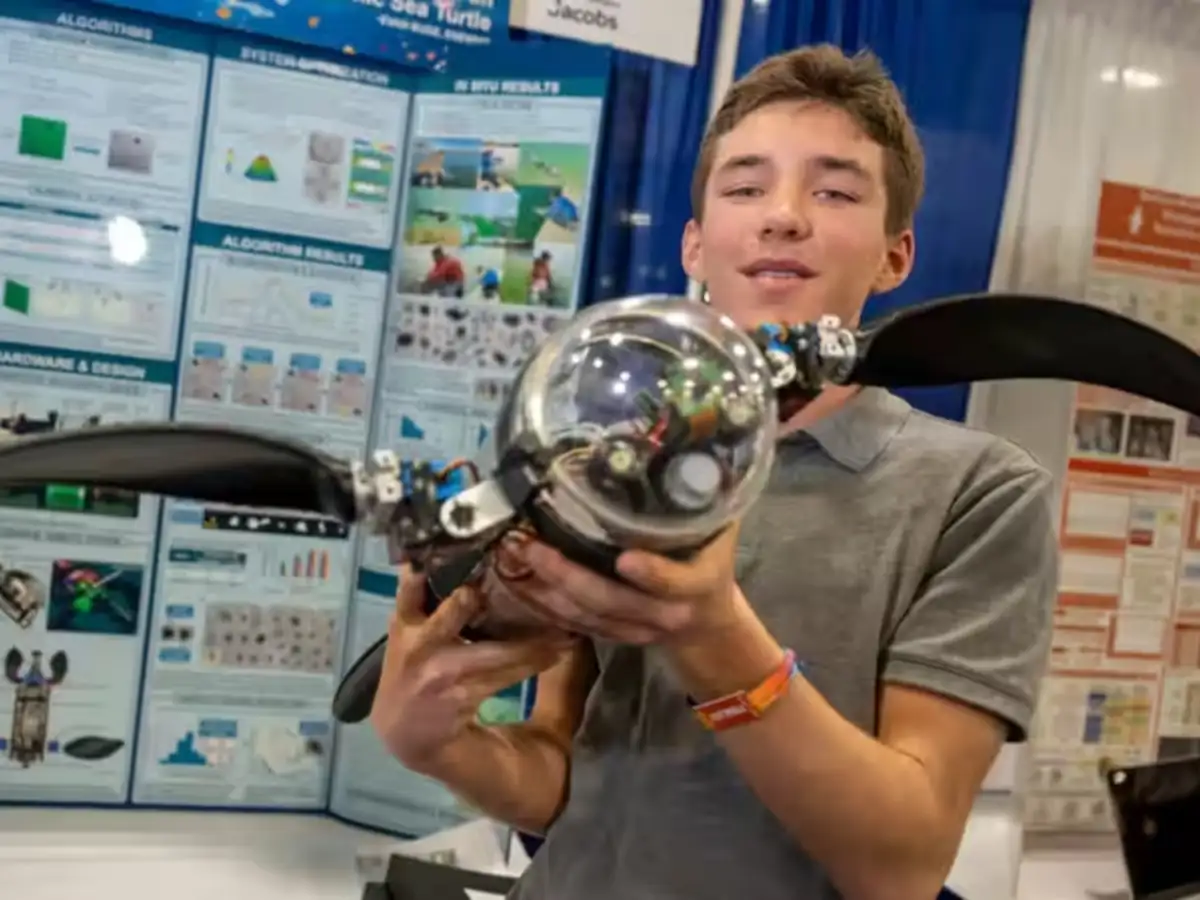
Evan Budz developed an autonomous AI-powered robot turtle capable of scanning water for microplastics. The robotic system combines turtle-inspired movement, underwater 3D holographic imaging and artificial intelligence to identify tiny plastic particles.
Read more - A Florida couple bought a 45-acre swamp to save it from development; 15 years later, 275 wood storks were nesting there in a thriving wildlife haven

Budz spent nearly 4,000 hours developing the project. His invention reportedly achieved 94% accuracy in identifying microplastics and earned him the Gordon E. Moore Award for Positive Outcomes for Future Generations at the 2026 Regeneron International Science and Engineering Fair (ISEF), along with a US$50,000 scholarship.

How Evan Budz built his AI robot turtle

The idea began during a family camping trip in Ontario in 2024.

Budz noticed a snapping turtle moving smoothly through the water and became fascinated by how efficiently it could swim. Instead of simply admiring the animal, he wondered whether its movements could inspire an underwater robot.

Read more - Green Card holder who spent 30 years in US detained even after court case was terminated: Indian-origin grandma had no criminal record, & her daughter is an immigration lawyer

He spent about five months developing the turtle-shaped machine before turning his attention to its environmental mission.

Over the following year, Budz worked on an underwater 3D holographic imaging system and trained AI models to identify microplastics. In total, he devoted nearly 4,000 hours to the project.

What started as an attempt to copy the swimming technique of a turtle eventually became a potential tool for monitoring water pollution.

Who is Evan Budz?

Evan Budz is a Canadian high school student interested in robotics, artificial intelligence, engineering and environmental conservation.

His interest in nature developed through family camping trips, during which he spent time around lakes and forests. His growing concern about plastic pollution eventually led him to explore whether robotics could be used to help scientists study contaminated water.

His project later earned international recognition at the 2026 Regeneron ISEF, a major science and engineering competition for school students.

Why did Evan Budz design a turtle-shaped robot?

Budz did not choose a turtle simply because it looked interesting.

The design was inspired by the animal's efficient swimming style. Turtles can move through water while using relatively little energy, making their body movements useful for a robot that may need to operate underwater for extended periods.

A turtle-shaped vehicle could also be less disruptive to wildlife than some conventional underwater equipment.

The robot's shell-like structure provides space for equipment including imaging technology, sensors and onboard computing hardware.

How does the AI-powered robot turtle work?

The invention is designed as an autonomous underwater vehicle, meaning it can navigate without requiring constant manual control.

The robot follows programmed search patterns while its onboard systems help regulate buoyancy, maintain depth and keep the vehicle stable as it moves through water.

Its most important component is the custom-built 3D holographic imaging system.

Rather than simply taking conventional photographs, the system captures three-dimensional holographic images of microscopic particles suspended in water.

Those images are then processed by AI models trained to distinguish microplastics from natural particles and microscopic organisms.

How can the robot detect microplastics?

The system is designed to identify plastic particles measuring as little as 10 microns.

After the robot captures holographic images, its machine-learning system analyses the particles' characteristics and attempts to determine whether they are microplastics.

According to the project details, the AI achieved a reported 94% accuracy when distinguishing microplastics from other microscopic particles.

That could make the technology particularly useful for environmental monitoring, although the robot remains a research prototype rather than a widely deployed commercial system.

Why are microplastics such a major environmental problem?

Microplastics are plastic particles smaller than five millimetres. They can be created when larger plastic items break down or can enter the environment through products and materials such as synthetic textiles and industrial waste.

Their tiny size makes them difficult to detect and remove.

Microplastics can travel through rivers, lakes and oceans and have been detected in a range of environments and organisms. Their growing presence has raised concerns among scientists about their effects on aquatic ecosystems and potential impacts on human health.

Ocean Conservancy estimates that around 11 million metric tonnes of plastic enter the world's oceans each year, highlighting the scale of the wider plastic pollution problem.

Evan Budz's robot initially failed in the water

The finished robot may look impressive, but getting it to work was far from straightforward.

During early experiments in his grandparents' swimming pool, the machine repeatedly sank instead of swimming properly.

Budz described the early version as behaving "like a brick", as he struggled to get the robot to control its buoyancy and maintain its position in the water.

He subsequently redesigned the propulsion system, worked on the robot's balance and improved its autonomous navigation.

He also consulted aquarium experts to better understand turtle movement and replicate the animal's swimming behaviour more effectively.

How could the robot improve microplastic monitoring?

Currently, detecting and analysing microplastics can involve collecting water samples and sending them to specialised laboratories.

That process can require expensive equipment, specialist expertise and additional time before researchers receive results.

Budz's robot is designed to bring the detection process into the water itself.

If the technology can be developed further, autonomous underwater robots could potentially help researchers monitor lakes, rivers and coastal areas that are difficult to access or far from laboratories.

The ability to combine underwater imaging with AI could also allow large quantities of microscopic particles to be analysed more efficiently.

Evan Budz wins US$50,000 scholarship at Regeneron ISEF

Budz's work received a major boost in May 2026 when he won the Gordon E. Moore Award for Positive Outcomes for Future Generations at the Regeneron International Science and Engineering Fair.

The award came with a US$50,000 scholarship.

The 2026 Regeneron ISEF brought together more than 1,700 students from around the world. Organised by Society for Science and Regeneron, the competition awarded more than US$7 million in prizes and scholarships.

Budz's award recognised the potential of his project to address a major environmental challenge through a combination of robotics and artificial intelligence.

Inputs from TOI

Sign up to read this article
Read news from 100's of titles, curated specifically for you.
Already a member? Sign in here
Related Stories
Top stories on inkl right now
One subscription that gives you access to news from hundreds of sites
Already a member? Sign in here
Our Picks
Fourteen days free
Download the app
One app. One membership.
100+ trusted global sources.