Get all your news in one place.
100's of premium titles.
One app.
Start reading
The Times of India
The Times of India
World
Neel Kamal

Third HSC brings together politicians, business leaders, academia to debate power of cooperation, driving progress together

HAMBURG: The third Hamburg Sustainability Conference (HSC) which started on June 29, themed, "The Power of Cooperation: Driving Progress Together," brought together high-level international representatives from politics, business, academia, and civil society. Through innovative, cross-sector dialogue formats, the conference aims to strengthen global cooperation and advance sustainable development.

Get breaking news anytime, anywhere. Download the TOI app now!

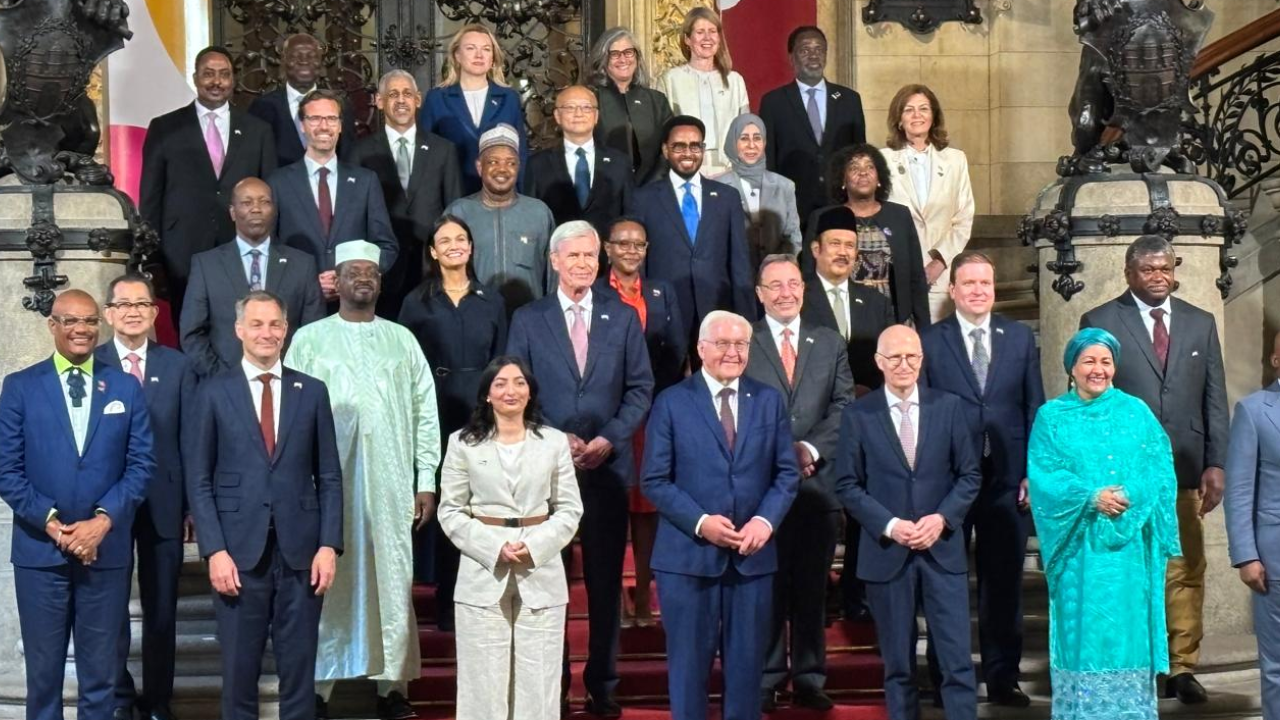
Around 1,600 participants from 115 countries, including German Federal President Frank-Walter Steinmeier, ministers, high-level representatives of international organizations, and executives from the private sector participated.

The 15 alliances for a sustainable future were launched or substantially advanced as part of the conference. A special highlight was the launch of the North-South Commission on Development, co-chaired by Olaf Scholz, former Chancellor of Germany, and Laura Chinchilla, former President of Costa Rica.

The world is in a phase of profound change. Multiple crises and conflicts are reshaping international security, the global economy, and development. Geopolitical tensions and uncertainties have intensified in recent years. The risk of further polarization is real and calls for decisive action and stronger international cooperation. Against this backdrop, HSC 2026 puts a positive perspective at the center: sustainable progress and dialogue toward a common future are possible. This requires the pragmatic recognition that cooperation can open up greater security and prosperity for all involved.

The UNDP for HSC 2026 underscores in a survey across 15 countries, respondents identify accelerating the energy transition, protecting nature, and better access to finance as key priorities for the future. At the same time, the findings show that people expect stronger international cooperation and more effective mechanisms to address global challenges. HSC 2026 creates space for this important exchange and focuses on how constructive international cooperation can be shaped. At the same time, the conference provides a platform to jointly develop and advance concrete approaches and solutions.

Initiated by the German Federal Ministry for Economic Cooperation and Development (BMZ), the United Nations Development Programme (UNDP), the Free and Hanseatic City of Hamburg, and the Michael Otto Foundation, the conference has established itself over the past two years as an international platform for open dialogue and concrete, joint solutions for sustainable development. A core element is the involvement of the private sector as an important partner for global progress and urgently needed future investments. This year, HSC focussed on three thematic areas: Resilient Economies, Technology and the Future of Our Planet; Risk, Uncertainty and Conflict; and Ensuring the Future of Human Collaboration: Multilateralism and Governance.

The conference opened with speeches by Peter Tschentscher, First Mayor of the Free and Hanseatic City of Hamburg; Frank-Walter Steinmeier, Federal President of the Federal Republic of Germany; Amina J. Mohammed, Deputy Secretary-General of the United Nations; Alexander De Croo, Administrator of the United Nations Development Programme (UNDP); Reem Alabali Radovan, Federal Minister for Economic Cooperation and Development; and Achim Steiner, Chair of the Hamburg Sustainability Conference. In the subsequent opening panel on "Investing in Transformation," Reem Alabali Radovan, Federal Minister for Economic Cooperation and Development, Masato Kanda, President of the Asian Development Bank, and Mo Ibrahim, Founder and Chief Executive Officer of the Mo Ibrahim Foundation, discussed the topic. Afterward, George Gray Molina, Head of Inclusive Growth and Chief Economist at UNDP, presented key findings from the HSC 2026 Curtain Raiser.

The second day of the conference opened with the launch of the North-South Commission on Development, with remarks from Achim Steiner, Chair of the Hamburg Sustainability Conference; Ngozi Okonjo-Iweala, Director-General of the World Trade Organization (WTO); Reem Alabali Radovan, Federal Minister for Economic Cooperation and Development; and the two co-chairs of the North-South Commission on Development, Olaf Scholz, former Chancellor of Germany, and Laura Chinchilla, former President of Costa Rica.

Further notable high-level participants from business and civil society include Christian Klein, Chief Executive Officer, SAP; Petra Scharner-Wolff, Chief Executive Officer, Otto Group; Chacko Thomas, Group Chief Sustainability Officer, Tata Sons; Vera Songwe, Chair and Founder, Liquidity and Sustainability Facility; Amitabh Behar, Executive Director, Oxfam International; Ani Dasgupta, President and Chief Executive Officer, World Resources Institute; and Sunita Narain, Director General, Centre for Science and Environment.

HSC Chair Achim Steiner said: “We meet at a difficult moment for international cooperation. Geopolitical tensions, conflict and growing mistrust are reshaping our world. But the answer to fragmentation cannot be more fragmentation. In a multipolar century, the imperative is not less cooperation, but better and broader cooperation. The Hamburg Sustainability Conference brings together governments and international organizations, business and finance, civil society and science, cities and young leaders from across the world. We can choose to see this diversity of perspectives and interests as a source of division. Or we can recognize it for what it is: the essential capacity required to tackle the systemic challenges of our time. The HSC has emerged as a global platform for pragmatic ambition and future-oriented cooperation on sustainable development—a place where dialogue becomes commitment, commitment becomes collective action, and collective action delivers real-world progress.”

Development Minister Reem Alabali Radovan said: “We live in a world in transition. Crises and conflicts are becoming more complex, and their far-reaching consequences do not stop at any border. Especially in a multipolar world, our future depends on whether we succeed in forging new partnerships, building more trust, and finding the courage to reshape international cooperation. This is exactly what the Hamburg Sustainability Conference stands for. Over the past two years, it has become an important platform for exchange and cooperation with the Global South. Here, politics, business, academia, and civil society come together to advance concrete solutions. New alliances are formed, investments are initiated, and innovative approaches are translated into practice. Sustainable development is not a luxury for good times, but an investment in peace, stability, and economic strength. The Hamburg Sustainability Conference demonstrates that international cooperation succeeds when dialogue turns into concrete action.”

UNDP Administrator Alexander De Croo: “Global crises are unravelling decades of hard-won development progress. We cannot pledge our way out of this reality—we must invest our way out. Rapid advances in areas like clean energy and A.I. offer massive opportunities, but their impact relies entirely on deploying them at scale in the countries that need them most. Today, multilateral cooperation can no longer just be about sharing ideals; it must be about structuring deals. By bringing public, private, and civil society leaders together, the Hamburg Sustainability Conference helps us close this delivery gap and build economies that work in service of both people and the planet.”

Hamburg‘s First Mayor Dr. Peter Tschentscher: “The Hamburg Sustainability Conference serves as a platform for the international exchange of experiences, the presentation of new concepts, and the establishment of multilateral partnerships for the implementation of the United Nations Sustainable Development Goals. Former German Chancellor Olaf Scholz is using the HSC 2026 to forge new connections with the North-South Commission on Development Policy. We look forward to welcoming guests from around the world and gaining new insights for the implementation of the United Nations’ 2030 Agenda.”

Honorary Chairman of the Supervisory Board of the Otto Group Michael Otto: “For me, the Hamburg Sustainability Conference is an indispensable place of action. In a time of complex global challenges, collaboration often lacks the necessary speed to turn good ideas into scalable solutions. This is exactly where the HSC comes in, to build alliances and mobilize support. What gives me confidence is that we have excellent ideas, technological expertise, and entrepreneurial drive worldwide—for example, in the expansion of renewable energies. This shows that progress is possible. Yet the biggest challenge often remains implementation. We need to act faster and more consistently. The HSC aims to help accelerate these next steps.”

Over its first two years, HSC has established itself as a platform for launching and advancing high-impact global alliances. These include Scaling Capital for Sustainable Development (SCALED) and Innovative Capital Mobilisation in Africa (ICAMA), which open up new pathways to mobilize private and institutional capital for sustainable development; the Hamburg Declaration on Responsible AI for the SDGs, which advances responsible and inclusive AI applications for the implementation of the Sustainable Development Goals; and the Global Alliance Against Inequality, which strengthens international cooperation to tackle inequality.

Sign up to read this article
Read news from 100's of titles, curated specifically for you.
Already a member? Sign in here
Related Stories
Top stories on inkl right now
One subscription that gives you access to news from hundreds of sites
Already a member? Sign in here
Our Picks
Fourteen days free
Download the app
One app. One membership.
100+ trusted global sources.