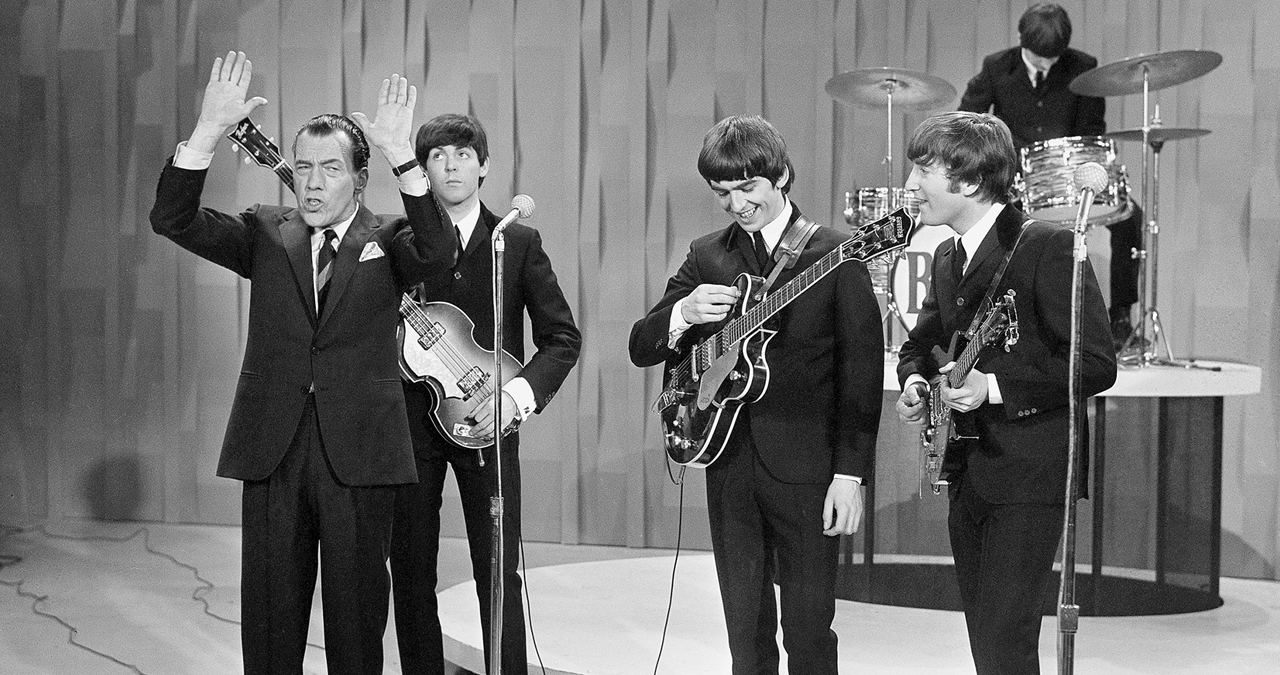
On the night of February 9th 1964 something extraordinary happened. A scant two and a half months since the assassination of President John F. Kennedy in November 1963 had deflated the optimism of a new decade, a besieged nation looked again to those newfangled machines sat in the corner of their living rooms.
They'd promised so much, these television sets, yet instead had provided a window on horror beyond imagining. But, tonight, this still ultra-modern contraption was offering Americans a front row seat for what was Europe was insisting was the next biggest thing in music. The Beatles were appearing for the first time on US TV.
For newcomers to the Beatles myth, it might seem somewhat hyperbolic to look back on the group’s first Ed Sullivan Show television appearance with such grandiosity.
Indeed, the black and white footage of the four mop-topped Beatles, sealed in their formal suits, delivering heartfelt songs to delirious female screams might seem fairly anodyne through a 21st century prism, especially when stacked against the media-saturated landscape which we all now live.
Yet, for many of the future innovators of rock and pop, this was the fountainhead moment, out of which everything else flowed.
“I wasn’t prepared by how powerful and totally mesmerising they were to watch. It changed me completely,” Aerosmith’s Joe Perry told us back in 2009. “I knew something was different in the world that night. Next day at school, the Beatles were all anybody could talk about. Us guys had to play it kind of cool, because the girls were so excited and were drawing little hearts on their notebooks: ‘I love Paul,’ that kind of thing. But I think there was an unspoken thing with the guys that we all dug the Beatles, too. We just couldn’t come right out and say it.”
On that night, over 60 years ago, some 73 million American viewers, many of whom children, had their first proper introduction to John Lennon, Paul McCartney, George Harrison and Ringo Starr.
The Beatles’ performance that night was an event far more profound than simply a memorable entertainment fixture. For some, it unlocked a realisation that aspirations were entirely possible to achieve, and that the future shape of popular culture could be dictated by young people, including themselves.
The Ed Sullivan Show appearance that February night was hotly anticipated. Finally, it gave millions the chance to actually put faces to the voices they’d begun hearing repeatedly on the radio, and to far-flung stories of international conquest circulating in the media.
“We had heard of them, but nobody had ever seen them,” recalled Ken Erlich, producer of the documentary The Night That Changed America. “It was before VCRs - it was before colour - and we were sitting there, and all of a sudden these kids came on. They didn’t really look like us, but they looked like we wanted to look, and they sang these great songs. They sounded familiar but they sounded different.”
The timing of the Ed Sullivan Show appearance was no fluke. In fact, it marked the carefully orchestrated conclusion of a deftly-steered PR campaign, overseen by hyper-perceptive manager Brian Epstein. The man who'd transformed the group from weathered, leather-clad rockers into a saleable, besuited, pop offering.