Get all your news in one place.
100's of premium titles.
One app.
Start reading
International Business Times UK
World
Bernadette B. Tixon

'They Don't Have… Military Means' — Pakistani General Says Iran Has No Choice But to Negotiate With Washington

No way past the blockade — Tehran’s only path is negotiation. (Credit: US Navy/WikiMedia Commons)

A retired Pakistani general has said Iran has no realistic military option left to sustain its conflict against the United States and Israel — and that economic pressure will ultimately drive Tehran back to the negotiating table, even after weekend peace talks in Islamabad collapsed without a deal.

Retired Lt Gen Muhammad Saeed made the assessment in an interview with the New York Post on Monday, days after US Vice President JD Vance departed Pakistan following 21 hours of negotiations that ended without agreement. Saeed, a former senior Pakistani official, said he believed Iran would eventually respond to Washington's terms, whether by accepting, rejecting outright, or seeking adjustments to the proposal on the table.
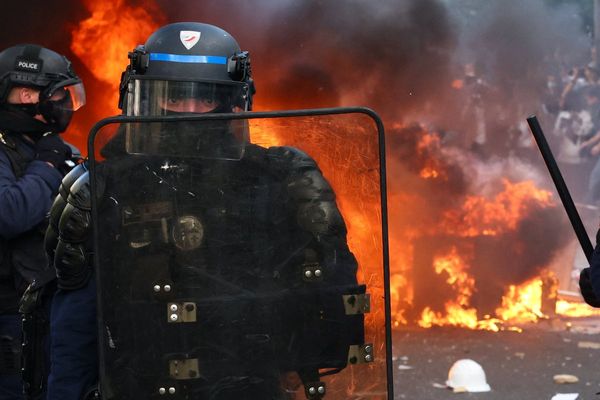
Iran's Military and Economic Walls

'While they would keep firing drones and missiles for a few more days, they don't have compatible military means' to counter the US and Israel, Saeed said, adding that Tehran also has 'no cost-effective military options to fall back on.'

His remarks came as the war has already killed thousands of people in Iran and Lebanon, caused lasting damage to infrastructure across the region, and severely disrupted global shipping through the Strait of Hormuz. Beyond the battlefield toll, Saeed pointed to the weight of Iran's domestic economic crisis as a key factor shaping Tehran's calculus. Iran's economy was struggling well before the conflict erupted on 28 February, with international sanctions and a weakened currency fuelling the largest Iranian protests since 1979 in January 2026, which were suppressed by Iranian security forces.

'Irrespective of their perception of victory,' Saeed said, 'they know what economic hardships their people are facing. They know the level of inflation. They know how terribly their own currency is.'

A Blockade as Leverage

Trump's decision to impose a naval blockade of Iranian ports following the breakdown of the Islamabad talks has introduced fresh pressure on Tehran. Saeed suggested the move targets one of Iran's most sensitive vulnerabilities, and that it could be enough to prompt a response to Washington's overtures. 'This may prove totally wrong, but it's my assumption that whatever option has been given to them as "take it or leave it," they will come back on it,' he said.

Former US State Department official Mark Kimmitt offered a more cautious reading of the situation. Kimmitt, who served as assistant secretary of state for political-military affairs under former President George W. Bush, said the blockade would likely draw Iran back to talks — but not straight away. 'The blockade of the Strait should bring the Iranians back to the negotiation table, but not immediately,' he said. He added that while Tehran might signal a willingness to discuss uranium enrichment, it was 'highly unlikely the current Iranian leadership would ever seriously consider terminating the programme.'

The Talks That Fell Apart

The United States and Iran failed to reach a truce deal after high-stakes talks in the Pakistani capital, with Vance saying Tehran had refused to accept Washington's terms after 21 hours of negotiations. the highest-level meeting between Washington and Tehran since the 1979 Islamic Revolution. Vance said the US needed to see a 'fundamental commitment' from Tehran not to develop nuclear weapons, while Iran's semi-official Tasnim news agency said that 'excessive' US demands had hindered reaching an agreement.

Pakistani mediators called on both countries to maintain the ceasefire, with Pakistan's Foreign Minister Ishaq Dar saying it was 'imperative that the parties continue to uphold their commitment to ceasefire.'

The two-week ceasefire between Washington and Tehran is due to expire on 21 April. No new round of negotiations has been publicly scheduled. Neither the US nor Iran has publicly responded to Saeed's or Kimmitt's assessments.

Sign up to read this article
Read news from 100's of titles, curated specifically for you.
Already a member? Sign in here
Related Stories
Top stories on inkl right now
One subscription that gives you access to news from hundreds of sites
Already a member? Sign in here
Our Picks
Fourteen days free
Download the app
One app. One membership.
100+ trusted global sources.