
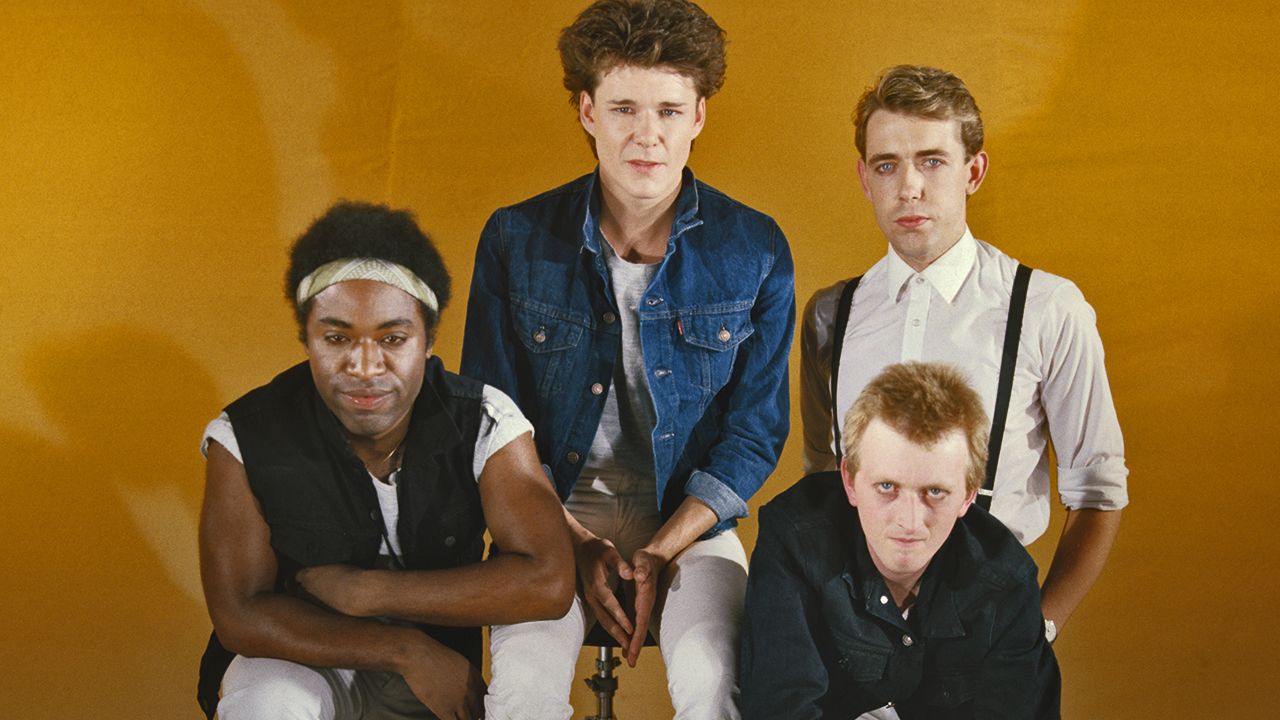
In February 1976, as the Sex Pistols stumbled onto the stage at the Marquee, Stuart Adamson and his mate Bill Simpson went to see Focus in Edinburgh. They would soon form The Skids with Richard Jobson on vocals.
But what began as a Clash/Buzzcocks-inspired punk band morphed into something more progressive and original. Adamson gleefully took a blowtorch to traditional song structures, Jobson’s lyrics were esoteric and ambitious, and their single sleeves featured Dadaist art.

Clearly, this was a world away from The Cockney Rejects.
Adamson left to form Big Country and recruited guitarist Bruce Watson and noted session players Tony Butler and Mark Brzezicki. The latter was a fusion drummer who’d had his life changed by seeing Brand X.
Bassist Butler was in a band with Simon (brother of Pete) Townshend, that, by all accounts, would have given Rush a run for their money. Gigging at London’s Golden Lion, the roadies for Genesis and ELP would come and watch them on their downtime.
Even Watson – on paper, a young punk from Dunfermline – was coming from an experimental angle: “I’m a rock guitarist,” he says, “but I can do a lot of leftfield stuff. All that Tom Verlaine, Richard Lloyd from Television stuff.”
Combined with Adamson’s songwriting and guitar playing, the results were explosive. Debut album The Crossing went platinum in the UK. It was modern, with guitar tones and effects that you’d find on records by U2 and New Order – but sometimes it sounded positively ancient, with lyrics that talked of mountainsides and ploughmen.
As a vision of Scotland, it was more relatable than the shortbread tin images of New Year ceilidhs and “See you, Jimmy” stereotypes.
Initially marketed as a pop band, by second album Steeltown, Big Country had moved on. It was a collaboration written in the studio and rehearsals. They’d always played fast and loose with traditional song structures, but this method of working pushed it even further.
Recorded in ABBA’s Stockholm studio, the verses of the title track were written using the rhyme scheme A-B-B-A as a knowing nod; and the song has a verse, then a pre-chorus, then a verse, then an instrumental break, a pre-chorus, then two verses. It’s not until two and a half minutes into the song – where other songs are often ending – that the actual chorus arrives.
They wouldn’t have called it a concept album, but the songs told a story about modern Britain: the decline of industry, the miners’ strike, the Falklands war.
They did it cleverly – Where The Rose Is Sown and Come Back To Me tell the same story from two different perspectives – and with incredible musicality. Dark, intense, adult: it’s prog, Jimmy, but not as you know it.







