Get all your news in one place.
100's of premium titles.
One app.
Start reading
Digital Camera World
Tom May

These astonishing American Civil War photos are 160 years old – but some of them feel surprisingly contemporary

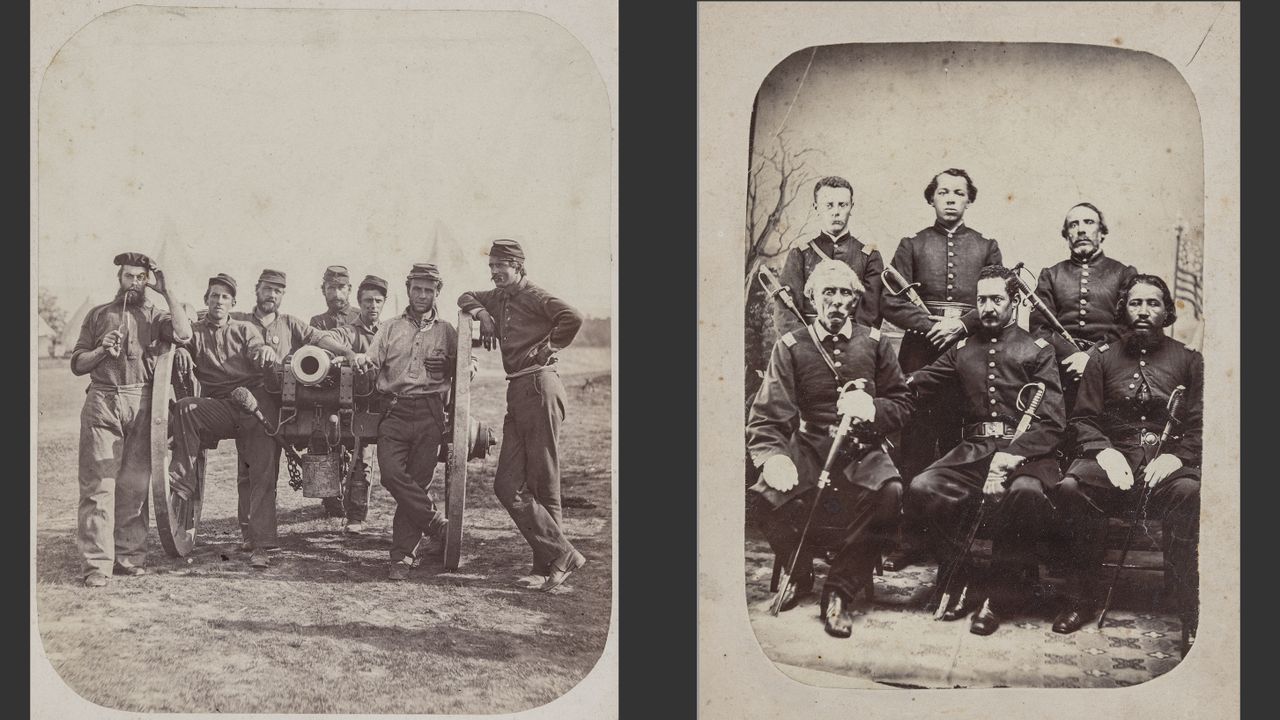
Seven Man Gun Crew, c. 1863 (left) 1st Louisiana Guards, c. 1862 (right).

Here's a good thing to remember the next time your autofocus hunts in low light, or your memory card fills up at the wrong moment. The photographers who pointed a camera at armed conflict 160 years ago had to coat a glass plate with volatile chemicals, load it into a hefty wooden camera not far off the size of a small trunk, expose it for several seconds, then develop it in a darkroom wagon before the emulsion dried. Usually within ten minutes.

This is the context worth holding in mind as the National Gallery of Art in Washington DC announces the acquisition of 35 photographs documenting America's Civil War: a collection it describes as marking "a seminal moment in the history of photography".
This wasn't the first use of photography to capture a war: British photographer Roger Fenton had taken images of Crimea in 1855, including a famous shot of cannonballs which is the subject of historical controversy (there are claims he arranged them, rather than shooting as he found). However, that trip was a relatively brief, single-photographer expedition, whereas the American Civil War took things to another level: years of systematic documentation by multiple photographers working across the entire theater of the conflict.

Who made them, and how

The collection includes work by three photographers whose names deserve to be as well known as Henri Cartier-Bresson or Ansel Adams.

Alexander Gardner, a Scottish-born photographer who had worked under Mathew Brady, produced one of the collection's centrepiece images: a wide-angle view of Abraham Lincoln's second inauguration in March 1865, taken on the steps of the Capitol just weeks before Lincoln's assassination. It's an image of real historical weight, captured with kit that would challenge most photographers today, even under studio conditions.

Lincoln’s Second Inauguration, Alexander Gardner, March 4, 1865 (Image credit: Courtesy of the National Gallery, Gift of Funds from Ronald M. Costell, M.D. and the Estate of Marsha E. Swiss)
Bull Run Bridge Repairs, Andrew Joseph Russell, 1863 (Image credit: Courtesy of the National Gallery, Gift of Funds from W. Bruce and Delaney H. Lundberg)
General W.S. Hancock and Staff, Matthew W. Brady, June 1864 (Image credit: Courtesy of the National Gallery, Gift of Funds from Diana and Mallory Walker)

George N. Barnard, meanwhile, accompanied General Sherman's army through the South, capturing the destruction left in its wake with a precision that is almost architectural. And Andrew Joseph Russell – employed directly by the Union Army as an official photographer – made images of railway construction, shattered bridges and supply lines that read now as both technical record and unintentional art.

A sobering lesson

When you look at these shots, remember: none of them had a light meter. None had a zoom lens. Depth of field was seriously constrained. Yet the images in this collection demonstrate a compositional instinct that holds up completely against modern standards.

The placement of a cannon in a trench with a tented camp stretching into the distance. The formal dignity of a group portrait of Union officers, swords in hand. The structural geometry of a collapsed bridge being repaired by workers who stand along its edge like a frieze.

Rebel Works in front of Atlanta, Georgia (No. 3), George N. Barnard, 1865 (Image credit: Courtesy of the National Gallery, , Gift of Funds from W. Bruce and Delaney H. Lundberg)
American 19th Century 1st Louisiana Guards, c. 1862 (Image credit: Courtesy of the National Gallery, , Gift of Funds from W. Bruce and Delaney H. Lundberg)

It's astonishing, really. This was an era in which photography stopped being a portrait studio novelty and became a way mass audiences could understand events they had not witnessed themselves. And it's sobering to realise that function has not changed, even if the technology behind it has.

Why this acquisition matters

We're used to hearing about museums acquiring paintings, sculptures. But when they acquire photographs – and particularly when they frame them as primary historical objects rather than illustrations of other events – it genuinely matters for the medium's standing.

The National Gallery already holds significant photographic collections, but this acquisition, made through a combination of gifts and private donations, substantially deepens its holdings of early US photography. It arrives alongside more than 140 other photographs spanning the 20th century, including work by Ilse Bing, Florence Henri and Sebastião Salgado, suggesting that the institution is making a serious, sustained commitment to photography as fine art rather than documentation. Long may this continue.

Sign up to read this article
Read news from 100's of titles, curated specifically for you.
Already a member? Sign in here
Related Stories
Top stories on inkl right now
One subscription that gives you access to news from hundreds of sites
Already a member? Sign in here
Our Picks
Fourteen days free
Download the app
One app. One membership.
100+ trusted global sources.