
Get all your news in one place.
100's of premium titles.
One app.
Start reading
Digital Camera World
Hillary K. Grigonis

These are the best photos from the dead Mars probe - MAVEN orbiter photographed the red planet in unprecedented detail for over a decade

Photos from the MAVEN Mars orbiter.

After six months of lost contact, NASA has officially declared the Mars orbiter MAVEN lost to deep space. On June 3, NASA announced that the MAVEN Mars spacecraft has come to an end.

NASA unexpectedly lost communication with the orbiting Mars spacecraft in December 2025. After evaluating potential recovery efforts, the space agency has now officially declared the spacecraft as unrecoverable.

While NASA’s loss of contact with the orbiter was unexpected, the MAVEN mission was originally only expected to last for one year after reaching Mars in 2014. However, the orbiter continued to supply researchers with data on Mars’ atmosphere for more than 11 years before an uncontrollable spin drained the orbiter's battery, ultimately causing a loss of signal that could not be recovered.

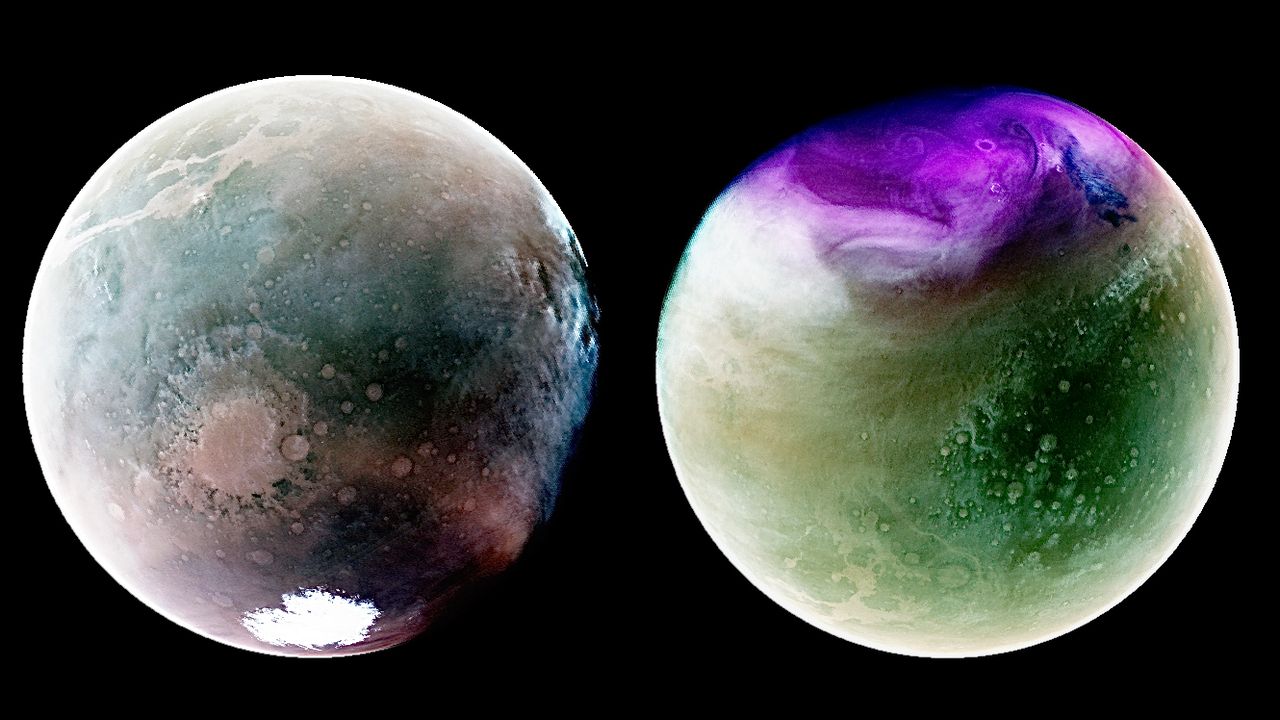
MAVEN did not have a traditional visible light camera on board. Instead, the spacecraft was equipped with an ultraviolet spectograph imager that not only helped researchers study the planet’s atmosphere, but also sent back unusually colored images of the red planet. Ultraviolet images are edited with different colored filters in order to create images that the human eye can easily interpret.

In honor of the MAVEN’s 11-year mission, these are some of the best images coming from that ultraviolet camera.

(Image credit: NASA/Goddard/University of Colorado/LASP)

This photograph, captured in July 2022, captures the red planet's southern hemisphere and polar ice cap. MAVEN captured this ultraviolet image as Mars was closest to the sun.

The ultraviolet capture shows off not only the polar ice cap, but the large pink Argyre Basin – one of the deepest on the planet – and at the top left, the Valles Marineris canyons.

(Image credit: NASA/Goddard/University of Colorado/LASP)

Ozone turns the northern section of the Red Planet purple in this shot from January 2023. The photo is the opposite of the one above, taken when Mars is the farthest from the sun and showing the northern hemisphere.

Credit: NASA/MAVEN/Goddard Space Flight Center/CU/LASP

NASA built this animation by combining ultraviolet images from MAVEN with a simulated view of Mars. Combined, the animation shows how Mars pulses and glows in the night, thanks to a chemical reaction creating nitric oxide, which NASA says is caused by downward winds.

(Image credit: NASA/Goddard/University of Colorado/LASP)

This ultraviolet photo, taken less than two years into the MAVEN mission, shows several of Mars' iconic features. The slash across the middle is the two-thousand-mile Valles Marineris canyon, while the three yellow dots to the left are volcanoes. The purple at the bottom is caused by ozone absorbing ultraviolet light.

(Image credit: NASA/Goddard/University of Colorado/LASP)

Mars orbiters can take selfies too. This image shows a small slice of the spacecraft with Mars in the background. The arm of the camera couldn't rotate enough to get the entire spacecraft in the image, but it did manage to capture a slight selfie to celebrate four years in orbit.

(Image credit: NASA/Goddard/University of Colorado/LASP)

NASA says this image shows rapid clouds building across a two-day span in July of 2016. The yellow spot near the top left is Olympus Mons, which is the tallest volcano on Mars.

(Image credit: NASA/University of Colorado/LASP)

This photo may not look like the shots of the Aurora on Earth, but the purple shows waves of energy that show that Mars gets auroras, too. MAVEN took this shot from underneath Mars, looking up. The South Pole ice cap is the white patch on the bottom left. NASA explains that Mars' auroras are not like those on Earth – they sit close to the equator, so it would be like viewing the aurora from Florida.

(Image credit: NASA/Goddard/University of Colorado)

This image may not look impressive enough to be wall art like some of MAVEN's other colorful shots, but it is both a significant scientific breakthrough and a technical imaging feat. The blue in the image shows hydrogen escaping from Mars' atmosphere.

NASA explains that the image is a composite of around 400,000 observations taken early in the MAVEN mission. MAVEN was able to take map this hydrogen loss that happens from the breakdown of water and Mars' low gravity continually over an entire Martian year.

(Image credit: NASA/Goddard/University of Colorado/LASP)

Finally, it feels fitting to honor the end of the MAVEN mission with a photo from the very start. The spacecraft launched aboard a United Launch Alliance Atlas V rocket from Cape Canaveral, Florida in November 2013. MAVEN took about ten months to reach Mars' orbit.

You may also like...

Love space images? These are the most iconic images from the Artemis II manned mission to the Moon.

Sign up to read this article
Read news from 100's of titles, curated specifically for you.
Already a member? Sign in here
Related Stories
Top stories on inkl right now
One subscription that gives you access to news from hundreds of sites
Already a member? Sign in here
Our Picks
Fourteen days free
Download the app
One app. One membership.
100+ trusted global sources.







