Get all your news in one place.
100’s of premium titles.
One app.
Start reading
Motorsport
Motorsport

These are America’s five F1 race winners

America’s domestic motorsport scene is one of the strongest in the world, which perhaps explains why so few drivers from the United States have made a big impact in Formula 1. It pays to stay at home.

With increasing American interest in grand prix racing, that could change in the years to come but – as of 2026 – just five American drivers have won a world championship F1 race.

We’re excluding the fine winners of the Indianapolis 500, which counted for the world championship between 1950-60 but had almost no crossover (and largely different machinery) with the rest of the F1 calendar.

So, here are the famous five that did crack F1 at least once…

Richie Ginther

Richie Ginther, BRM P57 leads Piet de Klerk, Alfa Romeo Special (Photo by: Motorsport Images)

Wins: 1
Starts: 52
Best championship position: 3rd (1963)

A fine test driver with good mechanical sympathy, Richie Ginther helped Ferrari and BRM win constructors’ titles in the early 1960s.

Following success in American sportscar racing, Ginther was encouraged to head to Europe by friend Phil Hill. Ginther scored a podium in just his second world championship start, finishing runner-up to Stirling Moss in the 1961 Monaco GP after a performance Ginther would later select as the race of his life.

Although rarely a match for team-mates Hill and Wolfgang Von Trips, Ginther added another couple of podiums as Ferrari dominated the season. He then joined BRM for 1962 and supported Graham Hill’s title challenge, playing his part in a 1-2 at Monza.

Given the unreliability of the time, Ginther’s 1963 campaign was remarkable and he scored points in all but two rounds. That was enough for third in the points, behind only runaway champion Jim Clark and Graham Hill, and ahead of race winner and Ferrari team leader John Surtees.

Personal issues hampered Ginther’s 1964 season, but he still scored two podiums and finished fifth in the table before joining the fledgling Honda operation. Once again, Ginther’s experience and hard work bore fruit and this time he got to reap the rewards, taking his one and only world championship victory in the 1965 Mexican finale.

There were only sporadic outings thereafter as Ginther focused on other things, including team management, but his tally of 14 podiums has only been surpassed by three other Americans.

Peter Revson

Peter Revson, McLaren M19C Ford (Photo by: Motorsport Images)

Wins: 2
Starts: 30
Best championship position: 5th (1972, 1973)

Peter Revson’s initial foray into F1 as a 25-year-old in 1964 was unsuccessful, but things were different the second time around. Having built his experience and standing in America, Revson won the 1971 Can-Am title and qualified on pole for that year’s Indy 500, both with McLaren.

He joined the team’s F1 squad for 1972, alongside Denny Hulme. Revson took pole for the Canadian GP in the M19C and scored four podiums on his way to fifth in the points, two spots behind 1967 world champion Hulme.

Beaten only by one of Jackie Stewart’s greatest drives in the 1973 South African GP, Revson then got to drive Gordon Coppuck’s brilliant M23. It was in this car that Revson would take his two world championship successes.

Revson, who had qualified on the front row with the same time as team-mate Hulme, avoided the mayhem caused by Jody Scheckter at the British GP. Revson battled the Lotuses of Emerson Fittipaldi and Ronnie Peterson after the restart and took the lead on lap 39 of 67 before going on to win by 2.8 seconds, with Hulme on Peterson’s tail in third.

Revson again qualified on the front row in Canada (ahead of fellow M23 driver Scheckter). He initially fell back in a wet race but held his nerve amid a chaotic event, which included F1’s first use of a pace/safety car, to take victory – once there’d been an investigation to confirm Fittipaldi hadn’t won!

Revson again finished the year fifth in the standings, but this time he was ahead of Hulme. He was coming of age as an F1 driver.

Revson joined Shadow for 1974 and showed flashes of pace in the DN3 before a front-suspension failure in testing pitched him off at Kyalami. Revson, who had started just 30 world championship F1 races, was killed and America lost one of its most promising drivers.

Phil Hill

Phil Hill, Ferrari 156 (Photo by: David Phipps)

Wins: 3
Starts: 49
Titles: 1 (1961)

Hill was the first American to taste success in the world championship. After a one-off outing for Maserati, Hill joined Ferrari and immediately helped team-mate Mike Hawthorn win the drivers’ title by stepping aside at the Moroccan GP finale.

Having played second fiddle to Tony Brooks in 1959, Hill became the first American to win a world championship GP at the 1960 Italian race, albeit on a day the leading British teams boycotted due to the use of the notorious Monza banking.

Better things were to come in 1961. Armed with Ferrari’s 156 ‘Sharknose’ that set the pace at the start of the 1500cc era, Hill battled team-mate von Trips for the crown. Having taken five podiums from six races, including heading a Ferrari 1-2-3-4 at Spa, Hill went to the penultimate round at Monza four points behind two-time winner von Trips.

When von Trips was killed in a crash that also took the lives of 15 spectators and Hill won, the 34-year-old became America’s first world champion in tragic circumstances. And with both titles wrapped up, Ferrari missed the season finale at Watkins Glen, so the newly crowned champion didn’t get to compete in front of his home crowd.

Already a sportscar star, Hill had also won the Le Mans 24 Hours in 1961 and added a third success in the French classic the following year. But in F1 terms, things went downhill quickly.

Ferrari was rapidly caught and overcome by Lotus and BRM, though Hill managed three podiums at the start of 1962. He then joined the Ferrari walkout to drive for the disastrous ATS operation and a season with Cooper in 1964 yielded just a single point.

Hill’s time in F1 was therefore brief, but he took his one chance to scoop the biggest prize.

Dan Gurney

Dan Gurney (Photo by: Motorsport Images)

Wins: 4
Starts: 86
Best championship position: 4th (1961, 1965)

Surely good enough to be a world champion, Dan Gurney was never quite in the right place at the right time, but he did win F1 races for three different teams.

Another to impress in sportscars before breaking into F1, Gurney took two podiums in his first three world championship outings with Ferrari in 1959. His 1960 campaign with BRM was disastrously unreliable, but consistency with Porsche in 1961 helped Gurney net fourth in the points. He also nearly won the French GP, being outpowered by Giancarlo Baghetti’s Ferrari on the run to the line at Reims.

Gurney finally got his breakthrough win at the 1962 French GP, which was also Porsche’s first world championship success, and added a third place in the epic German GP at the Nurburgring following a race-long battle with Graham Hill and Surtees.

Gurney joined Brabham for 1963 and quickly demonstrated he was quicker than team boss Jack Brabham, before giving the squad its first world championship win in the 1964 French GP. Gurney should have been a title contender in the BT7 but poor luck – such as running out of fuel while dominating at Spa – limited him to two victories and sixth in the standings.

Gurney scored five podiums on his way to fourth in 1965 and could have got his hands on the Brabham-Repco that would win two title doubles across 1966-67 had he not left to set up his own operation.

Anglo American Racers certainly made an impact with its distinctive Eagles. Reliability was suspect but Gurney famously won the 1967 Belgian GP at Spa, just a week after taking victory (and spraying champagne) at Le Mans with AJ Foyt and Ford.

The AAR F1 project came to an end in 1968 and Gurney only made a handful of starts before retiring in 1970, but his impact continued as a team boss and major player in motorsport for decades.

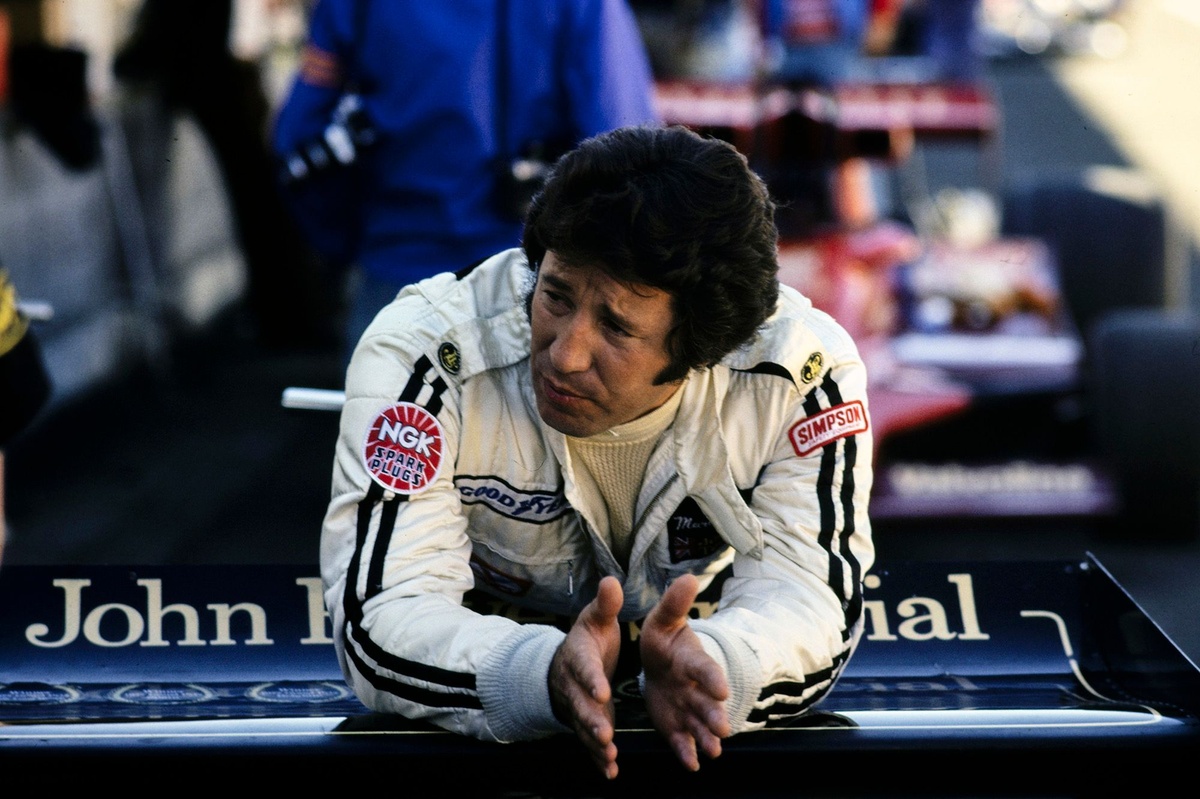
Mario Andretti

Mario Andretti, Lotus 79 Ford (Photo by: Motorsport Images)

Wins: 12
Starts: 128
Titles: 1 (1978)

One of the greatest racing drivers ever, Italian-born Mario Andretti is by far the most successful American in F1 history so far.

The USAC IndyCar star took pole for his first world championship GP at Watkin Glen in 1968 and secured victory on his Ferrari debut at the 1971 South African GP. But it was when he joined forces with Lotus boss Colin Chapman for a full-scale F1 assault that Andretti really made his mark.

Andretti had been part of the Parnelli outfit, which had abruptly pulled out of F1 early in 1976 due to a lack of funding. At the same time, Lotus was in the doldrums and Chapman’s squad was looking for a boost.

Andretti toiled away with the Lotus 77, winning the 1976 Japanese GP finale, while the team developed ground effect. Andretti and the Lotus 78 was the fastest combination of 1977 but unreliability – usually with the development Cosworth DFV engines – restricted Andretti to ‘only’ four wins and third in the standings.

There was no stopping Andretti and Lotus in 1978, though. He won the Argentinian GP opener and took second at Long Beach with the 78 before getting his hands on the sublime 79 from round six in Belgium.

At Zolder, Andretti took pole by 0.79s and led every lap, while team-mate Peterson finished second in the ‘old’ 78.

Thereafter, Andretti and Peterson, now also driving the 79, tended to set the pace wherever they went. Andretti won every race he finished, aside from at Monza (when he won on the road but got a penalty for a jump-start) and Montreal (early clash). His sixth spot in the Italian GP was enough to secure the title with two rounds to go, but his joy was lost when Peterson died unexpectedly after being involved in a multi-car start crash.

Lotus quickly lost its advantage and Andretti never won another GP, but there was still one more F1 highlight. Called up to drive for Ferrari, which was still reeling from the death of Gilles Villeneuve and serious crash for Didier Pironi, Andretti qualified on pole for the Italian GP.

A sticking throttle limited him to third – his 19th F1 podium – but Andretti had already done easily enough to be regarded as an all-time legend.

Sign up to read this article
Read news from 100’s of titles, curated specifically for you.
Already a member? Sign in here
Related Stories
Top stories on inkl right now
One subscription that gives you access to news from hundreds of sites
Already a member? Sign in here
Our Picks
Fourteen days free
Download the app
One app. One membership.
100+ trusted global sources.