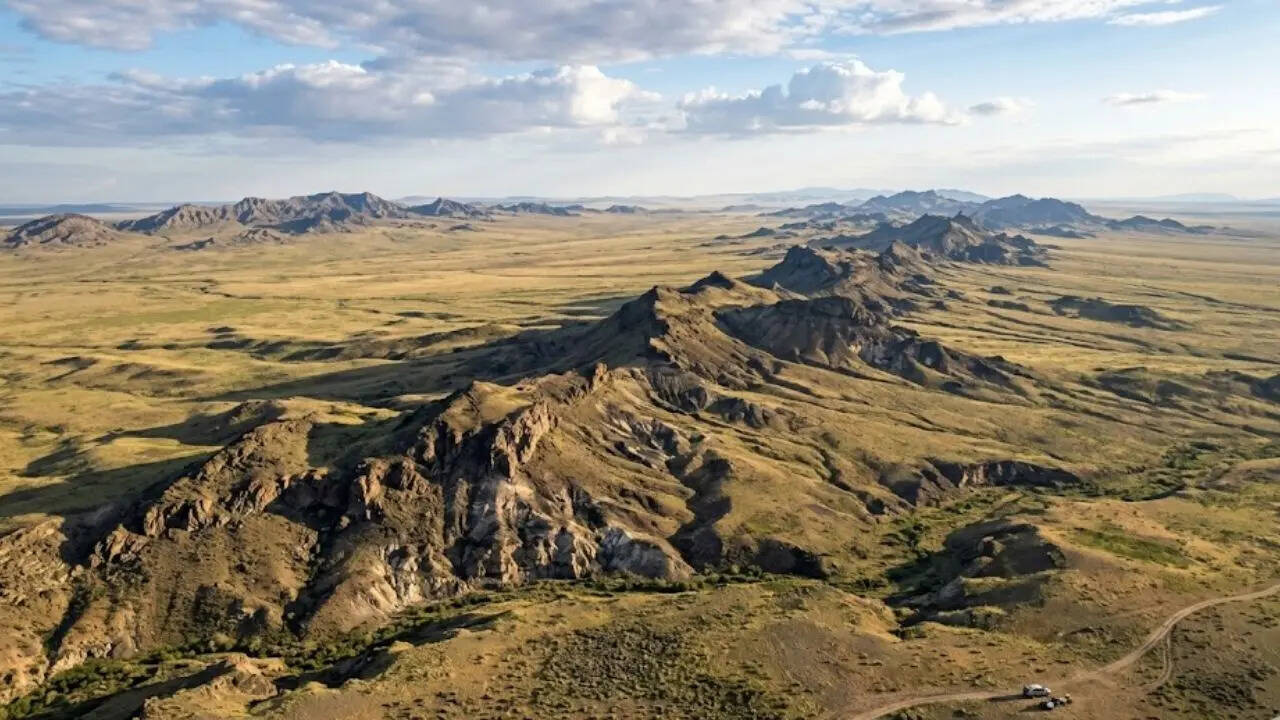
The vast Saryarka steppe in Kazakhstan hides a violent prehistoric history, marked by volcanic scars dating back 300 million years. New geological studies have revealed that these rugged ridges are remnants of an ancient, massive volcanic belt. This belt was once as active as the ‘Ring of Fire’ we know today. These structures formed during the Carboniferous and Permian periods, offering a rare glimpse into a world long gone - a world filled with ancient island arcs and tectonic collisions before the age of dinosaurs. But there’s more to these scars than just scientific interest. They form the architectural base of the region's vast mineral wealth. Scientists are unravelling this timeline by studying zircon crystals found in old lava, piecing together how fire and stone shaped Central Asia's core. These enduring geological remnants bridge the gap between primordial eruptions and Kazakhstan's modern industrial significance.

300-million-year-old volcanic scars and the lost world
As noted in research published on Research Gate, the Kazakh steppe owes its geological formation to two distinct episodes of volcanic activity. The first episode took place around 345 million years ago, during the transition from the Late Devonian to the Early Carboniferous period. A more intense phase followed, reaching its peak approximately 303 million years ago. These events marked the end of the Paleobalkhash Ocean as tectonic plates collided, giving rise to what we now know as the Eurasian landmass. Today, we can see the eroded remains of these ancient volcanoes, revealing what once were the plumbing systems of an oceanic arc system that has long vanished.
How volcanic arcs built the heart of Asia
In eastern Kazakhstan, volcanic rocks belong to the Central Asian Orogenic Belt (CAOB). This region represents one of Earth's largest continental growth areas. A study published in Nature suggests it was once a maze of island arcs, much like today's Japan or the Aleutian Islands. Over millions of years, these arcs collided and fused, forming the continental crust that now constitutes Kazakhstan. Evidence of this process lies in the chemical traces within the igneous rocks found in the Balkhash-Yili belt.
A 300-million-year legacy of mineral wealth
The volcanic activity did more than just form the mountains; it functioned as a giant hydrothermal engine. When magma moved upward through the crust 300 million years ago, it transported gold, copper, and molybdenum, as noted in research published on Research Gate. These elements ended up in concentrated ‘veins.’ Nowadays, these ancient volcanic formations make up about 80 per cent of the Saryarka porphyry copper-gold endowment. They also guide modern geologists in finding porphyry copper deposits, crucial for the global industry.