Jay Poom Euarchukiati might be the most anxious man in Thailand right now. The singer is a bag of nerves as he paces back and forth behind the main stage at Rock Alarm, frantically puffing on a cigar as excited cellists and violinists chatter around him. In a matter of minutes, he and his band, Defying Decay, will open the main stage of the 10,000-capacity outdoor festival in the Khlong Luang District, around 40km outside of Bangkok.
To mark the occasion, Defying Decay have brought a full symphony orchestra with them to enhance their polished, arena-ready metalcore. This is a big deal for everyone involved – and Jay is keenly aware of it.
“I’m just thinking about all the things that could go wrong,” he mutters, as much to himself as to Hammer. He’s defying the 36 degree heat in slacks, a longsleeve black shirt and a leather jacket, aviators and a large necklace completing the look of a stylish modern rock star. He certainly looks cool, even if his current mood is anything but. “It’ll be OK,” he adds unconvincingly, repeating it as he marches off to find his bandmates. “It’ll be OK…”
I’m just thinking about all the things that could go wrong
Jay Poom Euarchukiati, Defying Decay
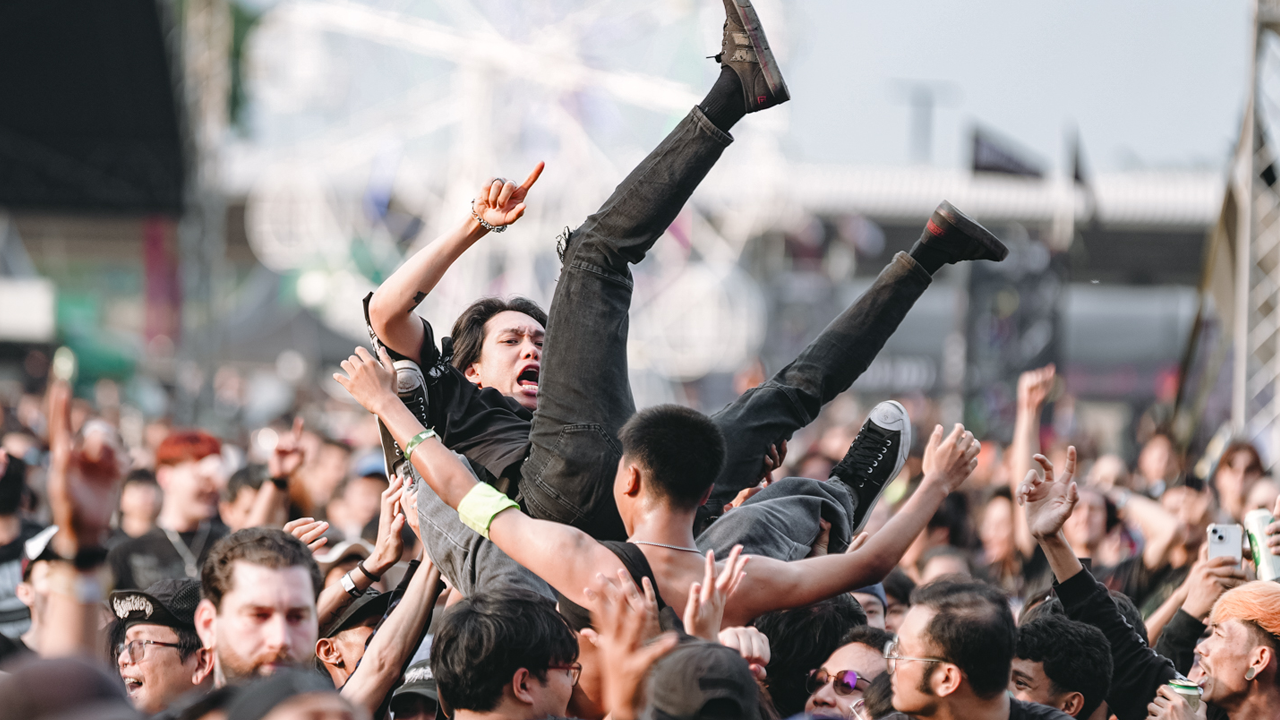
Soon it’s showtime, and as the band stride out, hordes of people rush towards the stage. The orchestra proves to be a masterstroke, making the seven-piece look and sound huge, their hooky anthems more bombastic than ever. There’s a hilariously botched attempt at a wall of death, fans completely missing Jay’s cue and instead opting to turn the giant pit that’s opened up in the middle of the field into a dance-off.
“I counted them in wrong,” he laughs as he comes offstage. “But we got a mosh pit at least!”
It’s a big deal for Defying Decay to open Rock Alarm, as it’s Thailand’s biggest dedicated rock festival. Asia is the world’s largest continent, so of course there are thousands of metal bands, but in the West we’re more likely to think of Mongolia’s The Hu, Taiwan’s Chthonic, Indonesia’s Burgerkill or Nepal’s Underside than any artist from Thailand.
We know there’s been a fanbase for decades. In 1993, Metallica played to 30,000 people in Bangkok – a big gig for any band, let alone a metal one. Head to Youtube, and you can see footage of the band riding elephants and handling snakes.

So, are we missing out on Thai metal because of cultural Eurocentrism?
According to Oak Phongpan Polasit, who co-founded Rock Alarm in 2018, there is a scene here, but it’s characterised by enthusiasm rather than by size or global reach.
“A lot of people might think the Thai scene is small, but it’s full of passionate people,” says Oak. “For a long time, there just wasn’t a proper space where everyone could come together. That’s one of the main reasons we started Rock Alarm. We wanted to give this scene a home.”
The festival itself is much like one you’d find in England or mainland Europe, though on a smaller scale: four stages, booze and food stalls. There are individual merch booths for each band playing, giving a more intimate feel to proceedings.
Highlights include the eccentric but captivating prog metal of The Darkest Romance, frontman Max conducting at least a third of the set from halfway through the crowd, alongside the juddering metallic hardcore of Oblivious and propulsive alt rock of Bomb At Track. All are greeted like returning heroes and play to packed-out stages, often with impressive light shows and pyro.
The Thai scene is small but it’s full of passionate people
Oak Phongpan Polasit, Rock Alarm co-founder
“We’re seeing a new generation of bands with crazy creativity and bigger ambitions,” Oak notes. “Production quality is improving everywhere. The Thai scene is definitely levelling up.”
We talk to some festivalgoers. “It’s so good to have a festival like this here,” beams Pim, a 22-year old in an Underoath shirt.
The Florida metalcore heavyweights will be closing the main stage later, and this year marks the first time the festival has welcomed a handful of Western bands. Everyone we talk to today is excited for this development. “I was too young the last time they played Thailand, in 2012,” Pim notes. “I’m excited!”
Oak’s goals for Rock Alarm are ambitious. He wants a festival that can go toe-to-toe with its international counterparts, but that continues to champion the best of the country’s rock scene.
“My hope is that Rock Alarm becomes a platform where Thai bands can stand side by side with international acts on the same stage, equally respected,” he explains. “I’d love to see stronger collaboration from every side: government, private sector, fans, local and international artists. If we build a solid foundation together, the rock and metal scene here can grow sustainably and get the recognition it deserves.”

The following day, Hammer meets up with Defying Decay’s Jay for a tour of Studio28, nestled in the Saphan Sung district of Bangkok, around 20km outside the city centre. He’s looking far more relaxed today and rocking another stylish ensemble, strolling over to greet us in a smart black shirt and suit trousers combo. Yesterday was one of the biggest gigs his band has played in their homeland, and he’s relieved everything went to plan.
“I'm quite happy with it,” he says calmly. “It was a weird set for us to play, because we were playing with an orchestra for the first time. It was a bit unusual for me.”
Studio28 was set up in 2014 by a group of moneyed locals from the Thai rock scene, and was one of the first independent venues of its kind in the country. Alongside the studio itself, there’s a state-of-the-art, 300-square-metre rehearsal space and an adjacent vinyl pressing plant – the only one in Thailand, owned by Jay’s uncle.
In the studio, we meet Shane Edwards, an Australian producer who worked on Defying Decay’s new studio album, Synthetic Sympathy, and is here to give us a listen. His diverse portfolio includes Aussie punks Hellions, Brit indie darlings The Libertines and pop icon Christina Aguilera.
Metal is so small here. You could just make pop rock and have a much more comfortable career
Shane Edwards, producer
Shane reiterates what Oak told us about the Thai metal scene: it’s not about size, it’s about people getting involved because they want to. “Thai bands are organised and hungry,” Shane explains. “Metal is so, so small here. You could just make pop rock and have a much more comfortable career.”
After a blast of some new Defying Decay tunes, we jump in a car with Jay, slowly snaking our way through Bangkok’s infamously savage traffic, towards the centre of the city. We chat about the similarly sluggish progress of Thai metal, a scene Jay has been immersed in for decades. He agrees with Shane that people aren’t making bank from it, and running on passion alone isn’t necessarily sustainable.
“In Thailand, one thing is for sure: there’s just not much money to be made in the metal scene,” he sighs, as cars, buses, mopeds, tuk-tuks and trucks almost spilling over with goods bob and weave around us. “A lot of the local Thai bands come and go. Not many bands stay around long enough to do anything.”
He name-checks Oblivious and posthardcore OGs Ebola, formed in 2006 and 1996 respectively, as two examples of Thai bands that have stayed the course, but clearly, there are serious challenges here. While metal has had a presence in Thailand for decades – aside from Metallica, Black Sabbath played in 1995 – native bands have always struggled to maintain momentum beyond playing local shows around Bangkok and nearby Pattaya.
The language barrier is one issue – English is commonly spoken in Bangkok, but most of the local bands Hammer watched at Rock Alarm sang in Thai. While the likes of Rammstein, Babymetal and The Hu have shown that you don’t need to sing in English to grow audiences in the West, such cases are rare, and Thailand’s own music scene doesn’t have many in-roads for bands willing to drop their mother tongue.
“If you want to be successful in Thailand, you probably want to be signed to a big label,” Jay explains. “The biggest labels here do not have a single band who sings in English. In Bangkok, English is fine, but if you go outside it and you don’t sing in Thai, they wouldn’t accept you.”
Defying Decay have attempted to buck the trend. Sixteen years in, they’re relative scene veterans by this point, and are one of the few Thai metal bands to have made it outside of Southeast Asia, having toured the UK, Europe and North America. But theirs is a rare story. Jay comes from a wealthy family and has been able to invest in Defying Decay’s journey. They’ve still struggled to build long term momentum, but it’s a bonus he readily acknowledges most Thai bands don’t have.
Who's gonna offer a Thai band that no one knows a festival slot?
Jay Poom Euarchukiati, Defying Decay
“It's a lot harder, for sure,” he says. “Who's gonna offer a Thai band that no one knows a festival slot, and fly everyone to go play? You can’t even drive to anywhere in Southeast Asia. It’s not like Europe or America, where you can get a van. Even if we’re just gonna play in Singapore, we gotta fly.”
Finally, we reach our destination: the banks of the Chao Phraya river, flowing right through the heart of the city and past iconic landmarks such as the fantastical-looking Grand Palace – the former official residence of the king – and the famous Wat Arun Buddhist temple.
As we hop in a speedboat for a cheeky evening cruise, Hammer asks Jay about one of the more promising things to happen in the Thai music industry. In 2024, the government introduced the Music Exchange initiative, providing financial support for artists that have been booked to play festivals abroad. It’s a start, but it overlooks the fact that touring, rather than occasional festival appearances, is essential to economies like metal.
“They don’t support tours because they don't understand touring or the metal scene,” Jay tells us. “They don’t get that you’ve got to play many shows to make an impact. They only care if it’s a big festival.”

Our brief James Bond experience wraps up and Jay bids us farewell, so Hammer takes a stroll through some busy market streets, dodging mopeds and cooing tuk-tuk drivers along the way. We have one final stop on our metal tourism weekender: Immortal Bar, Bangkok’s destination dive for metalheads.
Entirely outside, largely unsheltered and taking up what is essentially a cramped alleyway in the Phra Nakhon district, there’s a local metal covers band named Mönkey Head playing as we arrive. Dozens of locals and tourists are here, grinning, cheers-ing and headbanging in the sticky evening heat as Mönkey Head smash out enjoyably ramshackle covers of Black Sabbath, Iron Maiden and Motörhead, the sound of bass drops from the nearby party street of Khaosan Road throbbing away in the background.
You don’t build a metal venue for profit alone
Lakfah ‘Fah’ Sarsakul, Immortal Bar owner
Despite the challenges facing the Thai metal scene, Immortal has stood for almost thirty years, and we manage to grab owner Lakfah ‘Fah’ Sarsakul to find out how.
“You don’t build a metal venue for profit alone,” Fah states flatly. “If profit is your only motivation, you won’t last. Metal, for me, is not just an occupation. It is conviction. It is loyalty. It runs through my blood and into my bones.”
It’s a sentiment that metalheads of every nation can rally behind, but in Thailand, it’s one you truly have to live by if you want to survive. “I have fallen more times than I can count,” Fah sighs. “Financial pressure. Doubt. Physical and mental fatigue. There were nights when everything felt like it might collapse.”
It’s a story echoed by many bands in Thailand: funding, geography, language and infrastructure are just some of the hurdles artists here are having to overcome. But this is a scene stuffed with passionate, dedicated metalheads, determined to see Thai metal recognised on the international stage. Be it places like Immortal keeping the scene alive at its grassroots or Rock Alarm booking Western bands to help create a bigger buzz, no one is giving up.
“More Asian bands are appearing on major festival lineups,” Fah says. “That gives me hope. I truly hope Thai bands will stand on those stages more often in the future. We understand it will be difficult. But metal was never built for the easy road.”
For more on Rock Alarm, head to the official website. Defying Decay’s new album, Synthetic Sympathy, is out now