
Get all your news in one place.
100’s of premium titles.
One app.
Start reading
Guitar World
Guitar World
Entertainment
Dave Burrluck

“There’s nothing here that’s radical, let alone modern. But that’s in its favor – it’s a considered design that irons out some of Gretsch’s historic quirks”: Gretsch Electromatic Jet review

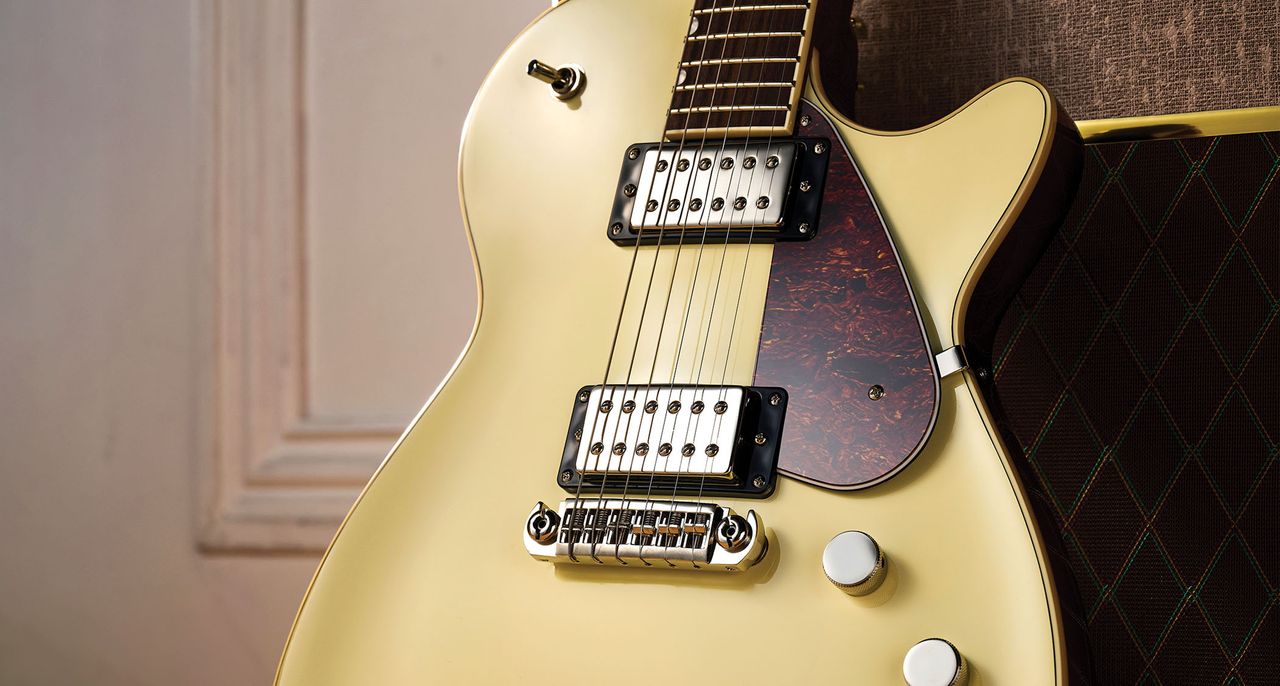
Gretsch Electromatic Jet in Vintage White, photographed in close-up.

What is it?

Gretsch tells us that the recently refreshed Electromatic and Streamliner Jets employ “time-tested craftsmanship and careful precision to fuel reckless creativity and untamed expression”, adding that these new Jets “represent Gretsch’s focused commitment to the next generation of musicians”.

Well, we’re wondering whether we’re actually allowed access to this party as we’re not exactly ‘the next generation’, but these fresh Jets straddle both the Electromatic and lower-cost Streamliner levels, and add to a sizable number of existing Gretsch Jets.

In brief, the seven new models feature dual or single humbuckers, a one-piece wrapover bridge and a simplified three- or two-control layout. The Electromatics all have glued-in necks, the Streamliners are bolt-ons, and pricing overall runs from the top-of-the-line Electromatic Jet you see here, down to the Streamliner Jet Club 1 Pickup at $189/£319.

As we’ve concluded before, Gretsch’s Electromatic level is typically pretty tidy in terms of build and attention to detail. We can’t see any wood under the creamy Vintage White top colour with low-contrast cream-coloured binding – apparently, it’s maple – while the mahogany back and neck have a glossy translucent brown finish and you can just about see that the body is three-piece, the neck with a headstock splice and heel stack.

The body is classed as chambered, and we understand that the cavities are more fan-like than simply scooping out either side of the central area. It results in a pretty good ‘solidbody’ weight of 3.63kg (7.97lb). There’s a little rounding at the heel, and a slight ribcage cut on the back with a smaller one on the treble side.

The top is quite arched in the centre area with a gradual slope to the body edges and, along with the neat edge-binding with its inner thin black purfling line, it’s tidily done. That smaller tortoiseshell-faced, teardrop-shaped raised pickguard adds a nice retro touch, too. With an overall depth of 52mm that’s approximately 45mm at the rim, it’s comfortably thinner than a Les Paul.

(Image credit: Future/Matt Lincoln)

There’s no explanation as to why, but the scale length here is slightly increased from 626mm (24.56 inches) to 632mm (24.88 inches) and, more obviously, we have a very un-Jet-like ‘Split-V’ style headstock that’s narrower than the one first shown off on the 1955 White Falcon.

In humbucking mode at the bridge we’re greeted with a good subtly thicker Patent Applied For voice that has classic honk and a slightly rounded, less crisp high-end

The single-bound fingerboard, with those classic thumbnail inlays, is rosewood not laurel (although the new Streamliner Jets still are), with a quoted 305mm (12-inch) radius.

Another new addition is the adjustable-saddle wrapover Lockdown bridge with locking studs. While it looks a bit generic and fairly chunky, it’s definitely an improvement in terms of adjustability and stability over a simple Les Paul Junior/Special-style wrapover.

A similar bridge is used on the Electromatic CVT double-cut that appeared earlier this year along with the Jet Two 90, but neither of those used the locking studs according to Gretsch spec.

(Image credit: Future/Matt Lincoln)

That CVT also introduced the PureVolt Twin Six humbuckers, which appear to be more affordable versions of the Pro Twin Six ’buckers – “some of our most modern and powerful pickups to date,” says Gretsch – that we saw earlier this year on the Broadkaster LX centre-block guitars.

Obviously, the Twin Six bit comes from the Filter’Tron-like dual rows of screw polepieces, and both levels advertise an Alnico IV magnet at the neck with an Alnico V at the bridge. These use classy pickup rings that are transparent plastic with a black face and are angled to follow the string line.

There’s another variation with the control setup: along with the shoulder-placed pickup toggle switch, for each pickup we get a master volume with a tone that has a coil-splitting pull-switch.

Specs

(Image credit: Future/Matt Lincoln)
  • PRICE: $579/£609
  • ORIGIN: China
  • TYPE: Single-cutaway chambered body electric
  • BODY: Chambered mahogany with maple top
  • NECK: Mahogany, ‘Performance C’ profile, glued-in
  • SCALE LENGTH: 632mm (24.88”)
  • NUT/WIDTH: Graph Tech NuBone/44.25mm
  • FINGERBOARD: Bound rosewood, pearloid Neo-Classic thumbnail inlays, 305mm (12”) radius
  • FRETS: 22, medium jumbo
  • HARDWARE: Lockdown locking wrapover bridge, enclosed tuners – nickel-plated
  • STRING SPACING, BRIDGE: 52mm
  • ELECTRICS: 2x Covered Gretsch PureVolt Twin Six humbuckers with 12 adjustable screw poles per pickup, 3-way toggle pickup selector, master volume, individual pickup tone controls w/ pull-switch coil-splits (hum-cancelling in middle position)
  • WEIGHT (kg/lb): 3.63/7.97
  • LEFT-HANDERS: Not this model
  • FINISH: Vintage White (as reviewed), Bristol Fog, Dark Cherry Metallic, Cadillac Green – gloss polyester
  • CONTACT: Gretsch

Playability and sounds

(Image credit: Future/Matt Lincoln)

With its good weight, it’s a very manageable single-cut played seated or strapped on, and another change lies in the neck shape, a ‘Performance C’ rather than the ‘Thin U’. It has a wide spacious feel in lower position with a measured nut width of 44.25mm (and standard 35.5mm string spacing), typically measuring 21.5mm deep at the 1st fret but filling out to a slightly deeper 24.35mm by the 12th.

The profile is good – quite a full ‘C’ with nicely tapered shoulders. The fretwork is rather good, too; the medium jumbo wire measures approximately 2.7mm wide by 1.1mm high with a good airy setup. The nut is cut really well, with the exception of slight snagging on the D string, quickly fixed with a couple of passes of a fret file.

In humbucking mode at the bridge we’re greeted with a good subtly thicker Patent Applied For voice that has classic honk and a slightly rounded, less crisp high-end, certainly when compared with our T-Type-equipped Gibson Les Paul Classic.

The neck (placed the same distance from the strings as the bridge for our initial test) actually sounds louder, a little fuller and again has that subtly less crisp high-end. It’s actually quite classy, and the splits are good, especially when one pickup is split with the other in full humbucker mode in the middle position.

(Image credit: Future/Matt Lincoln)

Crank up the volume and it does ‘big clean’ rather well, not least with a little volume reduction, which lightens the sound. To be honest, though, there’s barely any ‘Gretsch’ to the sounds we hear, although with both pickups on and split you can fudge that classic rockabilly snap. Overall, it’s less bright and attacking than our TV Jones Classic-equipped PRS S2 single-cut semi-hollow reference.

Kicking in some brighter-edged overdrive, it works well with quite a muscular voice at the bridge but not overdone in the midrange. The more vintage-y neck with the same overdriven sound is more hollowed and, again, just sounds rounder, a little darker in comparison with our references.

So, by design, a pretty different-from-classic Gretsch voicing. And while some might prefer a little more crispness, that’s personal taste. On the whole, this is a pretty musical though not over-rock‑voiced single-cut.

Verdict

Verdict: ★★★★½

Gretsch might want to reposition this new mini-refresh as something for a next generation, but there’s nothing here that’s radical, let alone modern.

But all of that is in its favour: it’s a considered design that irons out some of Gretsch’s historic quirks, not least to the control circuit, and gives us a great neck shape, fluid playability and thicker voicing, while retaining historical motifs such as the Falcon-inspired headstock, which is new to the Jet, and those thumbnail inlays.

Guitar World verdict: For a model that was introduced back in 1953 as Gretsch’s answer to the Les Paul, the Jet certainly has some legs. A class act that is also a great chassis to upgrade and voice as you like. Long live the Jet!

Hands-on videos

Gretsch

Tarpley Music

Sign up to read this article
Read news from 100’s of titles, curated specifically for you.
Already a member? Sign in here
Related Stories
Top stories on inkl right now
One subscription that gives you access to news from hundreds of sites
Already a member? Sign in here
Our Picks
Fourteen days free
Download the app
One app. One membership.
100+ trusted global sources.