
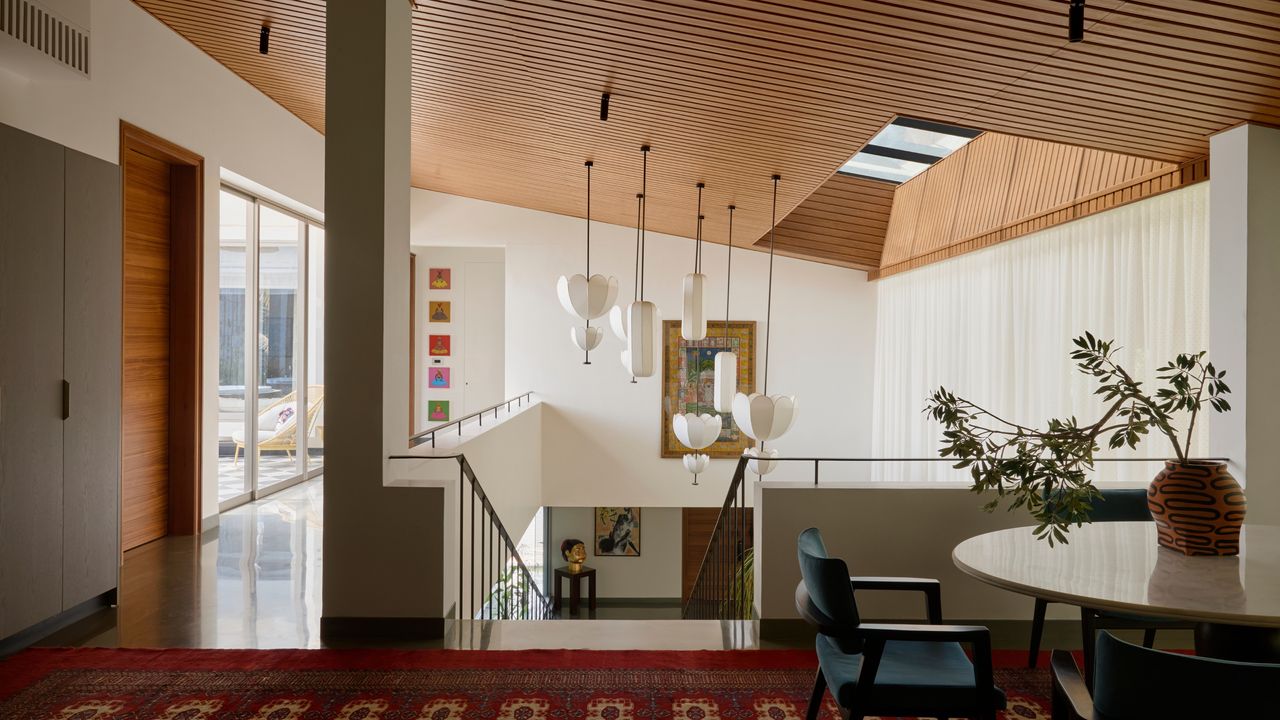
So, you have blank walls and a stack of art, but no placement plan and no clue where to start. I've been there and dealt with that — tackling how to hang art in your home is no easy feat. The good news, though, is that there are several designer-approved tips to make the process far less intimidating and end in gallery-like results.
The general goal is as simple as any: to avoid distracting art hanging mistakes. Starting with a blank spot on an open wall is always a good idea, but the questions often quickly follow. Should you hang one large piece or three smaller ones? Have you thought about scale, sightlines, and focal points? The road to well-hung art starts at the intersection of a clear vision and good guidance.
Don't settle for a haphazard gallery wall; well-placed art is like the cherry on top of a perfectly polished space. To help guide you on your curation journey, I asked the experts how, and below are their top seven tips for how to hang art like an interior designer would.
1. Overlooked Areas Make the Best Place for Art

"Often the best places to display lots of art are those that are overlooked, especially when you feel something is missing," says Cathy Glazer, founder of Artfully Walls. Whether the space is overlooked simply because of the purpose it serves, or because you haven't fully realized its potential, a mundane corner could be the perfect opportunity for your best art.
Think spaces like a home office, entryway, staircase, or living room corner. You may think of these rooms as places you should never hang art, but "Strategically placing artwork here can direct the viewer's attention, create new focal points, and breathe life into interiors," says Cathy.
Rather than viewing these spaces as transitional rooms or an afterthought, intentionally hanging art helps bring purpose and personality back into the picture (pardon the pun). This is especially true in entryway ideas, as these spaces are the first glimpse guests will have of your home. Give them something to talk about with a jaw-dropping accent piece or memento-oriented gallery wall.
2. Know The Number of Pieces You Want to Hang

Looking at a pile of art and photographs with nowhere to go can be intimidating, so the best next move is to make a plan. Gallery wall ideas can be stunning, but they can't be the solution to every blank space. It looks best when you carefully consider the appropriate number of pictures for each 'vignette' you're creating.
"In areas where you are looking to achieve either a calmer or cleaner look, or to make a dramatic focal point with a large statement piece, limiting the art to one or two pieces works best," says Cathy.
"I would also limit to one or two pieces in an area if there is already a lot of other things in that space," adds Hutton Kalik, former art gallery manager and now owner of HK Art Advisory Group.
Remember: there is beauty in restraint and playing with negative space in interior design, rather than just filling a blank with more art.
3. Size and Scale Matter

The size of a piece and scale in interior design both play a major role in where you should hang your art. "This applies mostly to larger pieces, as there are limited spaces with room to accommodate them," says Hutton.
But, while larger pieces often work well as focal points, wall art doesn’t always have to fill a set amount of space to make an impact. Smaller pieces, thoughtfully placed, can be just as striking, especially when paired with the right layout, lighting, or complementary decor.
Keep in mind that the size of your wall art will directly impact how balanced and cohesive a room feels. "Artwork that’s too small can make walls look unfinished, while overly large pieces can create visual tension," says Cathy. "The key is finding the perfect balance so the artwork enhances rather than disrupts the space."
Laying things out on the floor in front of the wall before you hang them is a great way to get a sense of the aesthetic before you have holes in your wall. "Especially when working with gallery walls, because you can switch the arrangement of the smalls until you like it," adds Hutton. "Then just mirror that formation onto the wall."
4. Sightlines are Key

The next tip for how to hang art like an interior designer is slightly more obscure, but just as crucial for creating high-impact positioning. It's all about sightlines. That refers to the way you can see peaks of other paintings in a gallery when you pass by doorways — you want to recreate this feeling in your interior.
"Sightlines are key to any promising art curation," says Cathy. "Keep in mind the view from different angles in the room, as well as views from room to room."
Hanging wall art in your living room? Consider how it looks when viewed from your dining room. If you can see art reflected in a mirror, be sure that it works with art in the same sightline.
5. Create a Focal Point

Next tip for how to hang art like an interior designer: Create emphasis in interior design by using art as a focal point. "Every room should have a strong primary and secondary focal point," Cathy says.
You want to think about where your eye naturally goes when you walk into a room. The primary focal point is likely a strong architectural feature, such as a mantel or a window, or perhaps a large piece of furniture like a bed, and the secondary is typically an interesting design element.
"If your room is lacking clear focal points, you can easily create them with art," adds Cathy.
6. Lighting Can Be Worth the Investment

While not always necessary, picture lights for your art can be the detail that elevates the entire look. It adds a little drama and luxuriously highlights your favorite pieces in darker spaces.
Whether or not lighting your art is right for your space depends on how much of a focal point the specific artwork is, and the lighting (both natural and artificial) already in the room where the art is displayed.
"Consider whether there is already a lot of natural lighting and what other lighting resources are available throughout the space before investing," notes Cathy. If you entertain a lot, perhaps it's a good route for you. "Otherwise, there is not really a reason for professional lighting," notes Hutton.
7. There is Strategy in Mixing and Matching

I love the look of mismatched artwork — it feels personal and adds that true lived-in style to your home. As Hutton says, "This approach is just being eclectic and characterful, and it works well, if that is your style, "however, there is an art to getting it right."
A foolproof way to hang artwork in a grouping that feels contemporary, yet timelessly chic, is to combine styles and mediums. "Oil paintings look phenomenal paired with photography, bold abstracts pair nicely with delicate line drawings, and so on," says Cathy.
She adds that her favorite 'recipe' is to combine one or two graphic prints, one portrait, one oil or acrylic painting, and one photograph.
But when doing this, Hutton warns to "Be careful if the rest of your space does not match the art in terms of quantity and difference of style, it may be a bit odd, and result in something more mismatched than expertly mixed."
So there you have it — seven tips for how to hang art like a designer, and curate your own gallery-worthy collection. But what if 'hanging' wasn't the only approach? That's where the leaning artwork trend creates a captivating look with real edge.