
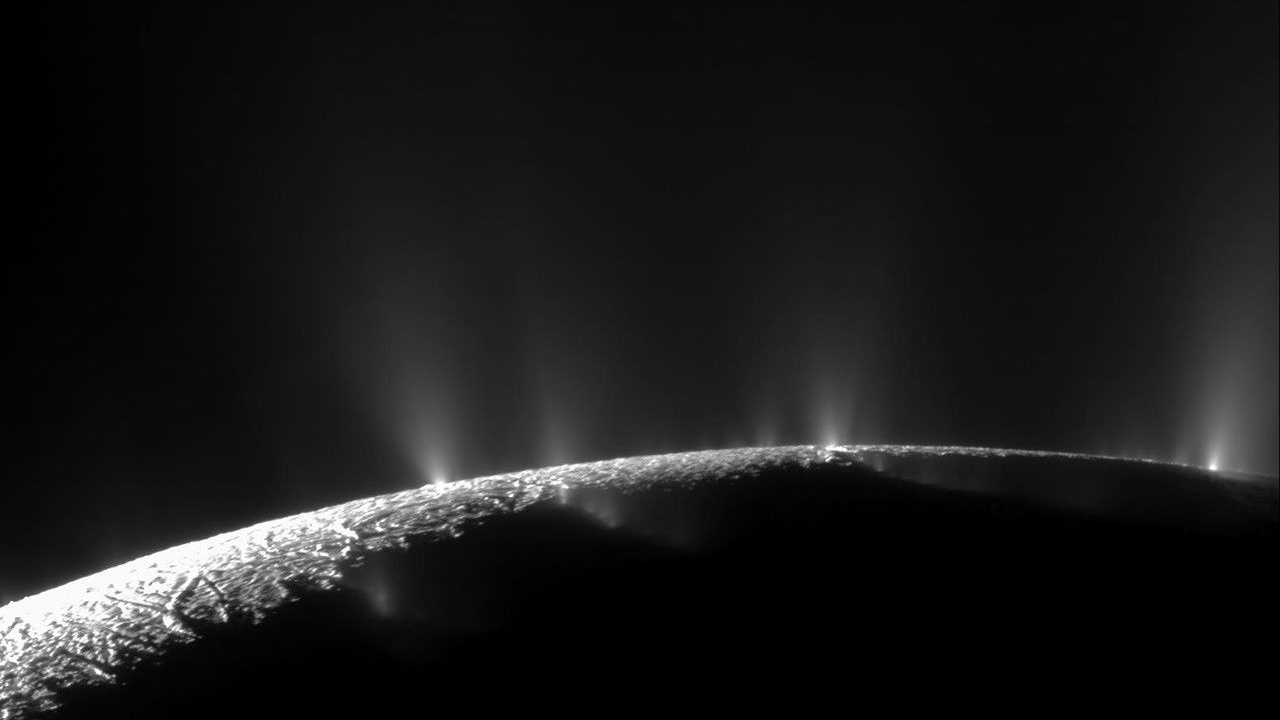
Of all the planets in our solar system, Saturn is by far the mooniest. And that's saying a lot. Sure, we're here in our corner with our single friend, The Moon™, but Neptune wanders the universe with 16 known companions, Uranus boasts 28 of its own, and there are a whopping 95 moons in the Jovian neighborhood. But Saturn? It's in a different league. This ringed world has 146 of these natural satellites. Yet, you may be surprised to know that even with such a lovely Saturnian selection, scientists are mostly pining over just one.
The golden child in Saturn's system is named Enceladus, and it's so special because scientists believe it to be a prime location to search for life beyond Earth. That belief stems from several discoveries made over the years, most obviously the fact that Enceladus seems to have a subsurface ocean that may host molecules known to help produce life as we know it. Better yet, it also appears to have giant plumes of water ice deposits (think icy geysers shooting into space) connected to that ocean, which means spacecraft orbiting the world could theoretically catch evidence of those molecules if they're actually there.














