Get all your news in one place.
100’s of premium titles.
One app.
Start reading
Guitar World
Guitar World
Entertainment
Jared James Nichols

“There is something really special that can happen when three musicians are playing off of each other and interacting in real time”: Jared James Nichols on why playing in a trio opens up your soloing approaches

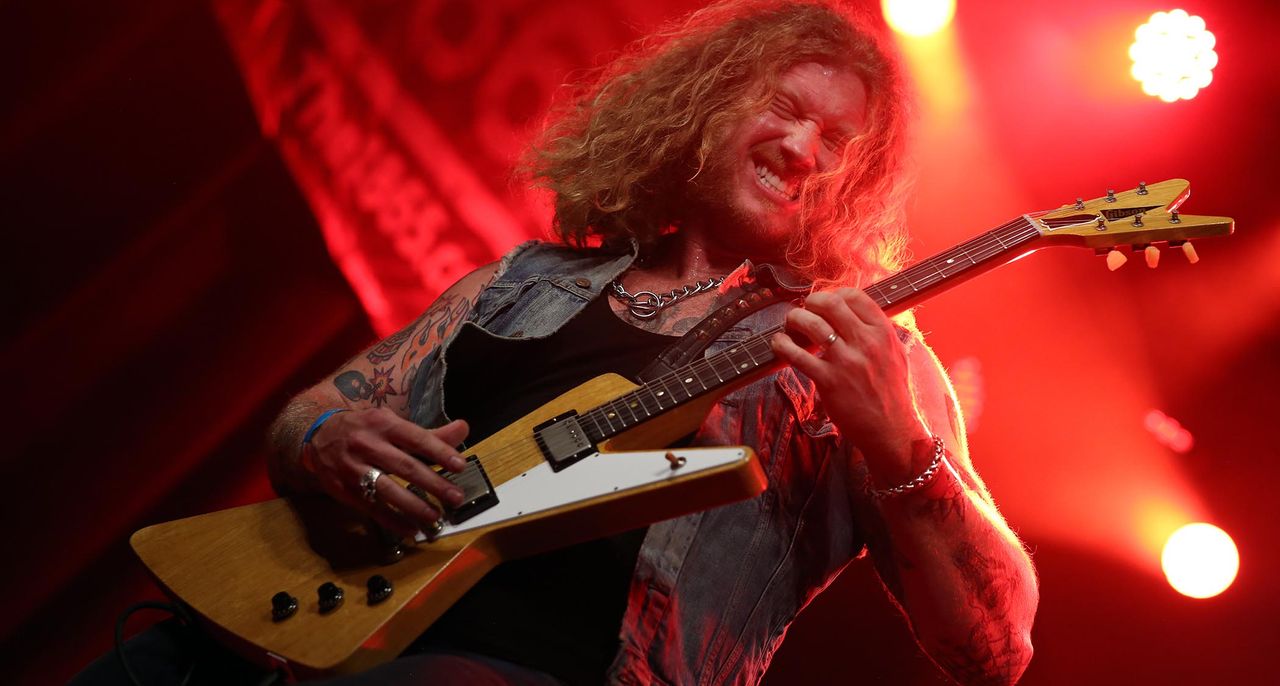
Jared James Nichols bends a not and grimaces as he performs during his 2025 UK tour, on a stage bathed in red lights.

My favourite ensemble to play in is the power trio. With only three instruments – electric guitar, bass guitar and drum kit – there’s so much freedom to explore concepts like space, time and dynamic range.

There is something really special that can happen when three musicians are playing off of each other and interacting in real time.

Think of all the adventurous, exciting moments you’ve heard in the recordings of the great rock guitar/bass/drums lineups, such as the Jimi Hendrix Experience, Cream, Mountain, Rush, Led Zeppelin, the Who, Free and others.

One of the ways I like to take advantage of what the power trio lineup affords me as a guitar player is when we are in improvisation mode, expanding away from an established song structure in order to venture into uncharted musical territory.

A perfect example of this can be found in my song Threw Me to the Wolves, which is built from a simple progression and arrangement that includes sections where we freely vamp over an A chord.

During these sections, the bass player is pedaling on an A note; because there is no minor or major 3rd provided by another chord instrument, I’m free to move between major and minor phrases at my discretion.

We like to make these sections as dynamic as possible by starting out quietly and reserved and then slowly build up the intensity as the improvisation develops.

(Image credit: Future)

Oftentimes, I’ll start out with a motive that alludes to an A7 sound, as in Figure 1. The initial lick is based on the A minor pentatonic scale (A, C, D, E, G), and in bar 2 I repeatedly slide into a two-note A7 voicing.

Once that’s established, I can develop the phrases a little more, as in Figure 2, where I hammer-on from the minor 3rd, C, to the major 3rd, C#.

(Image credit: Future)

Laying this A dominant 7 groundwork allows me to move to ideas based on the A Mixolydian mode (A, B, C#, D, E, F#, G), like the phrase shown in Figure 3.

I’ll then elaborate a bit more in this direction with lines like those in Figure 4, taking advantage of the sweet sound of the major 3rd.

(Image credit: Future)

What’s really cool is when you then bring in some different harmony, moving from A7 to Am7, as demonstrated in Figure 5. I might play four bars over A7 then change my whole mindset to focus back on the minor 3rd and the sound of Am7.

(Image credit: Future)

Figure 6 begins with four bars that revolve around an A7 sound, with the major third, C#, accentuated in the phrases. I then switch at bar 5 to lines that target the minor 3rd, C, by moving into licks based on A minor pentatonic (A, C, D, E, G), played in a bluesy Eric Clapton/Leslie West/Mick Taylor style.

Harmonically, I have the complete freedom to explore wherever I’d like to go. As is standard practice in blues-influenced music, I like to move back and forth between parallel major and minor licks, as these two sounds complement each other so well.

Sign up to read this article
Read news from 100’s of titles, curated specifically for you.
Already a member? Sign in here
Related Stories
Top stories on inkl right now
Our Picks
Fourteen days free
Download the app
One app. One membership.
100+ trusted global sources.