
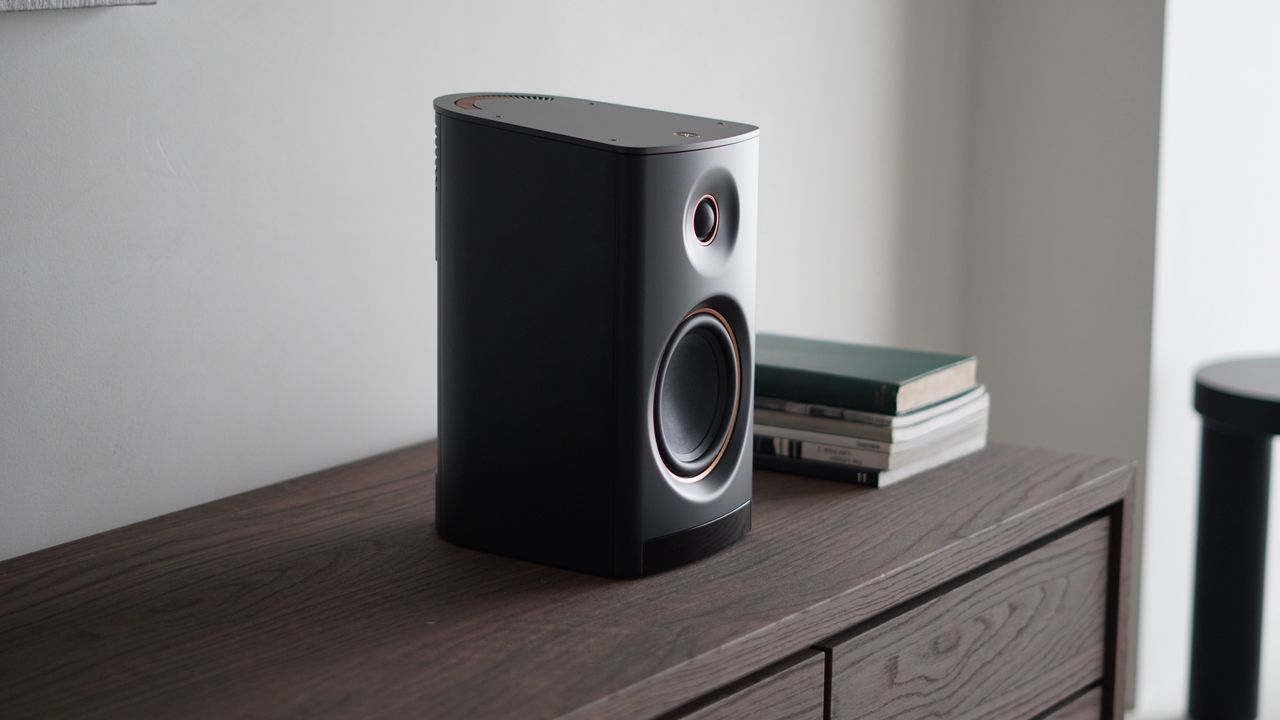
It might seem a long way from the concert hall to lounge, but Yamaha has just shortened that journey significantly. Its new wireless stereo speaker system – its first for a decade – uses some of the same technologies as the brand’s high-end models, and even some of the same materials as in its renowned grand piano soundboards.
But the big question is: can it take on the Award-winning KEF LS50 Wireless II?
The Yamaha NX-70A aims to make high-quality sound more accessible, whether it’s playing back one of the best music streaming services or a movie soundtrack straight from your TV.
It uses Yamaha’s Harmonious Diaphragm, which comprises a blend of ZYLON (from its flagship speakers) and spruce wood (used in its grand piano soundboards). This promises “a consistent tone over the entire frequency spectrum”, so that instruments and vocals are reproduced “naturally and with remarkable musicality”.
As with all active speakers, it sees the amplifier and speaker unit working in tandem – Yamaha calls this Synergistic Drive, and it should mean lower distortion.
It can adjust its output to your room size and layout thanks to room optimisation software – Yamaha calls this YPAO (Yamaha Parametric room Acoustic Optimiser). It works much like Sonos Trueplay, but uses a bundled microphone instead of the one on your smartphone.
Streaming support is strong, with Tidal and Spotify (plus their Connect versions), alongside Google Cast and Apple AirPlay 2. It also works with Yamaha MusicCast for multi-room playback, and is Roon Ready for unifying your music library across sources.
Because it supports HDMI eARC/ARC and CEC, you can hook it up to your TV and control its volume with your TV remote. And it would look right at home in the concert hall, with its rounded edges and copper accents. This rounded cabinet also helps subdue internal standing waves.
The Yamaha NX-70A is out in July for £2587 (around $3500 / AU$4799).
So can it topple the KEF LS50 Wireless II? Stay tuned for a full review.
MORE:
See the best hi-fi systems around
All the news from High End Vienna 2026
Active vs passive speakers: what's the difference? And which is better?