Get all your news in one place.
100's of premium titles.
One app.
Start reading
The Conversation
The Conversation
Emma Schwak, PhD Reseacher in the Department of History, European University Institute

The world’s first influencers were French and they emerged after the Revolution

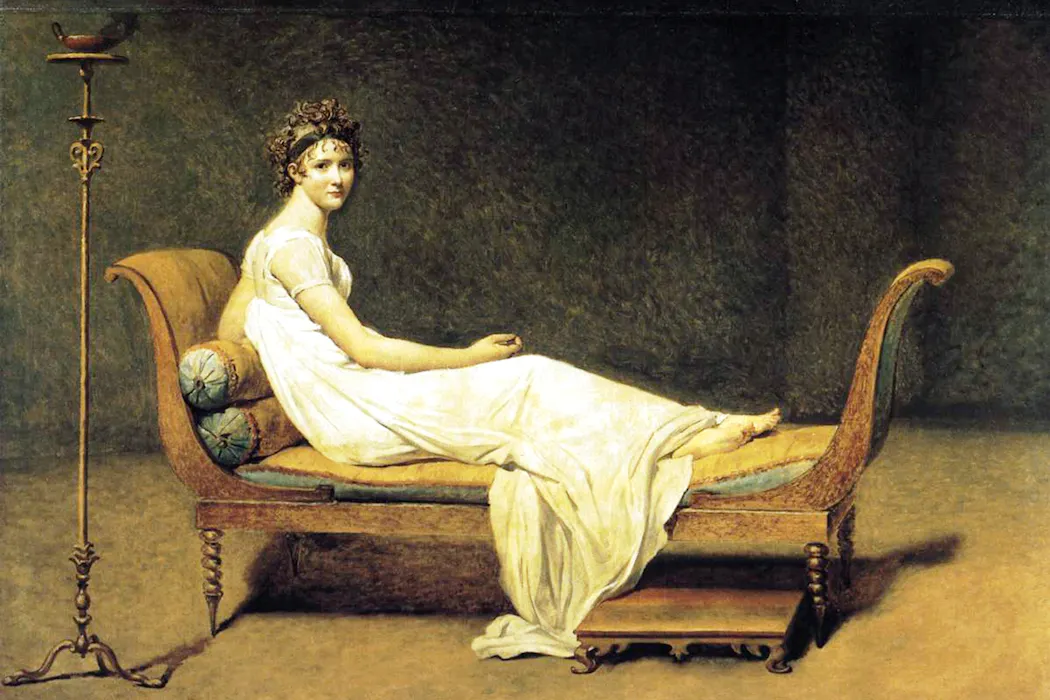
A painting by Jacques-Louis David of French socialite and Neoclassical icon Madame Récamier whose salon in Paris attracted leading literary and political circles in the early 19th-century. Wikimedia

In 1806, the Parisian gastronome Grimod de la Reynière launched a new periodical, the Journal des Gourmands et des Belles in post-revolutionary France. From the first issue, it set out to provide readers with advice on food, fashion, and theatrical life, all in one publication. Almost entirely forgotten today, the journal was perhaps the first of its kind in France to bring together such a full range of what we would now call lifestyle content. Early nineteenth-century language aside, it resembles the all-encompassing Instagram accounts of some of today’s influencers. Its author was already famous for the Almanach des Gourmands (1803-1812), the founding text of gastronomic criticism and the first restaurant guide in history.

Such influential figures were not, of course, without precedent. While conduct manuals, culinary guides, and trade gazettes had been prescribing behaviour and etiquette long before the French Revolution in 1789, the real change that ensued after the French people’s uprising was not so much the existence of such style guidance but the nature, volume, and, above all, the urgency of the advice that became widely available. While these works from the Ancien Régime addressed readers who already knew where they stood in society and needed to perform in a certain manner in order to secure a certain standing on the social ladder, post-revolutionary guides appealed to readers whose social status was uncertain or newly acquired. The question people asked themselves at that time shifted from how do I behave well in society? to how do I belong?

The unexpected trajectories of post-revolutionary lifestyle ‘influencers’ and the content they provided reflect the social, professional and even physical mobility (caused by exile, return or displacement) of the era that resulted from the Revolution, compared to the rigidity of the Ancien Régime. Grimod de la Reynière himself had been a lawyer turned theatre critic turned fine grocer, before reinventing himself as a food writer. Journalist and publisher Pierre de La Mésangère was a former priest who became the editor of the Journal des Dames et des Modes from 1797 to 1831, the longest-running fashion periodical of that period. After the French Revolution, Madame Campan who had been Marie-Antoinette’s head lady-in-waiting founded an elite boarding or ‘finishing’ school on the outskirts of Paris in Saint-Germain-en-Laye where the daughters of the new and old elite were groomed alongside one another in aristocratic etiquette.

Tastemaking, initially a «French affair»

In post-revolutionary France, an eccentric mix of individuals, united by a single ambition: to carry forth the cultural codes of the Ancien Régime in a world where the cards had been reshuffled, and where taste and material culture (or objects and the system of meaning attached to them, how they were chosen, displayed, and read by others), were more than ever socially determining.

Official taste, too, found its arbiters: Napoleon’s appointed architects Charles Percier and Pierre François Léonard Fontaine whose Recueil de décorations intérieures codified the Empire style for anyone with the means to adopt it.

Out with the old, in with the wives of financiers

Andrea Appiani’s 1798 portrait of Caribbean-born Madame Hamelin, one of Paris’ trendsetting Merveilleuses who defined Parisian fashion during the Directory era (1789-1804). Wikimedia

As for female fashion leadership, it had changed hands entirely. Before the Revolution, France’s fashion ‘establishment’ was made up of royal consorts or royal mistresses, from Madame de Pompadour to Marie-Antoinette. After 1789, influence shifted to the high-profile wives of bankers and financiers, noblewomen or socialites, like Juliette Récamier, Thérésa Tallien, Fortunée Hamelin whose interiors and dress were observed, imitated, and commented upon by the press run by figures like Pierre de La Mésangère.

Madame Hamelin, a Creole woman from the Caribbean island of Saint Domingue and today the least remembered of the three, was counted as one of the Merveilleuses,a group of influential women whose extravagant, neoclassical way of dressing defined the Directoire years. Hamelin’s hairstyles and tunics were widely copied, and her salon at the Hôtel de Bourrienne was one of the most brilliant in post-revolutionary Paris.

For these tastemakers, taste was never a matter of isolated choices but an entire way of living, encompassing everything from food to wallpaper to bed linen, and their ambition was to shape taste comprehensively.

Meanwhile across the English Channel

Of course, such guides existed elsewhere. In Britain, where the Industrial Revolution had been remoulding society for several decades already, comparable figures had emerged. Josiah Wedgwood cultivated royal endorsements and educated a rising middle class in neoclassical taste, turning manufacture into cultural authority.

George Romney’s portrait (1791) of British influencer, actress, dancer and model Lady Hamilton. Wikimedia

English socialite Beau Brummell (1778-1840), born neither noble nor wealthy, made the Prince of Wales defer to his judgement on the cut of a lapel.

Emma Hamilton, born Amy Lyon in 1765 into a Cheshire blacksmith’s family, became one of Europe’s most followed women, her image disseminated through Romney’s portraits, much as Juliette Récamier’s image was thanks to French Neoclassical painter Jacques-Louis David. Social authority was not built on birth but rather on personal charisma and the visual culture of that time.

What set the French case apart was not the existence of these figures but the conditions that produced them. The end of the Reign of Terror had unleashed a hunger for pleasures long suppressed. Napoleon actively encouraged the revival of the luxury trades – silk, furniture, jewellery, porcelain – as both economic policy and political legitimacy.

The revolution of fortunes was itself a product of the revolutionary years: fortunes had been made through the acquisition of biens nationaux (the confiscated estates of the nobility and clergy sold off by the state), through agiotage (speculative trading on the currency and the public debt that flourished amid revolutionary chaos), and through army supply contracts.

From 1808, the creation of an imperial nobility then institutionalised the rise of a new elite: administrators and army officers who had clambered through the Revolution now held titles without the cultural inheritance that traditionally accompanied them. While a marshal of the Empire may be a duke, he still needed to be told how to furnish his table and how to host guests.

The restaurant, a Parisian invention of the revolutionary years, had meanwhile created an entirely new kind of public space in which taste could be performed, observed, and judged by strangers – and where a guide like Grimod’s could present itself, not without self-interest, as an indispensable necessity.

In Britain, social change had been gradual: new industrial fortunes and a rising military elite had joined the old aristocracy without displacing it. The existing order absorbed its newcomers. In France, on the other hand, the Revolution had done something more disruptive: a far-reaching recomposition of the social world was observed, in which administrators, military men, newly made fortunes and returning noblemen and women found themselves navigating the same rooms, salons or balls, for instance, without a ‘shared map’. This is what made the post-revolutionary tastemaker a quintessentially French invention that was not a guide for a society on the move, but a bridge towards learning to speak France’s first common cultural language.

What this tells us is that we often treat the art of lifestyle influencing as a uniquely modern phenomenon, but the practice actually began in post-revolutionary Paris, and when we look to digital arbiters to curate our tastes, we are, in fact, continuing a tradition invented by Grimod de la Reynière and his influential contemporaries.

This article was originally published on The Conversation. Read the original article.

Sign up to read this article
Read news from 100's of titles, curated specifically for you.
Already a member? Sign in here
Related Stories
Top stories on inkl right now
One subscription that gives you access to news from hundreds of sites
Already a member? Sign in here
Our Picks
Fourteen days free
Download the app
One app. One membership.
100+ trusted global sources.