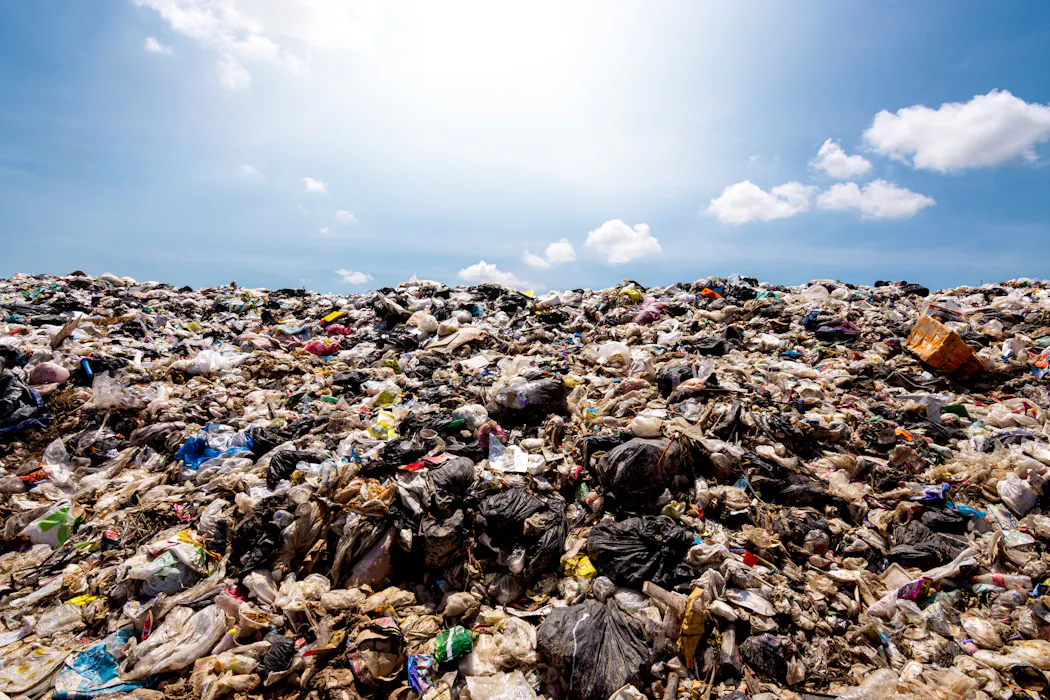
The world is struggling to deal with ever-growing quantities of waste.
A new World Bank Group report, What a Waste 3.0, shows that more than 2.6 billion tonnes of municipal solid waste (which includes rubbish from households, businesses and street cleaning) were generated in 2022. That figure is projected to rise to 3.9 billion tonnes by 2050. The good news is that the share of waste that is mismanaged is expected to fall over that period, from around 30% to around 20%.
That sounds like progress. But percentages can be misleading. The quantity of mismanaged waste, including plastics, is projected to remain almost unchanged, at around 760 million tonnes. This means that by 2050, enormous quantities of waste will still be openly dumped, burned or otherwise unmanaged, with many households and communities left to deal with it themselves.
This new report, which we contributed to, brings together the most recent publicly accessible municipal waste data from 217 countries and economies (such as the Channel Islands) and 262 cities. It highlights that although waste systems are improving in many places, those gains are being undermined by the growth in the amount of waste generated.
This matters because when waste is not managed properly, the consequences affect human health, the environment and the economy. Poor waste management contributes to air and water pollution, damages ecosystems, increases greenhouse gas emissions and makes cities harder and less pleasant to live in.
One of the clearest examples is open burning. In many developing countries, where formal waste collection remains incomplete or absent, open burning is one of the main ways households and communities “self-manage” their waste. These fires burn at low and uneven temperatures. Combined with a mixed waste stream that can include plastics, organics and other materials, they release a complex cocktail of pollutants that can threaten the health of people living and working nearby.
With new data on self-management, this report shows how waste is actually managed across large parts of the world, especially where formal systems remain weak. Forms of self-management of waste include open dumping, open burning, burying waste in informal pits, dumping into waterways and coastal waters, and some forms of informal recovery such as recycling or composting.
Read more: Health crisis: up to a billion tonnes of waste potentially burned in the open every year
So if the harms of poor waste management are well known, why does the problem persist?
One reason is cost. Municipal waste management is resource intensive. Many countries are still spending far less than is needed to provide universal and reliable services. Our analysis suggests that even basic systems involving collection, transport and disposal tend to cost at least US$40 (£30) to US$45 per tonne in low-income countries. In middle-income countries, basic systems cost roughly US$70 to US$80 per tonne, while in high-income countries costs can exceed US$200 per tonne.
At those cost levels, low-income countries would have needed around 0.78% of their combined GDP in 2022 to achieve universal waste management coverage. Middle-income countries would have needed roughly 0.31% to 0.46% of GDP. Yet reported public spending on solid waste management is less than 0.15% of GDP in about three-quarters of low- and middle-income countries and 0.31% in high income countries.
That financing gap helps explain why waste collection is not comprehensively provided, why open dumping is still common and why so many people are left to manage waste themselves.
The total financial costs are also rising fast. Globally, municipal waste management cost more than US$250 billion in 2022. Under a business-as-usual scenario, that annual cost is projected to reach US$426 billion by 2050.
Shifting the costs
The cost of inaction is higher than these service costs alone suggest. Poor waste management brings wider economic losses, for example through ill health, reduced land values, damaged ecosystems, lost materials and harm to sectors such as tourism, agriculture and fisheries.
The world may not be saving money by underinvesting in waste management. It is shifting the costs elsewhere – onto public health, the environment and future generations.
This is especially important in low- and lower-middle-income countries, where waste generation is rising rapidly, but service coverage and infrastructure are often far below sufficient levels. This report estimates that these countries will require hundreds of billions of dollars in investment over the next 25 years just to expand and improve municipal waste systems. Without faster investment, existing service gaps will widen and the costs of inaction will grow.
The world’s waste crisis cannot be understood only as an environmental problem. It is also a financing, public health, governance and development problem. Better data helps us see that more clearly.
Waste management is improving, but not fast enough. Unless investment and performance accelerate, the amount of mismanaged waste worldwide is unlikely to change, causing harm to public health.
Costas Velis has consulted for UNEP - International Environmental Technology Centre, the Organisation for Economic Co-operation and Development (OECD), EMG, the Resources and Waste Advisory Group (with funds from GIZ), the ICF (with funds from The Pew Charitable Trusts), and MARS Inc. via Imperial Consultants). He receives funding from UK Research Innovation and Global Challenges Research Fund, Grid-Arendal, The World Bank Group via UN Operations and the International Union for Conservation of Nature, and the EU via UK Research Innovation grant agreement. He serves on the steering committee for project STOP by SYSTEMIQ Indonesia; was Chair of the International Solid Waste Association Marine Litter Task Force; is on the policy and innovation forum for the Chartered Institution of Wastes Management; He is member of and served at Steering Committee of the Scientist's Coalition for an Effective Plastics Treaty, and is the owner and Director of Fuelogy, a small research consultancy registered in the UK that offers scientifically impartial services in solid waste management, resource recovery and the circular economy to sustainability-focused consultancies, non-governmental organisations, and international organisations.
Ed Cook has consulted for: Women in Informal Employment, Globalizing and Organizing (WIEGO), World Bank Group, Julie’s Bicycle, Vision 2025, ICF (funded by Pew Charitable Trust), OHE, WasteAware (funded by GIZ), IUCN (funded by World Bank via UNOPs). He has worked on research projects funded by: Grid Arendal (funded by NORAD), Mars, Eunomia Research and Consulting (funded by The World Bank Group), and ICF (funded by the Pew Charitable Trust). He is a Chartered Waste Manager with the Chartered Institute of Wastes Management in the UK, a member of The Scientists' Coalition for an Effective Plastics Treaty, and a member of the International Solid Waste Association.
This article was originally published on The Conversation. Read the original article.