
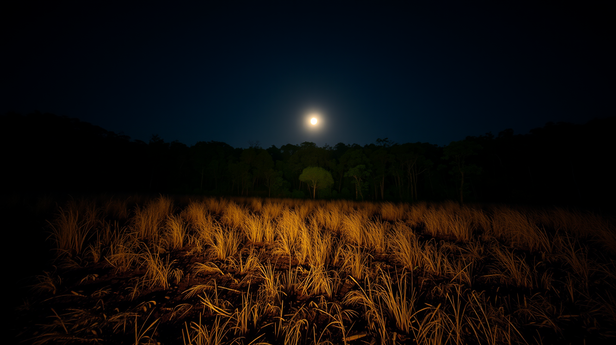
Why the Night Sounds Nothing Like the Day
The forest at Tadoba or Nagarhole doesn't fall silent after sunset. It reorganises. Diurnal species, the babblers, the drongos, the peacocks, drop out. A completely different set of animals takes the frequency bands they vacated, and the result is a soundscape so distinct from the daytime version that field biologists treat them as separate acoustic environments.The framework for understanding this comes from Bernie Krause, a soundscape ecologist who spent decades recording wild habitats across the world. Krause proposed that healthy ecosystems show acoustic partitioning: different species occupy different frequency ranges and time slots, reducing overlap and interference. He called the sum of all biological sound in an environment "biophony." When a reserve is ecologically intact, the biophony is dense and layered. When it is degraded, the layers thin out and gaps appear. The night shift is where this partitioning becomes most audible.














