
Get all your news in one place.
100's of premium titles.
One app.
Start reading
The Conversation
The Conversation
Hermes Bloomfield-Gadêlha, Mathematician, University of Bristol

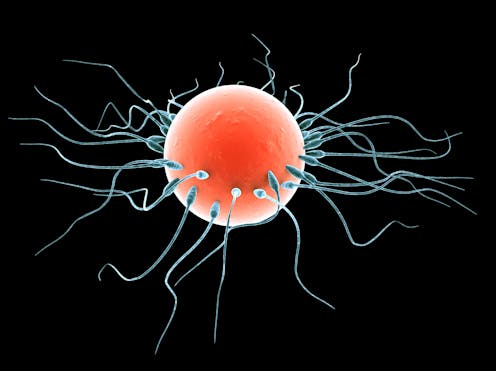
The way a sperm tail moves can be explained by mathematics worked out by Alan Turing

SciePro / Shutterstock

Alan Turing might be best known for his work helping to crack Germany’s “Enigma” communications code during the second world war. But he also came up with a theory where patterns can form just through chemical compounds spreading out (diffusing) and reacting with one another. This became known as reaction-diffusion theory for pattern formation.

PhD student James Cass and I recently published a study in Nature Communications that revealed the tail of a sperm, known as a flagellum, generates patterns as it moves – and that these patterns can be described by Turing’s theory.

Sign up to read this article
Read news from 100's of titles, curated specifically for you.
Already a member? Sign in here
Related Stories
Top stories on inkl right now
One subscription that gives you access to news from hundreds of sites
Already a member? Sign in here
Our Picks
Fourteen days free
Download the app
One app. One membership.
100+ trusted global sources.







