
Get all your news in one place.
100’s of premium titles.
One app.
Start reading
LiveScience
LiveScience
Jamie Carter

The US will see a rare 'blood moon' eclipse before sunrise this March: Where and when to look

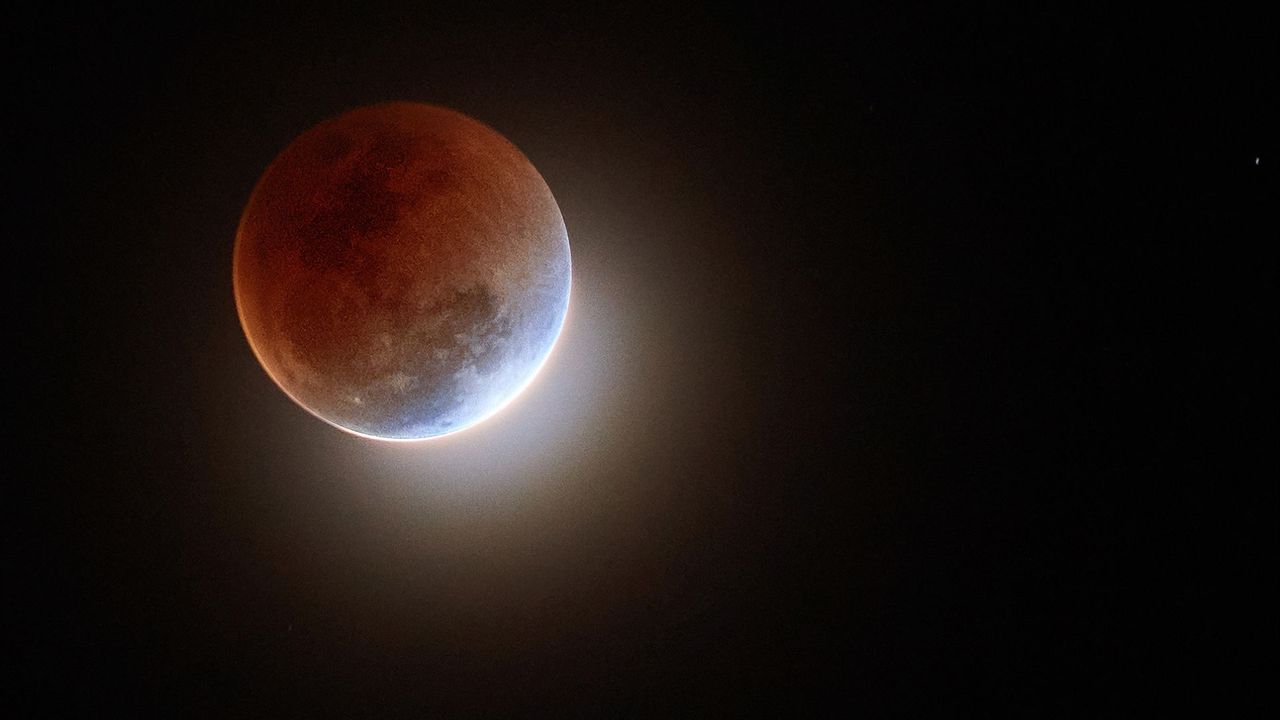
Image of a red-tinted moon against a clear black sky with a small ring of light peeking out from the bottom right of the moon. .

Skywatchers across western North America will have the chance to witness a total lunar eclipse, often dubbed a "blood moon," in the early morning hours of March 3.

A total lunar eclipse happens when the full moon — in this case, March's full "Worm Moon" — passes through Earth's shadow in space. As it does so, it appears red, as it's lit only by sunlight filtered through Earth's atmosphere.
That "blood moon" moment, called totality, will last 58 minutes, but the entire event is much longer. The more subtle penumbral phase (when the moon enters Earth's outer penumbral shadow) and partial phase (when it begins to move into the dark umbral shadow) will unfold over 5 hours, 39 minutes, according to Time and Date, which estimates that 176 million people will be able to see all phases of the eclipse, though clouds may impede the view.

That encompasses the night side of Earth, which, at the time of the eclipse, will be centered over the Pacific Ocean. That puts Hawaii, Kiribati, Samoa, Tonga and the Cook Islands in pole position, but East Asia, Australia, New Zealand and western North America will also get great views.

In North America, those located west of the Mississippi River will catch the whole show, while observers farther east — including those in cities like New York, Boston and Toronto — will see the moon setting during totality. Early risers along the West Coast and in Hawaii will have a good chance of viewing the entire sequence high in the sky. Clear skies will be essential, making the U.S. Southwest and northwest Mexico the places most likely to see the full event.

Here are the times for the total phase of the eclipse, according to Time and Date:

EST: 6:04-7:02 a.m. (Moonset will occur during this time.)

CST: 5:04-6:02 a.m.

MST: 4:04-5:02 a.m.

PST: 3:04-4:02 a.m

AKST: 2:04-3:02 a.m.

HST: 1:04-2:02 a.m.

Although totality will be the main attraction, it's also worth watching the partial phases that precede and follow totality, when the edge of Earth's shadow can be seen slowly moving across the lunar surface.

The March 3 event will be the first total lunar eclipse since September 2025 and the last until Dec. 31, 2028, when a celebratory "blood moon" on New Year's Eve will kick off a trio of total lunar eclipses, with the next two on June 25-26 and Dec. 20, 2029.

Sign up to read this article
Read news from 100’s of titles, curated specifically for you.
Already a member? Sign in here
Related Stories
Top stories on inkl right now
One subscription that gives you access to news from hundreds of sites
Already a member? Sign in here
Our Picks
Fourteen days free
Download the app
One app. One membership.
100+ trusted global sources.